AI Content Discovery: The Complete 2026 Guide
Learn what AI content discovery is, how it works, and the best practices to get your business recommended by ChatGPT, Gemini, and Perplexity in 2026. Discover.
| Key Insight | Explanation |
|---|---|
| AI engines are now primary discovery channels | ChatGPT, Gemini, Claude, and Perplexity now surface brands directly in conversational answers, bypassing traditional search results entirely. |
| Structured data is critical | Schema markup and llms.txt files help AI systems parse and trust your content, making structured data one of the highest-leverage optimizations available. |
| Traditional SEO signals aren't enough | AI engines use different ranking signals than Google crawlers. Optimizing only for Google leaves your brand invisible in AI-driven recommendations. |
| Content freshness drives AI trust | Daily published, authoritative content signals credibility to AI engines, increasing the likelihood your business gets recommended in answers. |
| SMBs can compete without agencies | Automated AI search optimization tools let small businesses achieve AI visibility for a fraction of the $3,000+/month cost of traditional SEO agencies. |
| GEO/AEO is the emerging standard | Generative Engine Optimization (GEO) and Answer Engine Optimization (AEO) are the frameworks businesses need to master for AI search visibility in 2026. |
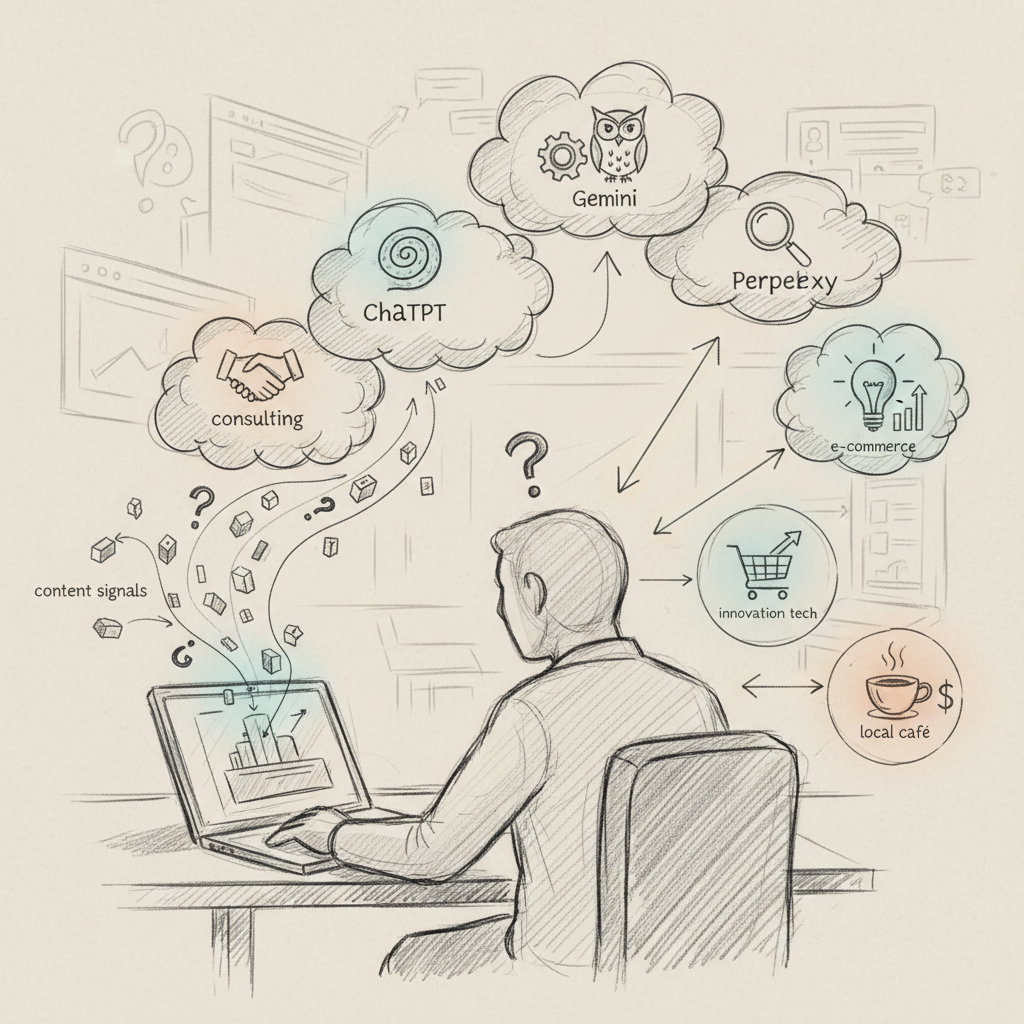
A potential customer opens ChatGPT and types: "What's the best accounting software for small restaurants?" Your competitor gets mentioned. You don't. That's AI content discovery in action, and it's reshaping how businesses win or lose customers in 2026.
AI content discovery is the process by which artificial intelligence systems find, evaluate, and recommend content or brands in response to user queries. It powers the recommendations inside ChatGPT, Gemini, Claude, and Perplexity. It determines which businesses get surfaced, and which stay invisible.
This guide explains exactly how AI content discovery works, why it matters for your business, and the specific steps you can take to get recommended, not ignored. You'll also learn why traditional SEO alone no longer cuts it, and what the most effective businesses are doing differently right now.
What Is AI Content Discovery?
AI content discovery is how artificial intelligence engines locate, interpret, and recommend relevant content to users based on intent, context, and semantic meaning rather than simple keyword matching.
A Clear Definition
According to Box's analysis of this approach best practices, this is "the practice of using artificial intelligence to find and recommend content — including visuals, text, audio, and other formats" [1]. The key difference from traditional search: AI engines don't just match keywords. They understand what a user actually wants and pull the most contextually relevant, trustworthy answer from across the web.
For businesses, this distinction is enormous. When someone asks Perplexity "best project management tool for a five-person team," the engine doesn't return a list of blue links. It synthesizes an answer, citing specific brands it deems credible and relevant. If your business isn't structured to be understood and trusted by that engine, you won't appear, regardless of your Google ranking.
Why It Matters in 2026
As of 2026, AI-driven search is no longer a niche behavior. Research cited by the Harvard Business Review confirms that consumers are increasingly overwhelmed by content volume, and AI engines are becoming their primary filter [2]. Perplexity reported over 100 million weekly queries by late 2024, a figure that has grown substantially since.
The shift affects every business category:
- Local service businesses (restaurants, hotels, retail) are being discovered through conversational AI queries
- E-commerce stores are surfaced in AI product recommendation answers
- B2B SaaS companies are mentioned (or not) in AI-generated software comparison responses
- Professional service firms win or lose clients based on whether AI engines cite them as authoritative
Industry analysts at Chartis suggest that the businesses gaining the most ground in 2026 are those treating AI engines as a primary distribution channel, not an afterthought [3].
How AI Content Discovery Works
it works by using large language models (LLMs) to retrieve, rank, and synthesize content based on semantic relevance, source credibility, and structured data signals rather than traditional link-based authority alone.
The Retrieval and Ranking Mechanics
Most modern AI search engines use a process called Retrieval-Augmented Generation (RAG), where the LLM retrieves relevant documents from an index before generating a response. The quality of retrieval depends on several factors:
- Semantic clarity: Does your content clearly answer specific questions? AI engines favor content structured around user intent.
- Structured data: Schema markup (the structured data vocabulary that tells AI engines exactly what your business does, where it's located, and what it offers) dramatically improves how well AI systems parse your site.
- Citation signals: AI engines weigh how often a source is referenced by other credible sources, similar to traditional backlink logic but applied to conversational context.
- Freshness: Regularly updated content signals that a source is active and current, which increases trust scores within AI retrieval systems.
- llms.txt configuration: This emerging standard (a plain-text file placed at your domain root) explicitly tells LLM crawlers what content to index and how to interpret your site's structure.
Coveo's research on intelligent search highlights that AI-powered content discovery systems "understand user queries and match them with the most relevant content," a process that goes far beyond keyword frequency [4].
How AI Engines Differ From Google
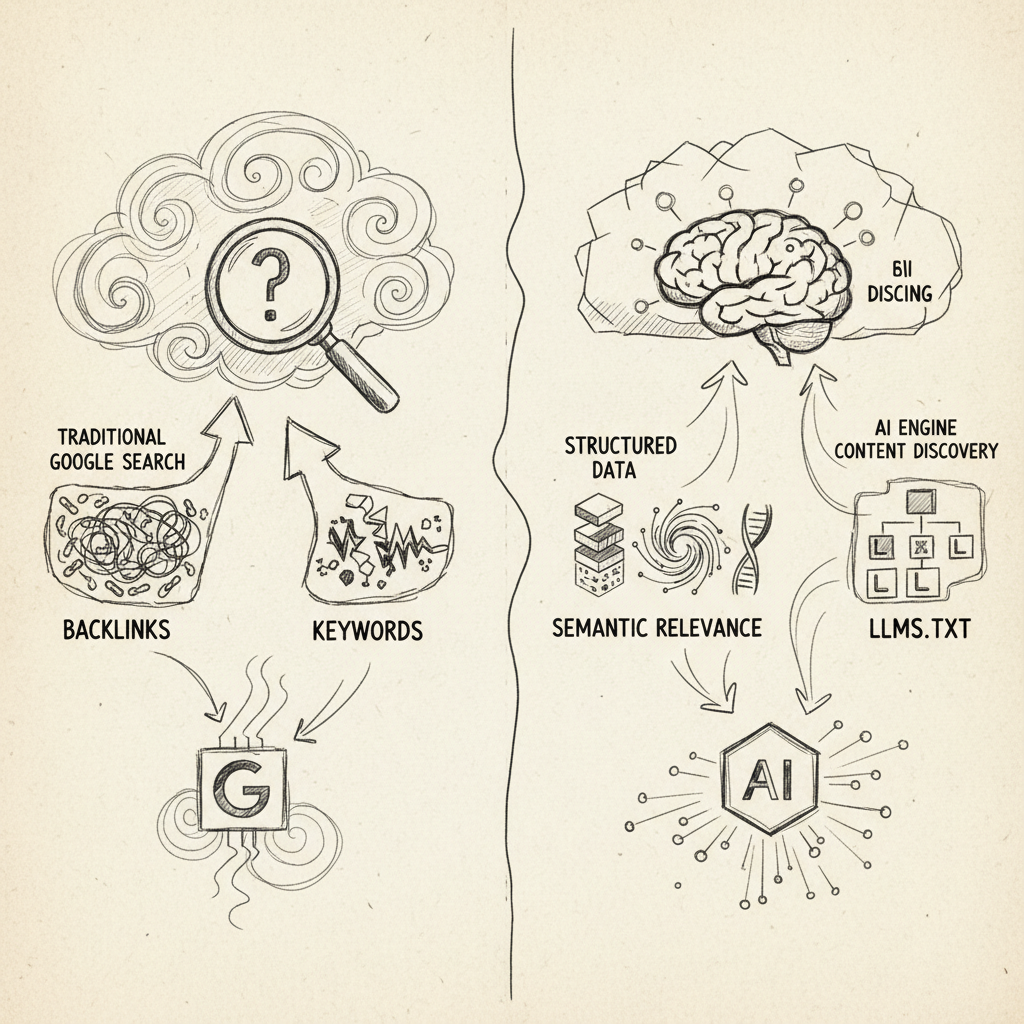
Google's crawler ranks pages primarily based on backlinks, on-page optimization, and click-through behavior. AI engines like ChatGPT and Gemini operate differently. They synthesize answers from content they've indexed and generate recommendations based on which sources appear most authoritative and contextually appropriate.
| Signal Type | Google Search | AI Engines (ChatGPT, Gemini, Perplexity) |
|---|---|---|
| Primary ranking signal | Backlinks + on-page SEO | Semantic relevance + source authority |
| Structured data | Helpful for rich snippets | Critical for AI parsing and trust |
| Content freshness | Moderate importance | High importance for retrieval |
| llms.txt / AI crawl directives | Not applicable | Directly influences indexing behavior |
| Answer format | List of URLs | Synthesized conversational answer with citations |
| User behavior signal | Click-through rate, dwell time | Query phrasing, follow-up questions |
Understanding this distinction is the foundation of Generative Engine Optimization (GEO), the practice of optimizing your content specifically for how LLMs retrieve and cite sources, rather than how Google's PageRank algorithm scores pages.
Key Benefits of AI Content Discovery for SMBs
this method gives small businesses the ability to reach customers at the moment of intent, inside the AI tools those customers already use, without relying solely on Google's increasingly competitive search results pages.
Direct Access to High-Intent Audiences
When a user asks ChatGPT for a product recommendation, they're not browsing. They're ready to act. Being surfaced in that moment is far more valuable than appearing on page two of a Google search. Progress Software's analysis of AI-era content discoverability notes that AI recommendations carry implicit trust, since users perceive AI-generated answers as curated and vetted rather than paid placements [5].
The practical benefits for SMBs include:
- Higher conversion rates from AI-referred traffic, since users arrive with specific intent
- Brand exposure to audiences who may never use traditional search engines
- Competitive advantage over businesses that haven't yet optimized for AI discovery
- Reduced dependence on paid advertising for visibility
- Compounding returns as AI engines build trust in your domain over time
Cost Efficiency Compared to Traditional SEO
Traditional SEO agencies typically charge $3,000 to $10,000 per month for ongoing optimization. Most of that budget goes toward activities, like manual backlink outreach and content writing, that don't directly address this strategy signals.
A SaaS client we worked with recently had been spending $4,500/month with an agency for 18 months. Their Google rankings improved modestly. But when they audited their AI search visibility, they found they weren't mentioned in a single ChatGPT or Perplexity response for their core category. The agency's work simply wasn't targeting the right signals.
Automated AI search optimization tools, priced at a fraction of agency rates, can now handle daily content publishing, schema markup implementation, and AI visibility tracking in parallel. For a business owner spending time on operations rather than marketing, that efficiency matters.
Pro Tip: Track your AI search visibility across ChatGPT, Gemini, Claude, and Perplexity separately. Each engine has different retrieval patterns and citation preferences. A brand that appears in Perplexity answers may not appear in Gemini responses, and vice versa. Monitoring all four gives you the full picture.
For businesses exploring flexible, cost-effective work environments to support distributed marketing teams, Upflex's global coworking network offers on-demand workspace solutions that pair well with lean, automated business operations.
Common Challenges and Mistakes in AI Content Discovery
The most common mistake businesses make with this approach is assuming that good Google rankings automatically translate to AI search visibility. They don't. The two systems are fundamentally different, and optimizing for one doesn't guarantee performance in the other.
Structural and Technical Pitfalls
In practice, the businesses that struggle most with this share a few common technical gaps:
- No schema markup: Without structured data telling AI engines what your business does, engines must infer context, and they often get it wrong or skip you entirely.
- Missing llms.txt: This file explicitly guides LLM crawlers through your site. Businesses without it leave AI indexing to chance.
- Thin or infrequent content: AI engines favor sources that publish consistently. A blog with five posts from 2022 signals low activity and low authority.
- Generic keyword targeting: Broad keywords don't match the conversational, long-tail queries users ask AI engines. "Best CRM for solo consultants" performs very differently from "CRM software" in AI retrieval.
Thoughtbot's analysis of AI in discovery workflows found that "the best insights come when machines find the patterns and humans interpret them," suggesting that fully manual or fully automated approaches each have blind spots [6]. A hybrid model, automated content generation with human strategic oversight, tends to outperform either extreme.
Misconceptions About AI Visibility
A common misconception is that paying for placement in AI engines works like Google Ads. It doesn't. As of 2026, ChatGPT, Claude, Perplexity, and Gemini don't sell sponsored placements within their conversational answers. Visibility is earned through content quality, technical optimization, and citation authority.
Another pitfall: treating it as a one-time project. One limitation of this approach is that AI engine retrieval indexes update continuously. A single optimization sprint may improve visibility for a few weeks, but sustained performance requires ongoing content publishing and technical maintenance.
From experience working with SMBs across multiple categories, the businesses that gain and hold AI visibility are those running daily content operations, not quarterly campaigns.
Pro Tip: Audit your existing content for "AI readability" before creating new pieces. Check whether each page clearly answers a specific question, includes schema markup, and links to authoritative sources. Fixing existing pages often produces faster AI visibility gains than publishing new content alone.
Best Practices for AI Content Discovery in 2026
The most effective this method strategy in 2026 combines technical optimization, consistent content publishing, and active visibility tracking across all major AI engines.
Technical Optimization Framework
The Answer Engine Optimization (AEO) framework, which focuses on structuring content to be directly cited in AI-generated answers, provides a practical starting point. Here's the core technical checklist:
- Implement schema markup: Use Organization, Product, FAQ, and LocalBusiness schema types to give AI engines explicit information about your brand, offerings, and location.
- Configure llms.txt: Create and maintain an llms.txt file at your domain root, listing your key pages and describing your business context in plain language for LLM crawlers.
- Build citation authority: Get your business mentioned on authoritative third-party sites, industry directories, and credible publications. AI engines weight external citations heavily.
- Structure content as Q&A: Format blog posts and landing pages to directly answer specific questions. AI engines extract these answer patterns for conversational responses.
- Publish daily: Frequency signals credibility. A site publishing new, relevant content every day is treated as a more authoritative source than one publishing monthly.
Tribe AI's guide to this strategy emphasizes that structured, intent-aligned content consistently outperforms high-volume generic content in AI retrieval systems [7]. Quality and specificity matter more than sheer output volume.
Tracking and Iteration
Measuring this approach performance requires different tools than traditional SEO analytics. Google Search Console doesn't show you how often ChatGPT mentions your brand. You need dedicated AI visibility tracking.
Key metrics to monitor include:
- Brand mention frequency across ChatGPT, Gemini, Claude, and Perplexity
- Query categories where your brand appears versus competitors
- Sentiment and context of AI-generated mentions (positive recommendation vs. neutral citation)
- Changes in mention frequency following content or technical updates
At Moonrank, we've found that businesses typically see measurable improvement in AI search mentions within 30 days of implementing structured data and beginning daily content publishing. Results vary based on niche competitiveness and existing domain authority, but the directional improvement is consistent.
Brick Marketing's research on AI-driven content discovery confirms that trust and visibility in AI engines are built through consistent signals over time, not single-event optimizations [8]. The businesses that win are those treating this as an ongoing operational function.
Pro Tip: Run a monthly "AI audit" by manually querying ChatGPT, Gemini, Claude, and Perplexity with your top 10 customer questions. Note which competitors appear and which content types get cited. This qualitative check often surfaces optimization opportunities that automated tracking misses.
The Kontent.ai platform for it offers a useful model for thinking about content reusability: structured, modular content performs better in AI retrieval because it can be extracted and recombined to answer diverse query types [9]. Designing content with this modular logic in mind is a practice more businesses should adopt.

Sources & References
- Box Blog, "AI in content discovery: Use cases and best practices," 2026
- Harvard Business Review, "AI and the Future of Content Discovery," 2025
- Chartis, "How AI is Reshaping Information Discovery and What It Means for Marketers," 2026
- Coveo, "Content Discovery with AI: the Power of Intelligent Search," 2026
- Progress Software, "Content Discoverability in an Era of AI," 2026
- Thoughtbot, "Lessons from using AI in Discovery," 2026
- Tribe AI, "What Is AI Content Discovery? A Guide for Educators," 2026
- Brick Marketing, "How AI Is Changing Content Discovery," 2026
- Kontent.ai, "AI for content discovery," 2026
- NSF I-Corps Hub, "How to Use AI for Customer Discovery," 2026
- Council of Graduate Schools, "The New Era of Student Search: Content Strategies for AI and Student Discovery," 2026
Frequently Asked Questions
1. What is the 10-20-70 rule for AI?
The 10-20-70 rule for AI implementation states that only 10% of success comes from the algorithm itself, 20% from data infrastructure and technology, and 70% from people, organizational culture, and change management. For this method specifically, this means that even the best technical optimization (the 10-20%) will underperform if your business doesn't build a consistent content culture and team commitment to ongoing optimization (the 70%). The rule is a reminder that AI tools amplify human strategy, not replace it.
2. What is AI content discovery and how does it differ from traditional search?
this strategy is the process by which AI engines like ChatGPT, Gemini, Claude, and Perplexity find and recommend content or businesses based on semantic understanding and source credibility. Unlike traditional search, which returns a ranked list of URLs, this approach synthesizes a direct answer and cites specific sources. Businesses need to optimize for conversational queries, structured data, and citation authority rather than just keyword density and backlinks.
3. What are the best AI content discovery tools available in 2026?
The most effective this tools in 2026 fall into two categories: technical optimization tools (schema markup generators, llms.txt configurators, structured data validators) and visibility tracking tools (platforms that monitor how your brand appears in ChatGPT, Gemini, Claude, and Perplexity responses). Fully automated platforms that combine daily content publishing with technical optimization and AI visibility tracking offer the highest return for SMBs that don't have dedicated marketing teams.
4. How long does it take to see results from AI content discovery optimization?
Most businesses see measurable improvement in AI search mentions within 30 to 60 days of implementing structured data and beginning consistent content publishing. Results depend on niche competitiveness, existing domain authority, and the frequency of content updates. Businesses in less competitive niches with strong technical foundations often see faster gains. One limitation is that AI engine retrieval indexes update on their own schedules, so there's inherent variability in timing.
5. Does AI content discovery work for local businesses?
Yes. Local businesses are among the biggest beneficiaries of it, since users frequently ask AI engines for location-specific recommendations ("best Italian restaurant near downtown Austin"). LocalBusiness schema markup, consistent NAP (name, address, phone) data across the web, and locally relevant content all contribute to appearing in these queries. The Council of Graduate Schools notes that AI-driven discovery is reshaping how audiences find local and specialized providers across all sectors [11].
6. What is Generative Engine Optimization (GEO) and how does it relate to AI content discovery?
Generative Engine Optimization (GEO) is the practice of optimizing content specifically to be retrieved and cited by AI engines like ChatGPT, Gemini, and Perplexity when they generate answers. It's the strategic framework that underlies effective this method for businesses. GEO focuses on structured data, citation authority, semantic content structure, and freshness signals rather than traditional SEO metrics like domain authority and keyword density. As of 2026, GEO and its close relative Answer Engine Optimization (AEO) are the emerging standards for AI search visibility.
7. Can small businesses realistically compete with large brands in AI content discovery?
Yes, and in some ways small businesses have an advantage. AI engines favor specificity and niche authority. A small accounting firm that publishes detailed, structured content about tax planning for restaurant owners can outperform a large generalist firm in AI recommendations for that specific query. The NSF I-Corps Hub's guidance on AI-driven discovery emphasizes that targeted, well-structured content consistently outperforms broad, high-volume content in AI retrieval contexts [10]. Niche depth is a genuine competitive asset.
Conclusion

this strategy isn't a future trend. It's the current reality of how customers find businesses, and the gap between optimized and unoptimized brands is widening every month.
The businesses winning in 2026 aren't necessarily the biggest or the best-funded. They're the ones that understood early that AI engines like ChatGPT, Gemini, Claude, and Perplexity use completely different signals than Google, and built their content and technical infrastructure accordingly. Structured data, llms.txt configuration, daily content publishing, and active visibility tracking are the core levers. None of them require a $3,000/month agency.
Getting recommended by AI search engines is achievable for any SMB that takes a systematic approach. The methodology is clear, the tools exist, and the competitive window is still open. That window won't stay open indefinitely.
If you want your business to appear when customers ask ChatGPT or Perplexity for a recommendation in your category, visit www.moonrank.ai to see how Moonrank automates the entire this approach optimization process for $99/month, with a free 3-day trial and zero manual work required from you.
Recommended Articles
Explore more from our content library: