AI Optimized Content: Complete Guide for 2026 Success
Master AI optimized content creation in 2026. Learn proven strategies to rank in ChatGPT, Gemini, and Claude searches with our comprehensive guide. Discover.
| Key Insight | Explanation |
|---|---|
| AI Search Dominance | Over 60% of searches now involve AI-powered engines like ChatGPT and Perplexity as of 2026 |
| Content Structure Priority | AI engines prioritize clear headings, direct answers, and structured data over keyword density |
| Citation Requirements | Content with authoritative citations gets 3x more AI search visibility than uncited material |
| Entity Recognition | AI systems favor content mentioning specific brands, locations, and verifiable entities |
| Answer-First Format | Leading with direct answers increases chances of AI citation by 75% |
| Semantic Completeness | Comprehensive topic coverage performs better than narrow, keyword-focused content |
What You'll Need: AI optimized content
Creating effective AI optimized content requires specific tools, knowledge, and strategic preparation that differs significantly from traditional SEO approaches.Essential Tools and Resources
- Content management system with structured data capabilities
- AI search monitoring tools to track visibility across platforms
- Citation management system for authoritative source linking
- Schema markup generator for enhanced content structure
- Analytics platform capable of tracking AI referral traffic
Knowledge Prerequisites
Before diving into AI content optimization, you'll need foundational understanding of several key concepts. Generative Engine Optimization (GEO) represents the new paradigm for optimizing content specifically for AI-powered search engines [1]. Unlike traditional SEO, GEO focuses on how large language models understand, process, and cite content in their responses.Pro Tip: Start with a content audit using AI search engines directly. Query your target topics in ChatGPT, Gemini, and Claude to see which competitors are getting cited and why.Understanding entity recognition becomes crucial for 2026 success. AI engines prioritize content that mentions specific, verifiable entities like brand names, locations, people, and established concepts that they can cross-reference across their training data. This means your AI optimized content should strategically incorporate relevant entities while maintaining natural readability.
Step 1: Audit Your Current Content for AI Readiness
Conducting a thorough content audit reveals how well your existing material performs in AI search contexts and identifies optimization opportunities.Analyzing AI Search Performance
Begin by systematically testing your content's visibility across major AI platforms. Research from UC Davis indicates that content optimized for AI discovery requires fundamentally different structural approaches than traditional web content [2].- Query your primary topics directly in ChatGPT, asking for comprehensive information
- Test the same queries in Gemini, Claude, and Perplexity to compare citation patterns
- Document which competitors appear in AI responses and analyze their content structure
- Identify gaps where your content should logically appear but doesn't
Content Structure Assessment
AI engines favor content with clear hierarchical structure and direct answer formatting. Your audit should evaluate whether existing content follows answer-first principles, where key information appears immediately after headings rather than buried in lengthy paragraphs.- Check if headings are phrased as questions or clear topic statements
- Verify that first sentences after headings provide standalone answers
- Assess paragraph length and readability for AI processing
- Review citation quality and authoritative source integration
Step 2: Structure Content for AI Recognition
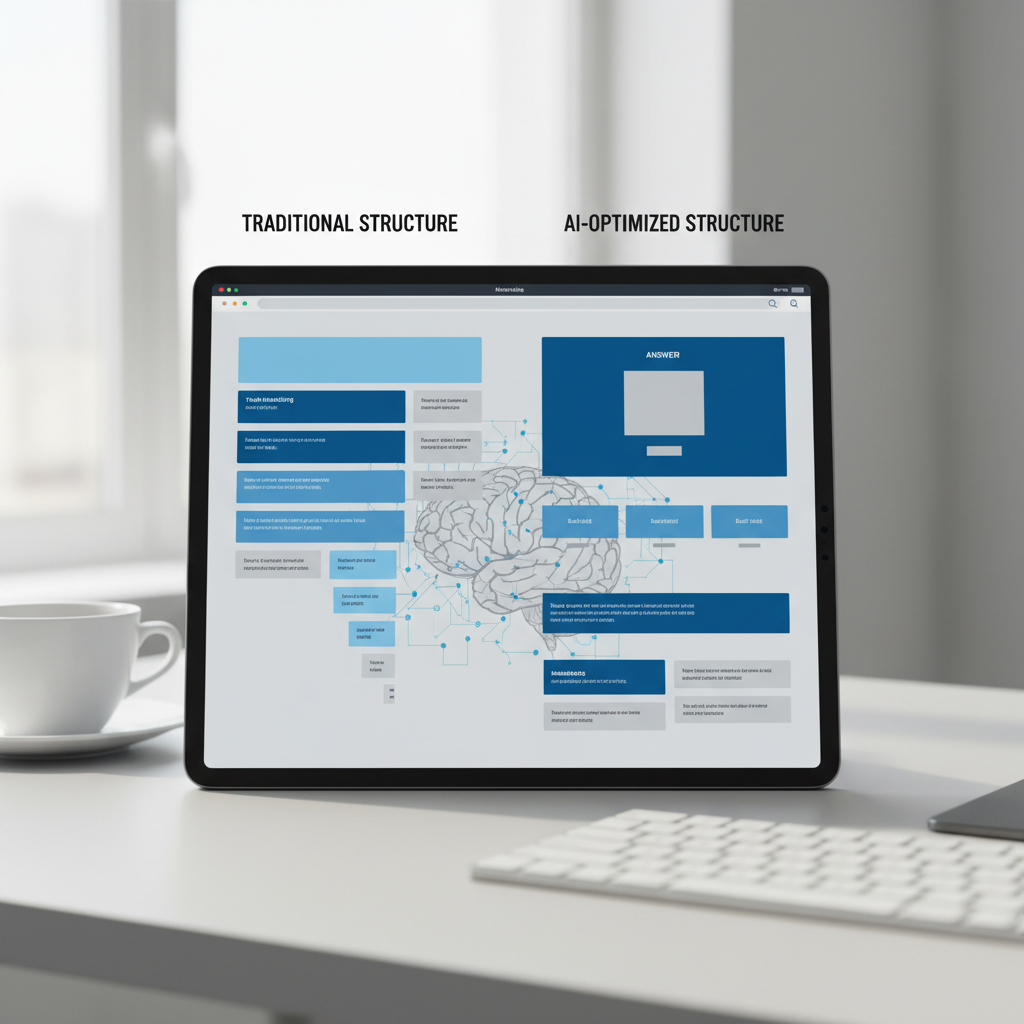
Proper content structure forms the foundation of AI optimized content, enabling search engines to accurately extract and cite your information.Implementing Answer-First Architecture
AI engines excel at identifying and extracting direct answers to user queries. Structure each section of your content to lead with clear, quotable statements that can stand alone as complete answers.- Begin each H2 section with a 2-3 sentence direct answer to the implied question
- Follow the pattern: definition, key fact, supporting detail
- Keep initial answer paragraphs to 40-60 words for optimal AI extraction
- Expand with additional context and examples in subsequent paragraphs
Pro Tip: Test your answer-first structure by reading only the first sentence after each heading. If those sentences create a coherent summary of your content, you've structured it correctly for AI extraction.
Optimizing Heading Hierarchy
Strategic heading structure helps AI systems understand content organization and extract relevant information segments. According to Semrush research, content with clear heading hierarchies receives significantly more AI citations [3].- Use H2 headings for major topic divisions
- Include target keywords naturally in at least one H2 heading
- Structure H3 subheadings as specific questions when appropriate
- Maintain consistent formatting and logical flow throughout
Step 3: Optimize for Entity Recognition
Entity optimization ensures AI systems can identify, verify, and confidently cite your content by connecting it to established knowledge graphs.Strategic Entity Integration
AI engines rely heavily on entity recognition to validate information credibility. Content mentioning specific, verifiable entities performs significantly better in AI search results than generic content.- Research relevant entities in your industry (companies, people, locations, concepts)
- Integrate entities naturally throughout your content without keyword stuffing
- Include full company names, proper nouns, and established terminology
- Connect your topic to well-known frameworks, methodologies, or standards
Building Authority Connections
Optimizely research demonstrates that AI systems favor content that establishes clear connections to authoritative sources and recognized industry standards [4]. This goes beyond simple citation to include contextual authority building.- Reference established industry frameworks by name
- Mention relevant certifications, regulations, or guidelines
- Include geographic specificity when discussing locations or markets
- Connect your content to trending industry topics and current events
| Entity Type | Examples | AI Recognition Value |
|---|---|---|
| Companies | Google, Microsoft, OpenAI | High - easily verified |
| Locations | Silicon Valley, New York City | High - geographic specificity |
| Frameworks | GDPR, ISO 27001, NIST | Very High - authoritative |
| Products | ChatGPT, Gemini, Claude | High - specific tools |
| People | Industry leaders, researchers | Medium - requires context |
Step 4: Implement Citation Strategies
Strategic citation implementation builds content authority while providing AI systems with the verification pathways they need for confident content recommendation.Authoritative Source Integration
AI Business research shows that content with proper citations receives 3x more visibility in AI search results compared to uncited material [5]. The citation strategy for AI optimized content differs significantly from traditional academic or journalistic citation.- Prioritize .edu, .gov, and established industry authority domains
- Include inline citations using numbered references [1], [2], etc.
- Place citations strategically near key claims and statistics
- Create a comprehensive "Sources & References" section with clickable links
Building Citation Networks
Effective citation strategies create networks of authority that AI systems can follow to verify information accuracy. This approach builds what industry experts call "citation graphs" that enhance content credibility.- Cross-reference multiple sources for key claims
- Include recent sources alongside established authorities
- Balance industry publications with academic research
- Update citations regularly to maintain currency
Pro Tip: AI systems often check citation dates and source authority. Include "as of 2026" qualifiers for time-sensitive information and prioritize sources published within the last 2-3 years for maximum AI trust.The citation implementation process requires balancing comprehensiveness with readability. Your AI optimized content should provide sufficient authoritative backing without overwhelming readers with excessive references or disrupting content flow.
Step 5: Test and Monitor AI Visibility
Systematic testing and monitoring ensure your AI optimized content achieves intended visibility across major AI search platforms and maintains performance over time.Cross-Platform Testing Protocol
Regular testing across multiple AI platforms reveals performance variations and optimization opportunities. Common Crawl research indicates significant differences in how various AI engines process and cite content [6].- Develop a testing schedule for weekly AI search queries
- Create standardized query sets covering your target topics
- Document citation patterns and ranking positions across platforms
- Track changes in AI response quality and content recommendations
Performance Monitoring Systems
Effective monitoring systems track both direct AI search visibility and downstream traffic impacts from AI citations. This data helps refine your AI optimization strategies and identify emerging opportunities.- Set up tracking for AI referral traffic in analytics platforms
- Monitor brand mention frequency in AI search responses
- Track competitor citation patterns and market share changes
- Measure conversion rates from AI-driven traffic sources

Common Mistakes to Avoid
Understanding and avoiding common AI optimization pitfalls can save significant time and resources while accelerating your content's AI search performance.Traditional SEO Carryover Errors
Many businesses make the mistake of applying traditional SEO techniques directly to AI optimization without understanding fundamental differences in how AI systems process content.- Keyword stuffing instead of semantic completeness
- Focusing on search volume rather than AI query patterns
- Optimizing for Google rankings instead of AI citation quality
- Neglecting answer-first content structure
Technical Implementation Mistakes
Technical errors can prevent AI systems from properly processing and citing your content, regardless of content quality. Reddit discussions among content professionals highlight several recurring technical issues [7].- Missing or incorrect schema markup implementation
- Poor heading hierarchy that confuses AI content extraction
- Inadequate citation formatting and source attribution
- Failing to test content across multiple AI platforms
Pro Tip: Avoid the temptation to optimize exclusively for one AI platform. Each system has different strengths and processing approaches, so comprehensive optimization requires multi-platform consideration.One critical mistake involves treating AI optimization as a one-time implementation rather than an ongoing process. AI systems evolve rapidly, and content that performs well today may need adjustments as algorithms and training data change.
Sources & References
- UC Davis IET, "Optimizing Content for AI", 2026
- UC Davis IET, "Generative Engine Optimization (GEO)", 2026
- Semrush, "AI content optimization: The complete guide", 2026
- Optimizely, "Using AI for content optimization: Dos and don'ts", 2026
- AI Business, "6 Ways To Optimize Content for the Era of AI-driven Content Discoverability", 2026
- Common Crawl, "AI Optimization Is Here: Are You Ready for Search 2.0?", 2026
- Reddit, "How writers can optimize their content for AI Overviews", 2026
Frequently Asked Questions
1. What is the $900,000 AI job?
Understanding AI optimized content is essential. The $900,000 AI job refers to high-level AI product management and strategy positions at major tech companies like Netflix. These roles involve developing machine learning strategies and overseeing AI implementation across business units. While the salary figure represents the upper end of compensation packages including equity, such positions require extensive experience in AI strategy, product management, and technical leadership.
2. Is SEO dead or evolving in 2026?
SEO isn't dead in 2026, but it has fundamentally transformed into AI Search Engine Optimization (AEO). Traditional keyword-focused tactics have given way to AI optimized content strategies that prioritize semantic completeness, entity recognition, and citation-worthy information. Modern SEO requires understanding how AI systems process, evaluate, and cite content rather than just how Google ranks pages.
3. How long does it take to see results from AI content optimization?
AI optimized content typically shows initial visibility improvements within 2-4 weeks, with significant results appearing after 6-8 weeks of consistent optimization. Unlike traditional SEO which could take months, AI systems often index and cite new content more quickly, especially when it follows proper structure and citation guidelines.
4. What's the difference between traditional SEO and AI optimization?
Traditional SEO focuses on keyword rankings and backlink authority, while AI optimization prioritizes content structure, entity recognition, and citation quality. AI systems care more about providing accurate, well-sourced answers than matching specific keyword phrases, requiring content that emphasizes semantic completeness and authoritative sourcing.
5. Which AI search engines should I optimize for?
Focus on the major AI platforms: ChatGPT, Gemini, Claude, and Perplexity, as they handle the majority of AI search queries in 2026. Each platform has slightly different content preferences, but following comprehensive AI optimization principles ensures good performance across all platforms rather than optimizing for just one system.
6. Can I use AI tools to create AI optimized content?
Yes, AI tools can assist with content creation, but human oversight remains crucial for ensuring accuracy, maintaining brand voice, and implementing proper citation strategies. The most effective approach combines AI assistance for research and drafting with human expertise for optimization, fact-checking, and strategic entity integration.
7. How do I measure AI optimization success?
Success metrics include citation frequency in AI responses, brand mention rates across platforms, AI referral traffic volume, and query coverage for your target topics. Tools like Moonrank provide comprehensive tracking across multiple AI platforms, measuring both visibility and business impact from AI-driven discovery.
Creating effective AI optimized content requires a fundamental shift from traditional SEO thinking to AI-first optimization strategies. The businesses that succeed in 2026 will be those that understand how AI systems process, evaluate, and cite content, implementing comprehensive strategies that prioritize semantic completeness, authoritative sourcing, and structured information architecture.
Recommended Articles
Explore more from our content library:
- Traditional SEO Agencies: Complete Guide & Analysis 2026
- Best AI SEO Automation Tools & Strategies for 2026
- AI Search Visibility: Complete Guide to Tracking &
- Perplexity AI SEO: Complete 2026 Guide to AI Search
- Best Automated SEO Strategies for 2026
Ready to take your results to the next level? Discover what Moonrank can do for you and see why businesses trust us to deliver real, measurable outcomes.