AI Search Engines: The Complete 2026 Guide to Smart Search
Discover the best AI search engines in 2026. Learn how ChatGPT, Perplexity, and other AI-powered search tools are revolutionizing information discovery.
| Key Insight | Explanation |
|---|---|
| AI Search Revolution | AI search engines use natural language processing to provide direct answers instead of just links |
| Leading Platforms 2026 | Perplexity, ChatGPT Search, Google Gemini, and Microsoft Copilot dominate the market |
| Business Impact | Companies must optimize for AI search visibility to maintain digital presence |
| Citation Challenges | AI-powered search tools fail to provide accurate citations over 60% of the time |
| Future Growth | Nearly 25% of Americans now use AI search instead of traditional search engines |
| Optimization Strategy | Structured data, clear citations, and conversational content are essential for AI discoverability |
What Are AI Search Engines?
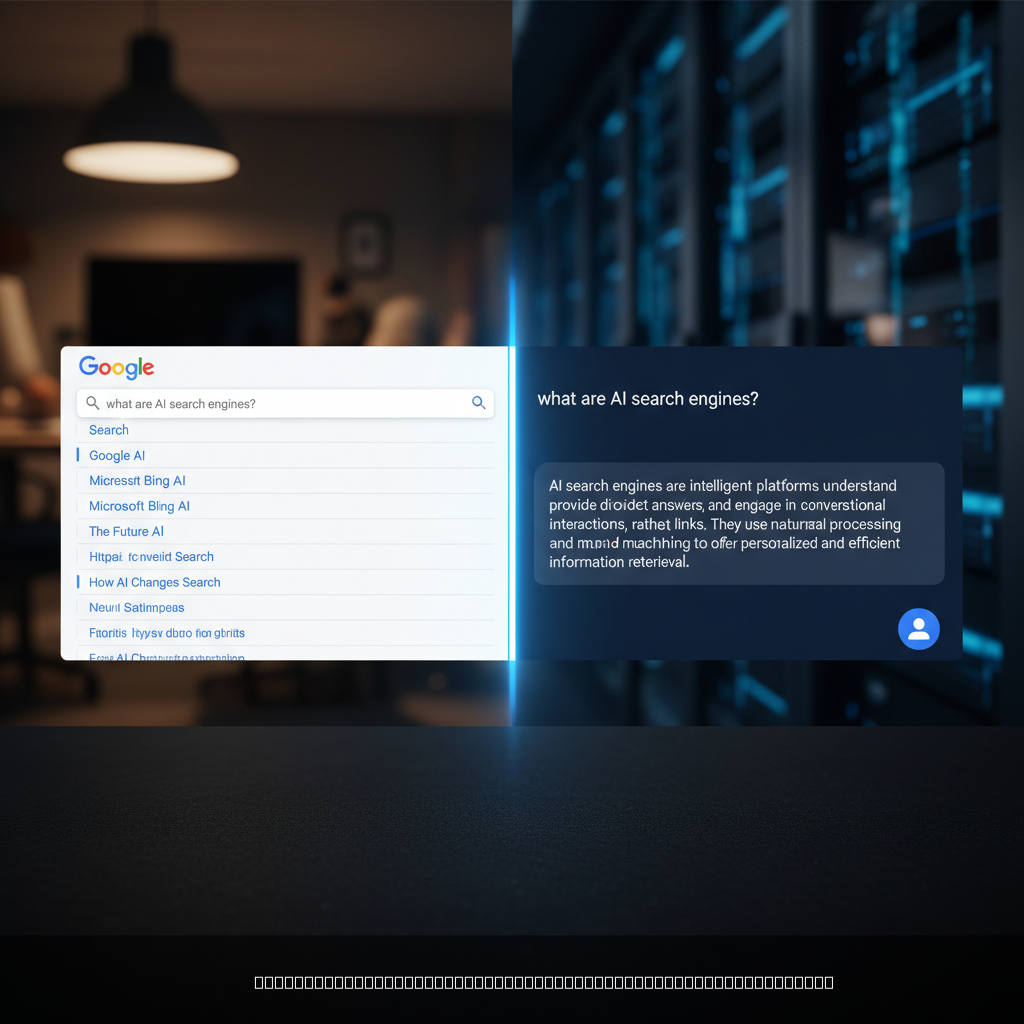
AI search engines are search platforms that leverage artificial intelligence technologies to understand user queries in natural language and provide direct, conversational answers instead of traditional ranked lists of web pages. Unlike conventional search engines that match keywords to indexed content, these platforms use natural language processing (NLP), machine learning, and large language models to interpret intent and synthesize information from multiple sources [2].Core Components of AI Search Technology
The foundation of AI-powered search tools rests on several sophisticated technologies working in harmony:- Natural Language Processing (NLP): Enables the system to understand context, intent, and nuance in human language queries
- Large Language Models (LLMs): Process and generate human-like responses by drawing from vast training datasets
- Real-time web crawling: Continuously indexes and updates information from across the internet
- Citation and source tracking: Attempts to provide references for generated answers, though accuracy varies
- Contextual understanding: Maintains conversation history to provide more relevant follow-up responses
Leading AI Search Platforms in 2026
The AI search landscape has consolidated around several major players, each offering unique strengths:| Platform | Key Strength | Best Use Case |
|---|---|---|
| Perplexity AI | Citation-backed research | Academic and professional research |
| ChatGPT Search | Conversational interface | Complex problem-solving |
| Google Gemini | Integration with Google ecosystem | General search and productivity |
| Microsoft Copilot | Enterprise integration | Business and professional tasks |
Pro Tip: When evaluating AI-powered search platforms, consider your primary use case. Perplexity excels at research with citations, while ChatGPT Search offers superior conversational depth for complex queries.According to IBM's analysis, these platforms represent a fundamental shift from information retrieval to information synthesis [3]. Rather than simply finding relevant documents, these platforms create new content by combining insights from multiple sources, making them powerful tools for research, analysis, and decision-making.
How AI Search Engines Work
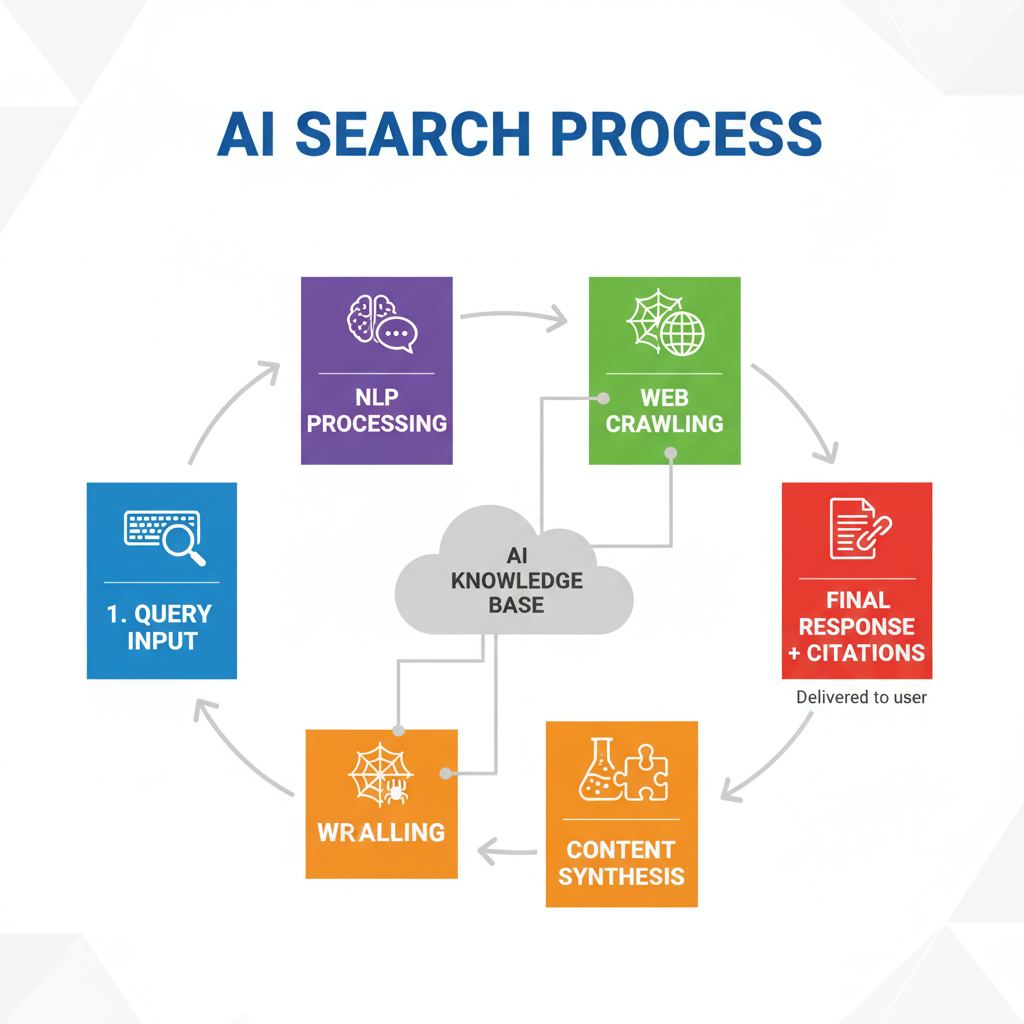
AI-powered search platforms operate through a sophisticated multi-stage process that combines real-time information retrieval with advanced language model processing. The system begins by parsing your natural language query to understand intent, context, and the type of information you're seeking.The AI Search Process Breakdown
The journey from query to answer involves several coordinated steps:- Query Analysis: The system uses NLP to break down your question, identifying key entities, intent, and context
- Information Retrieval: Multiple web sources are searched simultaneously using both traditional indexing and AI-powered relevance scoring
- Content Synthesis: The AI model processes retrieved information to create a coherent, contextual response
- Citation Generation: The system attempts to link generated content back to source materials, though accuracy varies
- Response Formatting: The final answer is structured for readability with citations, bullet points, and relevant formatting
Machine Learning Models Behind AI Search
Modern AI-powered search platforms rely on transformer-based language models trained on massive datasets. These models understand context, relationships between concepts, and can generate human-like responses. The training process involves:- Pre-training: Models learn language patterns from billions of text documents
- Fine-tuning: Specialized training on search-specific tasks and citation accuracy
- Reinforcement learning: Continuous improvement based on user feedback and interaction data
- Real-time adaptation: Models update their understanding based on current web content and trending topics
Pro Tip: AI-powered search platforms perform best with conversational, specific queries. Instead of searching "SEO tools," try "What are the best SEO tools for small businesses in 2026?"The technology behind AI search continues evolving rapidly. Recent advances include multimodal capabilities (processing text, images, and video), real-time fact-checking, and improved citation accuracy. However, as research from the Columbia Journalism Review indicates, citation accuracy remains a significant challenge, with these platforms failing to provide accurate source attribution in over 60% of cases [4].
Key Benefits of AI Search Engines in 2026
AI-powered search platforms offer significant advantages over traditional search methods, fundamentally changing how users discover and consume information. The primary benefit lies in their ability to provide direct, synthesized answers rather than requiring users to sift through multiple web pages to find relevant information.Enhanced User Experience and Efficiency
The conversational nature of these platforms creates a more intuitive and efficient search experience:- Direct answers: Get immediate responses to complex questions without clicking through multiple links
- Contextual follow-ups: Ask related questions within the same conversation thread for deeper exploration
- Natural language queries: Search using everyday language instead of carefully crafted keyword combinations
- Personalized responses: AI adapts answers based on your previous queries and stated preferences
- Multi-format synthesis: Combines information from various content types including articles, videos, and research papers
Advanced Research Capabilities
These platforms excel at complex research tasks that would be time-consuming with traditional search:- Comparative analysis: Automatically compare products, services, or concepts across multiple dimensions
- Trend identification: Spot patterns and emerging trends by analyzing current and historical data
- Cross-referencing: Validate information by checking multiple authoritative sources simultaneously
- Summarization: Distill lengthy documents or complex topics into digestible summaries
- Real-time updates: Access current information without worrying about outdated search results
Business and Professional Applications
For businesses and professionals, AI-powered search platforms provide strategic advantages:| Use Case | Traditional Search | AI Search Advantage |
|---|---|---|
| Market Research | Manual compilation from multiple sources | Automated synthesis with trend analysis |
| Competitive Analysis | Time-intensive manual research | Real-time comparative insights |
| Technical Documentation | Fragmented information across sites | Comprehensive, step-by-step guidance |
| Customer Support | Static FAQ pages and search | Dynamic, contextual problem-solving |
Common Challenges and Limitations
Despite their impressive capabilities, AI-powered search platforms face several significant challenges that users and businesses must understand. The most critical limitation involves citation accuracy and information reliability, which can impact decision-making processes that depend on verified sources.Citation and Source Reliability Issues
Research from the Nieman Lab reveals that these platforms fail to produce accurate citations in over 60% of test queries [6]. This represents a fundamental challenge for users who need to verify information or cite sources in professional contexts:- Inaccurate attributions: AI systems sometimes attribute information to incorrect sources or create non-existent citations
- Outdated information: Despite real-time crawling, AI models may reference outdated data without clear timestamps
- Source bias: Training data biases can influence which sources are prioritized or trusted by the AI system
- Hallucination risks: AI models may generate plausible-sounding but factually incorrect information
- Context collapse: Information from different contexts may be inappropriately combined or misrepresented
Technical and Performance Limitations
AI-powered search platforms also face operational challenges that can affect user experience:- Processing speed: Complex queries may take longer to process than traditional keyword searches
- Cost considerations: AI processing requires significant computational resources, potentially limiting free usage
- Language limitations: Performance varies significantly across different languages and cultural contexts
- Real-time accuracy: Breaking news and rapidly changing information may not be immediately reflected
- Privacy concerns: Conversational searches may reveal more personal information than traditional queries
Business and SEO Implications
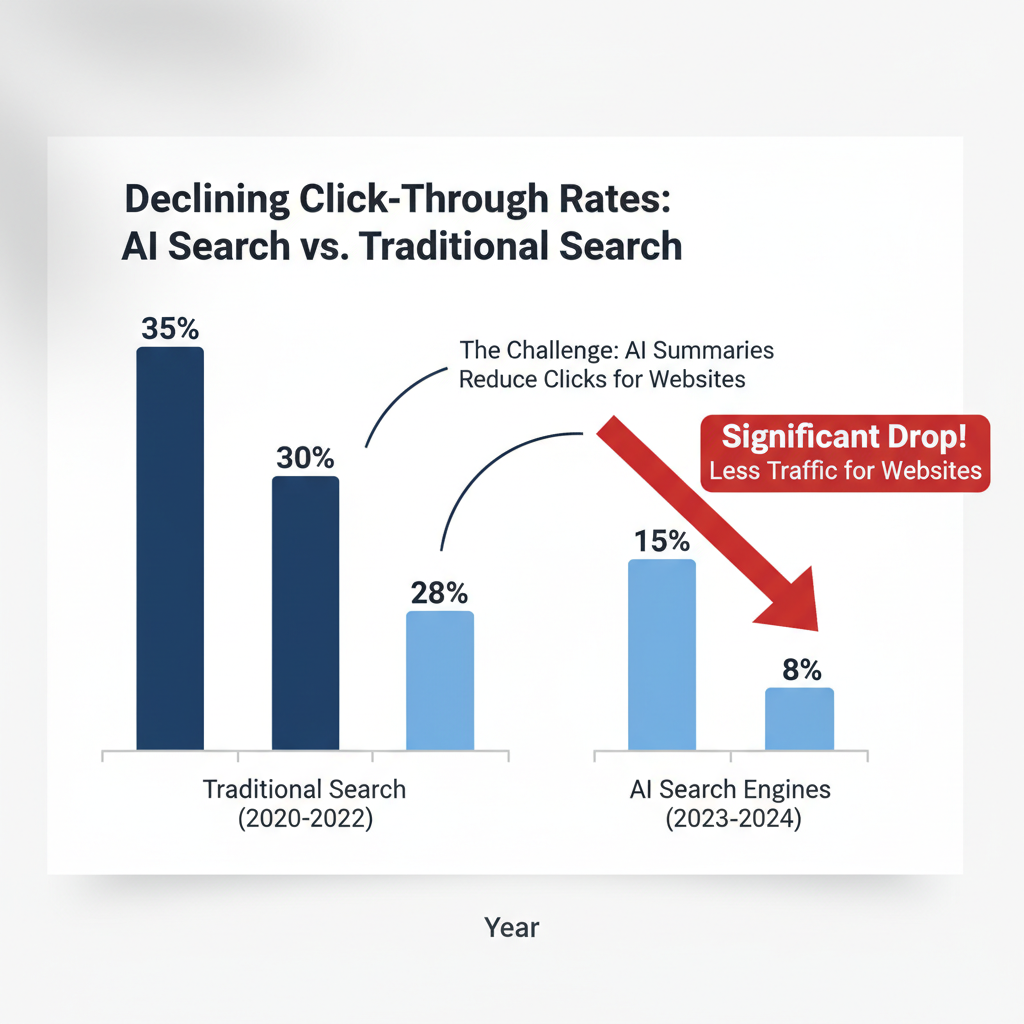
For businesses, these platforms present unique optimization challenges:Pro Tip: Traditional SEO metrics like click-through rates become less relevant with AI-powered platforms that provide direct answers. Focus on brand mentions and authority building instead.
- Ignoring structured data: Failing to implement schema markup that helps AI systems understand content context
- Overlooking conversational keywords: Continuing to optimize for short keywords instead of natural language queries
- Neglecting citation optimization: Not providing clear, authoritative sources that AI systems can reference
- Underestimating brand authority: Failing to build the domain authority and expertise signals that AI systems value
Best Practices for AI Search Optimization
Optimizing content for AI-powered search platforms requires a fundamentally different approach than traditional SEO. The focus shifts from keyword density and backlinks to creating authoritative, well-structured content that AI systems can easily understand, synthesize, and cite accurately.Content Structure and Formatting
AI-powered search platforms favor content that's logically organized and easy to parse:- Use clear headings and subheadings: Structure content hierarchically with descriptive H2 and H3 tags
- Implement schema markup: Add structured data to help AI systems understand content context and relationships
- Create FAQ sections: Address common questions directly with concise, authoritative answers
- Include citation-ready sources: Provide clear references and links to authoritative sources within your content
- Write conversational content: Use natural language that matches how people actually ask questions
Authority and Expertise Signals
AI systems prioritize content from authoritative sources when generating responses:- Author credentials: Include detailed author bios with relevant expertise and certifications
- Publication dates: Keep content current and clearly indicate when information was last updated
- External validation: Reference and link to other authoritative sources in your field
- Domain expertise: Focus on topics within your area of specialization rather than broad, generic content
- User engagement signals: Create content that generates meaningful discussion and sharing
Technical Implementation Strategies
| Optimization Area | Traditional SEO | AI Search Optimization |
|---|---|---|
| Keyword Strategy | Short, high-volume keywords | Natural language queries and questions |
| Content Focus | Keyword density optimization | Comprehensive topic coverage |
| Link Building | Quantity-focused backlinks | Authoritative source citations |
| Success Metrics | Rankings and click-through rates | Brand mentions and authority signals |
Pro Tip: Create content that directly answers the questions your target audience asks. Use tools like AnswerThePublic or analyze customer support queries to identify common question patterns.
Monitoring and Measurement
Tracking success in AI search requires new metrics and monitoring approaches:- Brand mention tracking: Monitor how often your brand appears in AI search responses across different platforms
- Citation analysis: Track when your content is referenced as a source by AI systems
- Query coverage: Ensure your content addresses the full range of questions in your domain
- Authority building: Focus on metrics that demonstrate expertise and trustworthiness
- User satisfaction: Monitor engagement and feedback when users find your content through AI search
Sources & References
- Columbia Journalism Review, "AI Search Has a Citation Problem", 2026
- PCMag, "The Best AI Search Engines We've Tested for 2026", 2026
- IBM, "What Is an AI Search Engine?", 2026
- Columbia Journalism Review, "AI Search Has a Citation Problem", 2026
- IMD, "Top 5 AI-powered search engines and why they're leading the industry", 2026
- Nieman Lab, "AI search engines fail to produce accurate citations in over 60% of tests", 2025
- North Carolina Bar Association, "The Difference Between Search Engines, Generative AI, and Automation Tools", 2023
Frequently Asked Questions
1. Which is the best AI search engine?
Understanding AI search engines is essential. The best platform depends on your specific needs. Perplexity AI excels at research with comprehensive citations, ChatGPT Search offers superior conversational depth for complex problem-solving, while Google Gemini provides seamless integration with existing Google services. For most users, Perplexity AI offers the best balance of accuracy, citations, and user experience as of 2026.
2. What is the 30% rule for AI?
The 30% rule for AI is a guideline suggesting that no more than 30% of any creative or academic work should come directly from AI tools. This principle helps maintain human creativity and critical thinking while leveraging AI as a supportive tool rather than a replacement for original thought and analysis.
3. Are there any AI free search engines?
Yes, several AI-powered platforms offer free tiers including Perplexity AI (limited queries), Brave Search with AI features, and DuckDuckGo's AI chat functionality. Google's AI-powered search features are also free, though some advanced platforms like ChatGPT Search require paid subscriptions for full access.
4. What are the 5 top search engines in 2026?
The top 5 search engines in 2026 are: 1) Google (with AI-powered features), 2) Microsoft Bing (Copilot integration), 3) Perplexity AI (AI-native search), 4) ChatGPT Search (conversational AI search), and 5) Brave Search (privacy-focused with AI features). Traditional engines like Yahoo and DuckDuckGo maintain smaller market shares.
5. How accurate are AI search engines?
AI-powered search platforms provide accurate information for general queries but struggle with citation accuracy, failing to provide correct source attribution in over 60% of cases according to recent studies. They excel at synthesizing information but users should verify important facts through original sources, especially for critical decisions.
6. Do AI search engines replace traditional search?
AI-powered search platforms complement rather than completely replace traditional search. They're ideal for research, analysis, and getting quick answers to complex questions, while traditional search remains better for finding specific websites, shopping, and when you need to verify sources independently. Most users benefit from using both approaches strategically.
7. How do businesses optimize for AI search engines?
Businesses should focus on creating authoritative, well-structured content with clear citations, implementing schema markup, optimizing for conversational queries, and building domain expertise. Unlike traditional SEO, AI search optimization prioritizes content quality, authority signals, and the ability to answer specific user questions comprehensively.
AI search engines represent a fundamental shift in how we discover and consume information online. As these platforms continue evolving, businesses and individuals must adapt their strategies to remain visible in an increasingly AI-driven search landscape. The key to success lies in creating genuinely valuable, authoritative content that serves user needs while optimizing for the unique requirements of AI systems. By focusing on expertise, clear structure, and comprehensive coverage of topics, you can ensure your content remains discoverable and valuable in the age of AI search.
Recommended Articles
Explore more from our content library: