AI Search Indexing: How It Works and Why It Matters
Learn how AI search indexing works, why it matters for your business visibility, and how to get recommended by ChatGPT, Gemini, and Perplexity in 2026.
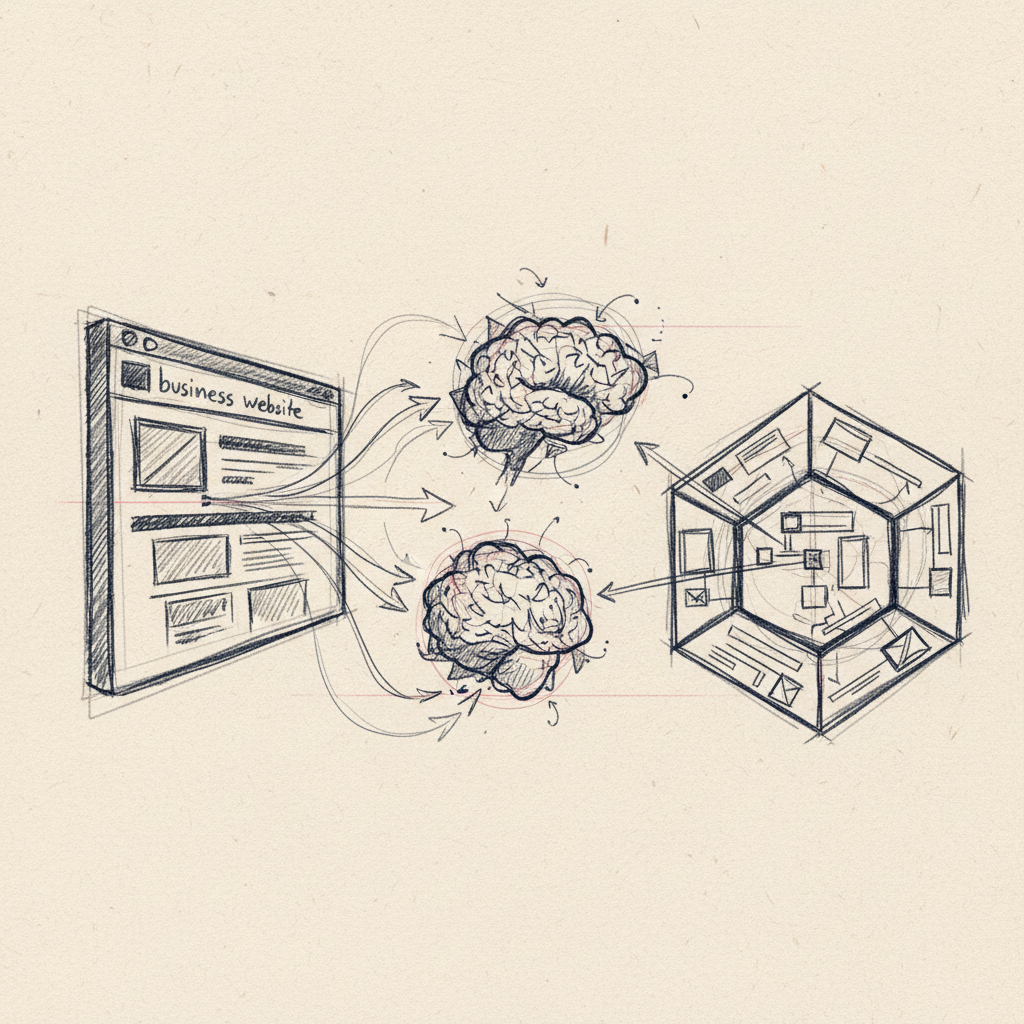
| Key Insight | Explanation |
|---|---|
| AI search indexing is distinct from traditional SEO indexing | AI engines like ChatGPT and Perplexity use vector embeddings and semantic understanding, not just keyword matching, to surface content. |
| Structured data dramatically improves AI discoverability | Schema markup and llms.txt files signal to AI crawlers exactly what your business does, increasing the chance of being recommended. |
| Continuous indexing keeps your content current | Modern AI search systems re-index content on a rolling basis, meaning fresh, regularly published content has a compounding visibility advantage. |
| Most SMBs are invisible to AI search engines | Without proper technical optimization, even well-established businesses won't appear in ChatGPT, Gemini, Claude, or Perplexity recommendations. |
| Automated tools make AI indexing accessible to small businesses | Platforms like Moonrank handle technical optimization and daily content publishing on autopilot, replacing the need for a $3K+/month agency. |
| Stanford's 2026 AI Index confirms accelerating AI search adoption | AI-generated answers now influence a significant share of information-seeking behavior, making AI search indexing a business-critical priority. |
A customer pulls out their phone, types "best Italian restaurant near me" into ChatGPT, and gets three specific recommendations. Your restaurant isn't one of them. That gap between your business and the AI's answer comes down to one thing: AI search indexing. AI search indexing is the process by which AI-powered engines crawl, parse, and store your content as machine-readable data so they can surface your business in response to user queries. It's the foundational layer that determines whether ChatGPT, Gemini, Claude, or Perplexity ever knows you exist. This article explains exactly how the process works, why it's different from traditional Google indexing, and what you can do right now to make sure your business shows up when it counts.
What Is AI Search Indexing?
AI search indexing is the mechanism by which AI-powered search engines collect, process, and organize web content into structured, queryable formats that large language models (LLMs) can retrieve when generating answers for users.
The Core Definition
Traditional search indexing, the kind Google has used for decades, stores pages based on keyword frequency and backlink signals. AI search indexing works differently. Instead of cataloging keywords, AI systems convert content into vector embeddings (numerical representations of meaning) that capture semantic relationships between concepts [1]. When a user asks ChatGPT a question, the engine retrieves the most semantically relevant indexed content, not just the page with the most keyword matches.
According to OpenSearch documentation, "AI search streamlines your workflow by generating embeddings automatically. OpenSearch converts text to vectors during indexing and querying" [1]. This shift from keyword-based to meaning-based retrieval is what makes this strategy fundamentally different from anything that came before it.
The Stanford HAI 2026 AI Index Report confirms that AI-driven information retrieval has accelerated sharply, with AI-generated answers now influencing a significant share of daily information-seeking behavior globally [2]. For business owners, that's not a future trend. It's the current reality.
Why This Matters for SMBs
Most small businesses have spent years optimizing for Google's crawlers. They've built backlinks, stuffed meta tags, and published keyword-rich blog posts. None of that directly translates to visibility in ChatGPT or Perplexity. Those engines use completely different signals, including structured data, citation authority, content freshness, and semantic clarity.
- AI search engines don't rank pages — they generate answers, pulling from content they've indexed and trust.
- Being "indexed" by an AI engine means your content has been processed into a format the model can retrieve and cite.
- Businesses without proper AI-readable signals are effectively invisible, regardless of their Google ranking.
- The opportunity is real — most SMBs haven't optimized for AI search yet, which means early movers gain a significant competitive edge.
Pro Tip: Don't assume your Google ranking protects you in AI search. A business ranked #1 on Google can be completely absent from a ChatGPT recommendation if its content lacks the structured signals AI engines need to parse and trust it.
How AI Search Indexing Works
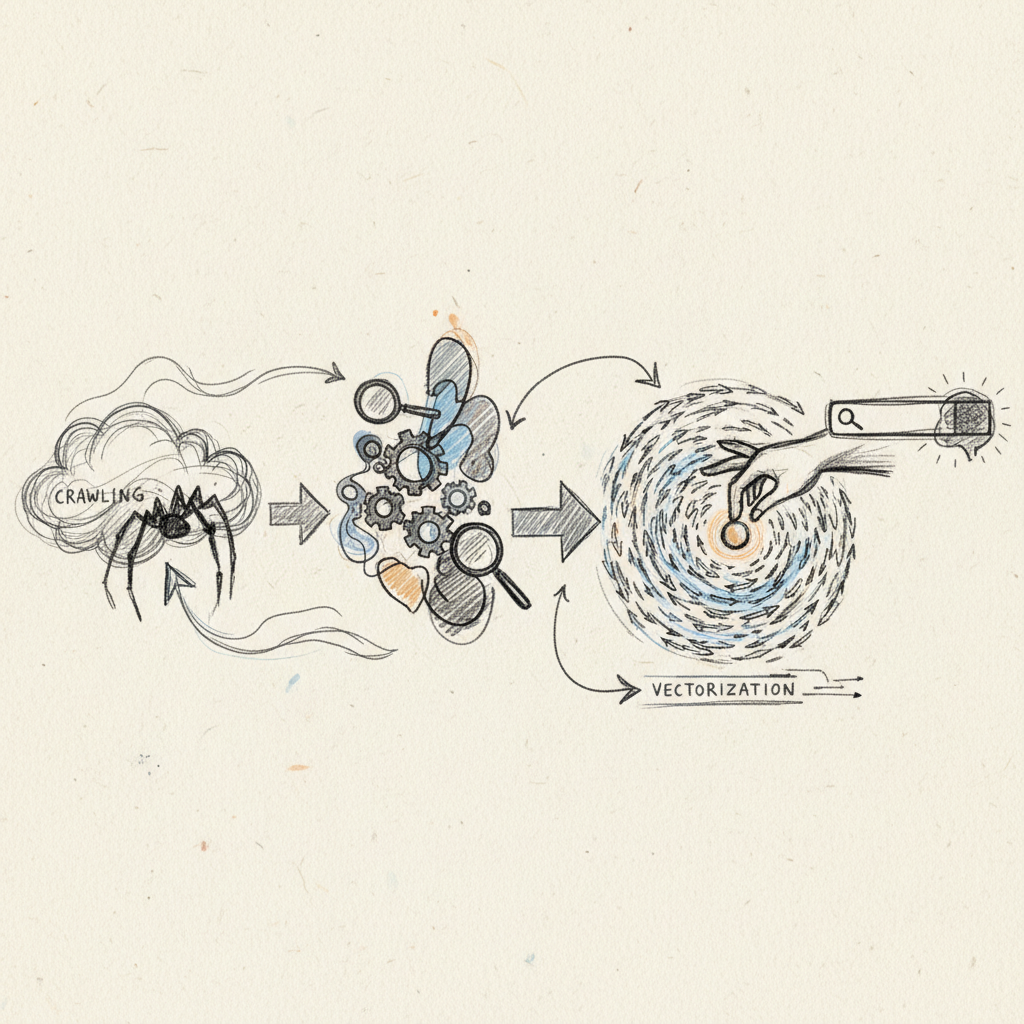
this approach follows a multi-stage pipeline: crawling, enrichment, vectorization, and retrieval, each stage transforming raw web content into something an AI model can actually use.
The Indexing Pipeline: Step by Step
- Crawling: AI search engines deploy crawlers (sometimes called indexers) that visit web pages and pull raw text, structured data, and metadata. According to Microsoft Learn, "an indexer in Azure AI Search is a crawler that extracts textual data from cloud data sources and populates a search index using field-to-field mappings" [3].
- AI Enrichment: The raw content passes through an enrichment layer where natural language processing (NLP) models extract entities, classify topics, identify sentiment, and chunk long text into digestible segments [4]. This is where schema markup and structured data become critical — they give the enrichment layer explicit signals rather than forcing the AI to infer everything.
- Vectorization: Text chunks are converted into vector embeddings — dense numerical arrays that represent meaning in high-dimensional space. Similar concepts end up close together in vector space, enabling semantic retrieval [1].
- Index Storage: The vectors and their associated metadata are stored in a search index, a structured database optimized for fast similarity search. Microsoft's Azure AI Search, for example, supports up to 4,096 dimensions per vector field [5].
- Retrieval: When a user asks a question, the AI converts the query into a vector and finds the closest matches in the index. Those matches inform the generated answer.
What Makes Content "Indexable" by AI Engines
Research published in the International Journal of AI-Based Data & Content Management Systems notes that "AI-based indexing approaches make use of machine learning (ML), natural language processing (NLP), and deep learning algorithms to automatically generate, classify, and retrieve structured information" [6]. In plain English: the cleaner and more structured your content, the better AI engines can process it.
Several technical signals directly influence how well your content gets indexed:
- Schema markup: Structured data that tells AI crawlers exactly what your business is, what it offers, and where it's located.
- llms.txt: A file placed in your site's root directory that explicitly guides LLM crawlers on how to read and cite your content.
- Citation signals: Mentions of your business on authoritative third-party sites that AI engines treat as trust indicators.
- Content freshness: Regularly updated content signals that your information is current and reliable.
- Semantic clarity: Clear, specific language that reduces ambiguity for NLP models parsing your content.
Industry analysts at SMPTE have noted that "semantic indexing will soon change how people find and consume content on the internet," pointing to the shift from keyword matching toward meaning-based retrieval as the defining transition in modern search [7].
Key Benefits of AI Search Indexing for Your Business
Proper this directly increases the likelihood that ChatGPT, Gemini, Claude, and Perplexity will recommend your business when users ask relevant questions.
Visibility Where Customers Are Actually Looking
The search behavior shift is real and measurable. Perplexity reported over 100 million weekly queries by late 2024, and that number has grown substantially through 2026 [2]. ChatGPT's browsing and search features have made it a primary research tool for millions of consumers. Gemini is integrated directly into Google's own results pages. These aren't niche tools anymore. They're mainstream discovery channels.
Businesses that have properly optimized for it gain several concrete advantages:
- Direct recommendations: AI engines cite specific businesses by name when answering "best [product/service] in [location]" queries.
- Zero-click authority: Your business gets mentioned even when the user never visits your website, building brand recognition at the point of intent.
- Compounding content value: Each new piece of indexed content adds to your overall semantic footprint, making future recommendations more likely.
- Competitive differentiation: Most SMBs haven't optimized for AI search yet, so early adopters capture disproportionate share of AI-driven referrals.
Comparing AI Search Indexing vs. Traditional SEO Indexing
| Factor | Traditional SEO Indexing | AI Search Indexing |
|---|---|---|
| Primary signal | Keywords, backlinks, page authority | Semantic meaning, structured data, citation trust |
| Output format | Ranked list of URLs | Generated answer with cited sources |
| Content freshness impact | Moderate — older pages can rank for years | High — AI engines favor recently updated content |
| Structured data importance | Helpful but optional | Critical for accurate entity recognition |
| User interaction model | Click through to website | Answer consumed directly in the AI interface |
| Optimization target | Google's PageRank algorithm | LLM retrieval and trust signals |
At Moonrank, we've found that businesses which invest in both traditional SEO and this method see the strongest overall visibility results. The two approaches aren't mutually exclusive, but they require different tactics and different technical implementations.
Common Challenges and Mistakes in AI Search Indexing
The most common mistake businesses make is assuming that existing Google SEO work automatically translates to AI search visibility. It doesn't, and that assumption leaves most SMBs invisible to the engines their customers are actually using.
Technical Pitfalls That Block AI Indexing
From experience working with SMB owners across e-commerce, hospitality, and B2B services, several technical issues consistently prevent proper this strategy:
- Missing or incomplete schema markup: Without structured data, AI crawlers must infer what your business does from unstructured text alone. That inference is often wrong or incomplete.
- No llms.txt file: This relatively new standard tells LLM crawlers how to interpret your site. Without it, your content may be crawled but poorly understood.
- Thin or infrequent content: AI engines build trust through repeated exposure to authoritative content. A site that publishes once a month won't build the semantic footprint needed for consistent recommendations.
- Inconsistent entity information: If your business name, address, and category appear differently across your website, social profiles, and third-party directories, AI engines struggle to build a confident entity profile for your brand.
- JavaScript-heavy pages: Many AI crawlers have limited JavaScript rendering capability. Content that only loads via JavaScript may never get indexed properly [3].
Strategic Mistakes to Avoid
A common mistake is treating AI search optimization as a one-time project. In practice, this approach is a continuous process. Engines re-index content regularly, and businesses that stop publishing fresh content gradually lose ground to competitors who don't.
One pitfall to watch for: optimizing for the wrong queries. Many SMBs focus on broad, competitive keywords when AI engines are actually most useful for specific, conversational queries like "best vegan bakery in Austin that ships nationwide." Targeting these long-tail, intent-rich phrases in your content dramatically increases the chance of being cited in an AI-generated answer.
Pro Tip: Run a test right now. Open ChatGPT or Perplexity and search for your business category in your city. If your business doesn't appear in the top three recommendations, you have an AI search indexing gap that needs immediate attention.
Best Practices for AI Search Indexing in 2026
Effective this in 2026 requires a combination of technical infrastructure, consistent content publishing, and ongoing visibility monitoring across ChatGPT, Gemini, Claude, and Perplexity.
Technical Optimization Framework
The Generative Engine Optimization (GEO) framework, which has emerged as the standard methodology for AI search visibility, centers on three pillars: technical readability, content authority, and citation building. Here's how to implement each:
- Implement comprehensive schema markup: At minimum, deploy Organization, LocalBusiness, Product, and FAQ schema types. These tell AI engines exactly what your business is, what it sells, and who it serves. Microsoft's documentation confirms that well-structured field mappings dramatically improve retrieval accuracy [4].
- Configure your llms.txt file: Place this file in your site's root directory with clear instructions for LLM crawlers about your content structure, key pages, and business context.
- Build citation authority: Get your business mentioned on authoritative third-party sites. Industry directories, press mentions, and niche publication features all contribute to the trust signals AI engines use when deciding whether to cite your brand.
- Publish content daily: Frequency matters. AI engines update their indexes on rolling schedules, and businesses that publish regularly maintain a larger, fresher semantic footprint [6].
- Structure content for direct answers: Write in clear, specific language. Include definitions, step-by-step explanations, and factual statements that AI engines can extract and cite directly.
- Monitor your AI visibility: Track how and when your business appears across ChatGPT, Gemini, Claude, and Perplexity. Without monitoring, you can't identify gaps or measure improvement.
The Pros and Cons of DIY vs. Automated AI Indexing Optimization
Results may vary depending on your technical comfort level, available time, and budget. Here's an honest comparison:
| Approach | Pros | Cons |
|---|---|---|
| DIY optimization | Full control, no tool cost, deep learning opportunity | Time-intensive, requires technical knowledge, inconsistent execution |
| Traditional SEO agency | Expert execution, comprehensive strategy | $3,000+/month, often Google-focused rather than AI-search-focused |
| Automated AI search platform (e.g., Moonrank) | Fully automated, purpose-built for AI search, $99/month, zero ongoing effort | Less manual customization than a bespoke agency engagement |
Our team at Moonrank recommends that SMBs prioritize automated solutions specifically built for it, rather than adapting traditional SEO tools that weren't designed for how ChatGPT, Gemini, Claude, and Perplexity actually work. The technical requirements are different enough that a purpose-built approach consistently outperforms a retrofitted one.
Pro Tip: Schema markup alone isn't enough. AI engines like Perplexity and ChatGPT also weigh how often your business is mentioned across the web. Pair technical optimization with a consistent content publishing strategy to build both the technical signals and the citation footprint that AI engines reward.
Sources & References
- OpenSearch Documentation, "AI Search," 2026
- Stanford HAI, "The 2026 AI Index Report," 2026
- Microsoft Learn, "Azure AI Search — Indexer Overview," 2026
- Microsoft Learn, "Introduction to Azure AI Search," 2026
- Microsoft Learn, "Search Index Overview — Azure AI Search," 2026
- International Journal of AI-Based Data & Content Management Systems, "AI-Driven Indexing Strategies," 2026
- SMPTE, "Semantic Indexing: How AI and Machine Learning Will Lead to More Efficient Internet Searches," 2026
Frequently Asked Questions
1. What is indexing in AI search?
this method is the process of converting web content into structured, machine-readable formats, typically vector embeddings, that AI-powered engines can retrieve when generating answers. Unlike traditional keyword indexing, this strategy captures semantic meaning, allowing engines like ChatGPT, Gemini, Claude, and Perplexity to understand context, not just match words. Once indexed, content is continuously refreshed so the AI's knowledge base stays current and queryable in real time.
2. Can AI do indexing?
Yes, and AI doesn't just perform indexing — it transforms it. Modern AI systems use machine learning models, natural language processing, and deep learning to automatically classify, chunk, enrich, and vectorize content during the indexing process [6]. This means AI can index unstructured content like PDFs, long-form articles, and product descriptions in ways that traditional keyword-based crawlers cannot, extracting entities, topics, and relationships that make retrieval far more accurate and context-aware.
3. What is the indexer in AI search?
An indexer in AI search is the automated component that crawls data sources, extracts content, applies AI enrichment (such as entity extraction and vectorization), and populates the search index. Microsoft's Azure AI Search describes its indexer as "a crawler that extracts textual data from cloud data sources and populates a search index using field-to-field mappings" [3]. In the broader context of consumer AI engines like Perplexity or ChatGPT, the indexer functions similarly but operates at web scale, continuously processing billions of pages to keep the model's retrieval layer current.
4. How many indexes does Azure AI Search have?
The number of indexes available in Azure AI Search depends on the service tier. Free tier accounts are limited to 3 indexes, while S3 HD tier accounts can support up to 1,000 indexes per partition or 3,000 per service [5]. Each index can contain up to 1,000 simple fields and supports vector fields with up to 4,096 dimensions, making it suitable for both small-scale prototypes and large enterprise deployments. For most SMBs exploring this approach, the standard tier provides more than sufficient capacity.
5. How is AI search indexing different from traditional SEO indexing?
Traditional SEO indexing focuses on keywords, backlinks, and page authority to rank URLs in a list. this, by contrast, converts content into vector embeddings that represent semantic meaning, enabling AI engines to generate direct answers rather than just ranking pages. Structured data like schema markup and llms.txt files play a much more critical role in AI indexing than in traditional SEO. A business can rank highly on Google while being completely absent from ChatGPT or Perplexity recommendations if it hasn't addressed its it signals.
6. How long does it take for AI search engines to index new content?
Indexing timelines vary by engine. Some AI search systems, like Perplexity's real-time web search, can surface new content within hours of publication. Others, like the training data underlying ChatGPT's base model, update on longer cycles. In practice, publishing fresh content consistently, ideally daily, gives your business the best chance of being picked up during each indexing cycle. Pair this with proper technical signals (schema markup, llms.txt, structured data) to maximize the speed and accuracy of indexing across all major AI engines.
Conclusion
this method isn't a technical detail reserved for engineers. It's the mechanism that decides whether your business gets recommended by ChatGPT, Gemini, Claude, or Perplexity, or gets passed over entirely. The businesses that understand this now, and act on it, will hold a significant advantage as AI-driven search continues to capture a larger share of how consumers discover products, services, and brands.
The good news: you don't need a $3,000/month agency or a team of developers to get this right. Proper this strategy comes down to consistent content publishing, clean technical signals, and ongoing visibility monitoring. Those are exactly the things Moonrank handles on autopilot, every single day, for $99/month.
If your business isn't showing up when customers ask ChatGPT or Perplexity for a recommendation in your category, that's an this approach problem. And it's one that's very solvable. Visit www.moonrank.ai to see how Moonrank tracks your AI visibility, fixes your technical gaps, and publishes daily content that puts your business on the AI search map.