AI Search Intent: What It Is and Why It Matters
Learn what AI search intent is, how it works, and how to optimize your content so ChatGPT, Gemini, and Perplexity recommend your business in 2026. Discover.

| Key Insight | Explanation |
|---|---|
| AI search intent goes beyond keywords | AI engines like ChatGPT and Gemini interpret the purpose behind a query, not just its literal words, using natural language understanding. |
| Four core intent types still apply | Informational, navigational, commercial, and transactional intent remain the foundation, but AI search adds a fifth: conversational/generative intent. |
| Structured data accelerates AI understanding | Schema markup and llms.txt files help AI engines parse your content accurately, increasing the chance your business gets recommended. |
| 43% of queries trigger AI Overviews | Research from Medill Spiegel Research Center found informational intent dominates AI Overview triggers across major industries. |
| Content freshness signals matter more | AI engines reward brands that publish consistent, authoritative content — daily publishing directly improves AI search visibility. |
| SMBs can compete without agencies | Automated platforms can handle AI intent optimization for $99/month, versus $3,000+ for a traditional SEO agency. |
A potential customer types "best espresso machine under $300" into Perplexity. They don't get a list of links. They get a direct recommendation. Whether your brand appears in that answer depends entirely on how well you've addressed AI search intent. AI search intent is the underlying purpose a user has when querying an AI-powered search engine, interpreted through natural language understanding rather than keyword matching alone. It determines which sources AI engines cite and which brands they recommend.
This guide covers what AI search intent actually means in 2026, how AI engines decode it, why it matters for your business, and the specific steps you can take to align your content with it. You'll also find a breakdown of the most common mistakes, a comparison of intent types, and answers to the questions SMB owners ask most.
What Is AI Search Intent?
AI search intent is the goal or motivation behind a user's query as interpreted by an AI-powered search engine, going beyond surface-level keywords to understand context, phrasing, and the likely next action a user wants to take.
The Classic Definition, Updated for the AI Era
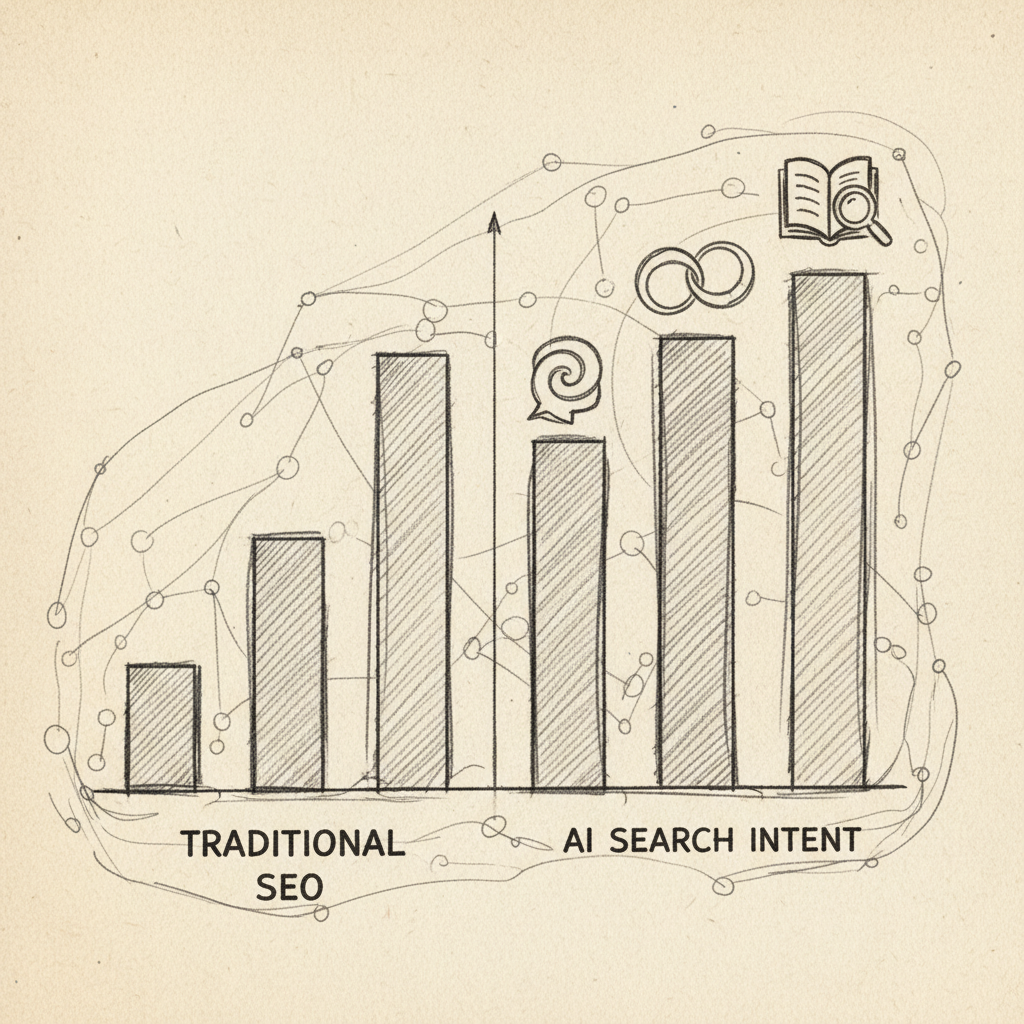
Traditional SEO frameworks have long recognized four types of search intent [1]. Informational (the user wants to learn something), navigational (the user wants to reach a specific site), commercial (the user is researching before buying), and transactional (the user is ready to buy). These categories still matter. But AI search engines like ChatGPT, Gemini, Claude, and Perplexity have introduced a fifth type that many SEO guides still miss: conversational or generative intent, where the user expects a synthesized, direct answer rather than a list of links [2].
According to research published by SE Ranking, generative AI intent is characterized by queries phrased as full questions or requests for recommendations, comparisons, or explanations [2]. This is the intent type that most SMBs are currently invisible to — and it's growing fast.
Why the Shift Matters Right Now
As of 2026, AI search engines handle hundreds of millions of queries weekly. Perplexity alone reported over 100 million weekly queries by late 2024, and that figure has climbed significantly since. A test of 160 queries across four industries found that 43% triggered AI Overviews, with informational intent being the dominant driver [3].
The practical implication is direct: if your content doesn't signal the right intent alignment, AI engines won't pull from it. They'll pull from a competitor who does. Understanding AI search intent isn't an academic exercise — it's the difference between being recommended and being invisible.
| Intent Type | User Goal | Example Query | AI Engine Response Style |
|---|---|---|---|
| Informational | Learn or understand | "How does cold brew coffee work?" | Summarized explanation with cited sources |
| Navigational | Find a specific site or brand | "Coletti Coffee website" | Direct link or brand card |
| Commercial | Research options before buying | "Best drip coffee makers 2026" | Comparative recommendation list |
| Transactional | Complete a purchase or action | "Buy espresso beans online" | Product links with pricing context |
| Conversational/Generative | Get a synthesized direct answer | "What's the best local coffee shop near me?" | Named recommendation with rationale |
How AI Search Intent Works
AI search engines interpret intent by analyzing query structure, context signals, and the semantic relationships between words — then matching that analysis to the most trustworthy, relevant content in their training data and live index.
Natural Language Processing and Semantic Understanding
The mechanics start with natural language processing (NLP), which allows AI engines to parse full sentences rather than isolated keywords [4]. When a user asks "which accounting software is easiest for a freelancer?", the AI doesn't just look for pages containing those words. It identifies the intent class (commercial investigation), the user persona (freelancer), the product category (accounting software), and the evaluation criterion (ease of use).
This is what researchers call intent classification, a process where the AI assigns a query to a category based on its semantic content [5]. Modern large language models (LLMs) like those powering ChatGPT and Gemini are trained on vast corpora of human language, which means they've learned the patterns that distinguish a research question from a buying signal. According to Bloomreach's analysis of AI-powered search behavior, AI systems can "conversationally interpret user intent, behavior, and context" in ways that static keyword matching never could [6].
How AI Engines Decide What Content to Surface
Once intent is classified, the AI engine retrieves content that best satisfies that intent. Several factors influence what gets pulled [7]:
- Topical authority: Sites that publish consistent, in-depth content on a subject are treated as more authoritative sources.
- Structured data: Schema markup (the structured data that tells AI engines exactly what your business does) and llms.txt files (configuration files that guide LLM crawlers through your site) directly improve how accurately an AI engine represents your brand.
- Citation patterns: AI engines notice which sources are frequently cited by other credible pages. Building citations increases the likelihood your content is included in AI-generated answers.
- Content freshness: Regularly updated content signals that a source is actively maintained and trustworthy.
- Query-to-content match: The closer your content's language mirrors the natural phrasing of real user questions, the better the intent alignment.
Daniel Tunkelang, a noted information retrieval researcher, has written that AI systems excel at recognizing "query equivalence or similarity" — meaning they can match a user's question to relevant content even when the exact phrasing differs [8]. That's a significant shift from traditional SEO, where exact keyword matches carried outsized weight.
Pro Tip: Don't just optimize for the keywords you think people search. Write content that answers the full question behind the keyword. A page titled "Best Espresso Machines Under $300" will perform better if it also addresses why someone is searching at that price point and what trade-offs they should expect.
For businesses looking to understand how AI search intent intersects with real purchasing behavior, resources like Rapid Search Results offer useful context on how product-focused queries translate into customer actions.
Key Benefits of AI Search Intent Optimization
Optimizing for AI search intent produces measurable advantages over traditional keyword-only SEO, particularly for SMBs competing against larger brands with bigger content budgets.
Higher Visibility in AI-Generated Recommendations
The most direct benefit is appearing in the answers that ChatGPT, Gemini, Claude, and Perplexity generate for your target queries. These recommendations carry significant weight. Users trust AI-generated answers because they feel curated rather than advertised. A business that appears in an AI recommendation for "best local accountant for small businesses" is perceived very differently from a paid search result [9].
Research from the Medill Spiegel Research Center confirms that informational intent queries have the highest rate of triggering AI Overviews, at 43% across tested industries [3]. Brands that align their content with informational and commercial intent are disproportionately represented in these AI-generated answers.
Better Content Relevance and Conversion Rates
Intent-aligned content doesn't just get found — it converts better. When a page directly addresses what a user actually wants, they stay longer, engage more, and are more likely to take action [10]. This applies whether the action is a purchase, a form submission, or a phone call.
The practical advantages of AI search intent optimization include:
- Reduced bounce rates: Content that matches intent keeps users on the page.
- Higher click-through from AI summaries: When AI engines cite your content, the accompanying link gets clicks from high-intent users.
- Compounding authority: Each piece of intent-aligned content strengthens your topical authority, making future content more likely to be surfaced.
- Zero-click visibility: Even when users don't click through, being cited in an AI answer builds brand recognition.
- Competitive differentiation: Most SMBs still optimize purely for Google. AI intent optimization is a genuine gap most competitors haven't filled yet.
At Moonrank, we've found that SMBs who consistently publish intent-aligned content start appearing in AI search recommendations within their first 30 days — a timeline that would be unthinkable with traditional SEO alone.
Pro Tip: Track your AI search visibility separately from your Google rankings. Tools that monitor how your brand appears across ChatGPT, Gemini, Claude, and Perplexity give you a much clearer picture of your actual reach in 2026 than Google Analytics alone.
Common Challenges and Mistakes
Most businesses fail at AI search intent optimization not because the concept is too complex, but because they carry over assumptions from traditional SEO that simply don't apply to how AI engines work.
Treating AI Search Like a Google Keyword Problem
A common mistake is stuffing content with exact-match keywords in the hope that AI engines will respond the same way Google's crawler does. They don't. AI engines use semantic understanding, not keyword frequency, to determine relevance [4]. A page that repeats "best coffee shop New York" fifteen times will not outperform a page that genuinely answers the question "where should I go for specialty coffee in Manhattan and why?"
From experience working with SMB clients, the most frequent content error is writing for a keyword rather than for a question. Real users ask full questions. AI engines are trained on full questions. The mismatch between keyword-stuffed content and conversational queries is one of the main reasons businesses don't appear in AI recommendations despite having decent Google rankings [11].
Neglecting Technical AI Readability
Another significant pitfall is ignoring the technical layer that AI engines rely on to parse and trust your content. This includes:
- Missing schema markup: Without structured data, AI engines have to guess what your business does, who it serves, and where it's located.
- No llms.txt file: This configuration file tells LLM crawlers which parts of your site are most important and how to interpret your content hierarchy.
- Thin citation profile: AI engines weight sources that are cited by other credible pages. A business with no external citations is less likely to be included in AI-generated answers.
- Inconsistent publishing: Sporadic content signals low authority. AI engines favor sources that demonstrate ongoing expertise through regular publishing.
One limitation worth acknowledging: even with perfect technical optimization, results may vary based on your industry, geographic market, and the specific AI engine in question. ChatGPT, Gemini, Claude, and Perplexity each have different retrieval logic, so a strategy that maximizes visibility on one platform may need adjustment for another [12].
Overlooking Conversational Intent Entirely
Many businesses still build content strategies around informational and transactional intent while completely ignoring conversational queries. This is a growing blind spot. As AI search usage increases, more users are asking recommendation-style questions that require a business to have established topical authority and a clear, structured brand presence online. Businesses that don't address this intent type are leaving the fastest-growing segment of AI search visibility on the table.
Best Practices for AI Search Intent in 2026
Optimizing for AI search intent in 2026 requires a combination of content strategy, technical infrastructure, and consistent execution — none of which need to be complicated if you have the right framework in place.
Build Content Around Questions, Not Keywords
The most effective shift you can make is restructuring your content strategy around the actual questions your customers ask. This aligns directly with how AI engines process queries [13]. Use these steps to get started:
- Identify your core customer questions by reviewing support tickets, sales call notes, and review content for recurring phrasing.
- Map each question to an intent type (informational, commercial, transactional, or conversational) so you can match the right content format.
- Write direct answers first. Start each piece of content with a 40-60 word paragraph that directly answers the question. AI engines extract these for summaries.
- Add supporting depth. Expand with context, examples, comparisons, and data that demonstrate topical authority.
- Publish consistently. Daily or near-daily publishing significantly outperforms monthly content drops in AI search visibility.
Implement the Full Technical Stack
Content strategy alone isn't enough. The technical signals that tell AI engines how to interpret your brand are equally important [14]. Our team at Moonrank recommends treating these as non-negotiable baseline requirements:
- Schema markup: Implement Organization, LocalBusiness, Product, and FAQ schema types relevant to your business category.
- llms.txt configuration: Create and maintain an llms.txt file that guides LLM crawlers to your most authoritative content.
- Structured citation building: Earn mentions on credible third-party sites in your industry to strengthen your citation profile.
- Mobile and page speed optimization: AI engines retrieve content from the live web; slow-loading pages are less likely to be included in real-time retrieval.
- Clear entity definition: Make sure your business name, location, category, and key offerings are stated explicitly and consistently across your site and external profiles.
Pro Tip: Run a technical AI audit before investing in new content. Many SMBs spend months producing content that AI engines can't properly parse because the underlying technical infrastructure is broken. Fix the foundation first, then build on it.
According to Search Engine Land's analysis of AI-driven content optimization, using AI as "a second set of eyes" to evaluate intent signals and compare top results can meaningfully improve underperforming pages [15]. The key is treating intent alignment as an ongoing diagnostic process, not a one-time fix.
| Optimization Area | Action Required | Priority Level | Impact on AI Visibility |
|---|---|---|---|
| Schema Markup | Implement structured data for business type, products, FAQs | Critical | High — directly improves AI parsing accuracy |
| llms.txt File | Configure LLM crawler guidance file | Critical | High — guides AI crawlers to priority content |
| Daily Content Publishing | Publish intent-aligned content consistently | High | High — builds topical authority over time |
| Citation Building | Earn mentions on credible third-party sites | High | Medium-High — strengthens authority signals |
| Conversational Content | Write Q&A-style content matching natural queries | High | Medium-High — aligns with conversational intent |
| AI Visibility Tracking | Monitor brand mentions across ChatGPT, Gemini, Claude, Perplexity | Medium | Indirect — identifies gaps and opportunities |
Sources & References
- WebTech Solution, "What is Search Intent? Its Importance in Modern SEO and AI Era," 2026
- SE Ranking, "The 6 Types of Search Intent (Including the New Generative AI Intent)," 2026
- Medill Spiegel Research Center, "Google AI Overviews Decoded," 2026
- Absolute Websites, "From Keywords to Conversations: How AI Understands Search Intent," 2026
- Insightland, "Intent-based search: why AI understands customers better than keywords," 2026
- Bloomreach, "Understanding Customer Intent With AI Search," 2026
- Switch2Us, "AI Keyword Research Strategies to Find High-Intent Searches Faster," 2026
- Daniel Tunkelang, "Using AI to Understand Search Intent," Medium, 2026
- Hello Operator, "Ultimate Guide to AI Search Intent Personalization," 2026
- Originality.ai, "What Is Search Intent? How Is AI Changing Search Intent Marketing?," 2026
- Growth Rocket, "The Death of Keywords: How AI Reads Intent Instead," 2026
- Finch, "Generative AI: Reshaping Search Intent and User Behavior," 2026
- Coursera, "AI Keyword Research & Intent," 2026
- Wikipedia, "Search engine optimization," 2026
- Search Engine Land, "How to use AI to diagnose and improve search intent alignment," 2026
Frequently Asked Questions
1. What are the 4 types of search intent?
The four core types of search intent are informational (the user wants to learn), navigational (the user wants to reach a specific site or brand), commercial (the user is researching options before making a purchase decision), and transactional (the user is ready to take a specific action like buying or signing up). In the context of AI search intent, a fifth type has emerged: conversational or generative intent, where users expect a synthesized direct answer or recommendation rather than a list of links. Optimizing for all five types is increasingly important as AI-powered engines like ChatGPT and Gemini handle a growing share of search queries.
2. What is the $900,000 AI job?
This question refers to high-compensation AI product and engineering roles that have emerged as major technology companies compete for talent with deep AI expertise. Netflix's widely cited job posting for an AI-focused product manager offered up to $900,000 in total compensation, signaling the premium the industry places on professionals who can translate AI capabilities into product value. This is not directly related to this approach optimization, but it does reflect the broader economic weight companies are placing on AI-driven search and recommendation systems as a core business function.
3. What are the 3 C's of search intent?
The 3 C's of search intent are content type (what format of content dominates the results for a query, such as blog posts, product pages, or videos), content format (the specific structure used, such as how-to guides, listicles, or comparison articles), and content angle (the unique value proposition or framing the top-ranking pages use, such as "for beginners" or "in 2026"). These three dimensions help you reverse-engineer what AI search engines and traditional search engines are already rewarding for a given query, making them a practical diagnostic framework for intent alignment.
4. Is SEO dead or evolving in 2026?
SEO is not dead — it's undergoing its most significant structural shift since the introduction of mobile-first indexing. As of 2026, traditional keyword-based optimization for Google remains relevant, but this optimization has become a parallel and increasingly important discipline. Businesses that treat AI search as a separate channel requiring its own content strategy, technical configuration, and visibility tracking are gaining ground on competitors still focused exclusively on Google rankings. The businesses at risk are those that assume nothing has changed.
5. How do I optimize my content for AI search intent?
Start by restructuring your content around full questions rather than isolated keywords. Write direct, extractable answers in the first paragraph of each piece. Implement schema markup and an llms.txt file so AI engines can accurately parse your brand. Publish consistently to build topical authority. Finally, track how your brand appears in recommendations across ChatGPT, Gemini, Claude, and Perplexity so you can identify gaps and measure progress. Automated platforms like Moonrank handle all of these steps on autopilot for $99/month, making it optimization accessible to SMBs without dedicated SEO resources.
6. How is AI search intent different from traditional search intent?
Traditional search intent analysis focuses on matching content to the keywords that Google's crawler rewards. this method goes further: AI engines interpret the semantic meaning of a query, the user's likely context, and the type of answer they expect, then synthesize a response from multiple sources. This means your content needs to be accurate, authoritative, and structured in a way that makes it easy for AI to extract and cite, not just keyword-rich. The shift is from ranking on a results page to being included in an AI-generated answer.

Conclusion
this strategy is the organizing principle behind how every major AI engine decides what to recommend. Understanding it isn't optional anymore — it's the baseline for being visible to customers who use ChatGPT, Gemini, Claude, or Perplexity to make decisions. The businesses that show up in those recommendations aren't there by accident. They've built content that answers real questions, structured their sites so AI engines can parse them accurately, and published consistently enough to establish genuine topical authority.
The good news for SMBs is that this doesn't require a $3,000-a-month agency. It requires the right system. Moonrank automates the entire process — daily content publishing, technical optimization (schema markup, llms.txt, structured data), and AI visibility tracking across ChatGPT, Gemini, Claude, and Perplexity — for $99/month. You provide the business context once. The platform handles this approach optimization on autopilot from there.
If a competitor is already being recommended by AI search engines in your category, the gap is closing. Start your free 3-day trial at www.moonrank.ai and see where your brand stands today.
Recommended Articles
Explore more from our content library: