AI Search Optimization: A Small Business Guide
Learn how AI search optimization for small business works in 2026. Get recommended by ChatGPT, Gemini & Perplexity with proven, affordable strategies.

| Key Insight | Explanation |
|---|---|
| AI search is a new channel, not an upgrade | ChatGPT, Gemini, Claude, and Perplexity use different ranking signals than Google. Traditional SEO alone won't get you recommended. |
| Structured data is the foundation | Schema markup and structured data help AI engines parse who you are, what you do, and why you're trustworthy — before they cite you. |
| Content frequency matters more than ever | AI engines favor brands with consistent, authoritative content. Daily publishing builds the trust signals these systems rely on. |
| Most SMBs are invisible to AI search | As of 2026, the majority of small businesses haven't optimized for AI engines at all, creating a significant first-mover opportunity. |
| Automation closes the resource gap | Automated platforms can handle daily content, technical audits, and visibility tracking at a fraction of agency costs. |
| Tracking visibility is non-negotiable | You can't improve what you can't measure. Monitoring your brand's appearance across AI engines is the starting point for any strategy. |
A customer pulls out their phone and asks ChatGPT, "What's the best bakery near downtown Austin?" Your bakery has a website, decent reviews, and solid foot traffic. But the AI recommends three competitors instead. That's the problem AI search optimization for small business is designed to solve. This guide explains exactly what AI search optimization is, how it works in 2026, and what practical steps you can take to get your business recommended by ChatGPT, Gemini, Claude, and Perplexity — without hiring an expensive agency or becoming a technical expert overnight.
What Is AI Search Optimization for Small Business?
AI search optimization for small business is the process of structuring your website content, technical signals, and brand authority so that AI-powered search engines can find, understand, and confidently recommend your business in their answers. Unlike traditional SEO, it targets how large language models (LLMs) retrieve and rank information — not just how Google's crawler indexes pages.
The Difference Between Traditional SEO and AI Search Optimization
Traditional SEO (search engine optimization) focuses on ranking in Google's blue-link results by earning backlinks, targeting keywords, and optimizing page speed. AI search optimization — also called AEO (Answer Engine Optimization) or GEO (Generative Engine Optimization) — targets a fundamentally different system.
AI engines like ChatGPT and Perplexity don't return a list of ten links. They synthesize an answer from sources they deem credible and authoritative. According to Harvard Business Review, LLMs are rapidly overtaking traditional search as the default way consumers find recommendations, particularly for local services and product categories [1].
The signals these engines use include:
- Structured data and schema markup (the machine-readable layer that tells AI what your business does)
- Citation authority (how often credible third-party sources mention your brand)
- Content clarity and directness (whether your pages answer questions in plain, extractable language)
- Crawlability by LLM bots (including support for llms.txt, a configuration file that guides AI crawlers)
- Consistent topical depth (covering your niche thoroughly across many pages)
For small businesses, this distinction matters enormously. You might rank on page two of Google and still get zero recommendations from ChatGPT. Conversely, a well-optimized small business with strong AI signals can get recommended ahead of larger competitors who haven't adapted [2].
Why This Matters Right Now
As of 2026, AI search is no longer a future trend. Perplexity reported over 100 million weekly queries by late 2024, and that number has grown significantly since. Forbes notes that small businesses that optimize for AI-generated answers are gaining a measurable edge over competitors still relying solely on Google rankings [3].
The U.S. Small Business Administration acknowledges that AI tools are reshaping how consumers find and evaluate businesses, and recommends SMBs actively engage with AI-driven discovery channels [4].
Pro Tip: Search your own business category in ChatGPT right now. If you don't appear in the first response, that's your baseline. Screenshot it — you'll want to compare it again in 60 days after you've implemented AI search optimization.
How AI Search Optimization Works
AI search optimization works by sending structured, authoritative, and consistently updated signals to the retrieval systems inside LLMs, so those systems can confidently cite your business when users ask relevant questions.
The Three Core Layers of AI Search Optimization
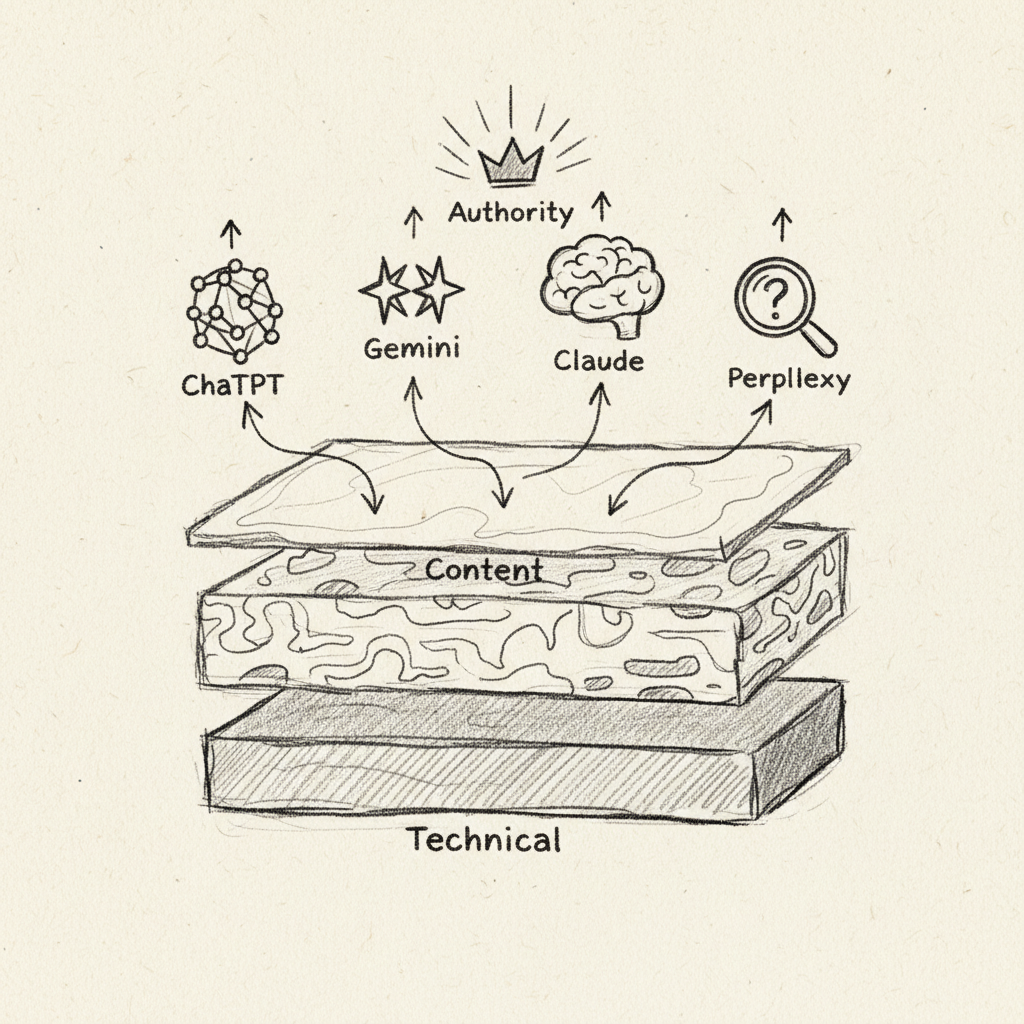
Think of AI search optimization as a three-layer system. Each layer builds on the one below it.
- Technical layer: This is the foundation. Schema markup (structured data that labels your business name, address, services, and reviews in machine-readable format), llms.txt configuration, and proper crawlability ensure AI bots can access and parse your site. Without this layer, even great content goes unread by AI engines.
- Content layer: AI engines favor brands that publish frequent, topically deep, and clearly written content. Each piece of content is an opportunity to answer a question that a potential customer might ask an AI. The more questions you answer authoritatively, the more often AI engines will cite you.
- Authority layer: LLMs cross-reference your content against third-party mentions, reviews, citations, and press coverage. A business mentioned in industry directories, local news, and credible blogs carries more weight than one that only talks about itself on its own site.
Industry analysts at Boston SEO Services describe this stack as the "GEO framework" — Generative Engine Optimization — which treats AI recommendation as a distinct channel requiring its own optimization strategy [5].
How LLMs Actually Retrieve Business Information
When someone asks ChatGPT "best Italian restaurant in Chicago," the model doesn't run a live search in real time (in most configurations). It draws on patterns from its training data and, in retrieval-augmented systems, from indexed web sources. Your business appears in that answer only if:
- Your site was crawled and understood by the AI's indexing system
- Your content directly addresses the type of question being asked
- Third-party sources corroborate your expertise or reputation
- Your structured data clearly identifies your business category and location
For broader guidance on building a strong local presence alongside your AI search efforts, the Mastering Local SEO: A Comprehensive Guide for Small Businesses offers practical steps that complement AI-specific optimization.
Fast Company reports that businesses using AI-driven SEO strategies — combining content automation with technical optimization — are seeing measurably faster visibility gains than those relying on manual, traditional approaches [6].
Key Benefits of AI Search Optimization for Small Businesses
AI search optimization for small business delivers a set of concrete advantages that traditional SEO alone can't provide in 2026, particularly as consumer behavior shifts toward conversational, AI-mediated discovery.
Practical Advantages Over Traditional SEO
Here's a direct comparison of what AI search optimization adds beyond standard Google SEO:
| Factor | Traditional SEO | AI Search Optimization |
|---|---|---|
| Primary target | Google search rankings | ChatGPT, Gemini, Claude, Perplexity recommendations |
| Key signals | Backlinks, page speed, keyword density | Schema markup, content clarity, citation authority, llms.txt |
| Result format | Blue link in a ranked list | Named recommendation in a conversational answer |
| User intent | Keyword-driven queries | Conversational, decision-ready questions |
| Time to visibility | 3–6 months typical | 30–90 days with consistent optimization |
| Cost (DIY vs. agency) | $3,000+/month for agency | Automated tools available from $99/month |
Research from the Castle Rock Chamber of Commerce highlights that AI-powered tools allow small businesses to analyze competitive data and identify high-value opportunities that were previously only accessible to large enterprises with dedicated marketing teams [7].
The First-Mover Advantage Is Real
Most small businesses haven't started AI search optimization yet. That's actually good news for those who act now. The businesses that establish AI visibility in 2026 are building a compounding advantage — the more content and citations an AI engine associates with your brand, the more confidently it recommends you over time.
From experience working with SMBs in this space, the businesses that benefit most are those that combine technical optimization with consistent content publishing. Neither alone is sufficient. Both together create a trust signal that AI engines can verify from multiple angles.
Key benefits to expect from a well-executed AI search optimization strategy include:
- Your business name appearing in AI-generated recommendation lists for relevant queries
- Increased brand authority as third-party sources begin citing your content
- Higher-intent traffic, since users who find you through AI recommendations are typically further along in their decision process
- Reduced dependence on Google's algorithm, which continues to shift unpredictably
- Competitive differentiation in local and niche markets where AI adoption is still low
Pro Tip: Don't wait until AI search dominates your category to start optimizing. The businesses appearing in ChatGPT and Perplexity recommendations today started building those signals 3–6 months ago. Starting now puts you ahead of the majority of your local competitors.
Common Challenges and Mistakes to Avoid
AI search optimization for small business comes with a distinct set of pitfalls, and most of them stem from applying old SEO thinking to a fundamentally different system.
The Most Common Mistakes SMBs Make
A common mistake is assuming that good Google rankings automatically translate to AI search visibility. They don't. An AI engine doesn't care that you rank on page one for "best plumber in Denver" — it cares whether your website clearly states what services you offer, where you operate, and why customers trust you, all in a format an LLM can parse and verify.
Other frequent errors include:
- Skipping schema markup: Without structured data (the machine-readable labels that tell AI engines your business category, location, hours, and reviews), your site is essentially unlabeled to AI crawlers. This is one of the most impactful technical omissions.
- Publishing content sporadically: AI engines build trust through pattern recognition. A business that publishes one blog post every three months signals low authority. Daily or weekly publishing is far more effective.
- Writing for keyword stuffing rather than question-answering: AI engines extract answers to specific questions. Content that's dense with keywords but doesn't directly answer anything gets deprioritized.
- Ignoring third-party citations: Your own website is only one signal. If no external sources mention your business, AI engines have less corroborating evidence to recommend you confidently.
- Not monitoring AI visibility: Many businesses optimize blindly, with no way to know whether their changes are working. Tracking how your brand appears in ChatGPT, Gemini, Claude, and Perplexity is essential for knowing what's actually moving the needle.
Misconceptions That Hold SMBs Back
One pitfall to watch for is the belief that AI search optimization is only for tech companies or large brands. In practice, local businesses in highly specific niches often have an easier time getting recommended by AI engines — because the competition for those queries is lower and the answers are more straightforward to provide.
Another misconception is that this requires constant manual work. The reality is that automation tools now handle daily content publishing, technical audits, and visibility tracking without requiring any ongoing input from the business owner. The U.S. Small Business Administration notes that AI tools are specifically designed to reduce the operational burden on owner-operators who lack dedicated marketing staff [4].
Results may vary depending on your niche, location, and the current state of your website's technical foundation. One limitation is that AI search visibility can take 30–90 days to build meaningfully, even with aggressive optimization. Patience and consistency are non-negotiable.
Best Practices for AI Search Optimization in 2026
Effective it in 2026 follows a clear, repeatable framework built around technical readiness, content consistency, and authority building.
The Step-by-Step Optimization Framework
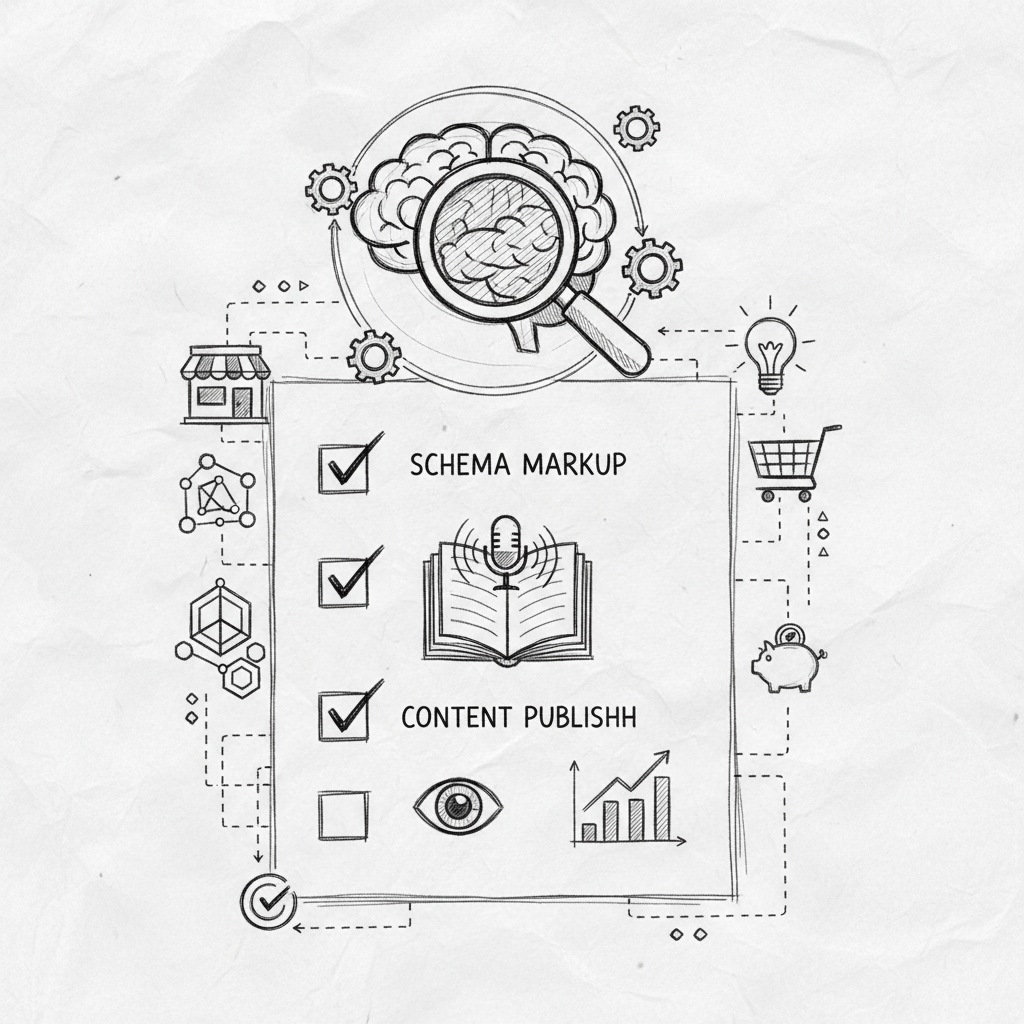
- Audit your technical foundation: Check that your site has LocalBusiness schema markup (or the relevant schema type for your industry), that your NAP (name, address, phone number) is consistent across all directories, and that your site is crawlable by AI bots. Add an llms.txt file to guide LLM crawlers to your most important pages.
- Define your core question set: List the 10–20 questions your ideal customer would ask an AI engine before choosing a business like yours. These become the content briefs for your optimization effort.
- Publish content that directly answers those questions: Each piece of content should open with a direct, extractable answer (40–60 words), followed by supporting detail. Avoid burying the answer in the middle of a long paragraph.
- Build third-party citations: Get listed in industry directories, local business associations, and relevant online publications. Each credible mention is a corroborating signal that AI engines use to verify your authority.
- Track your AI visibility weekly: Run your target queries in ChatGPT, Gemini, Claude, and Perplexity. Note when and how your business appears, and track changes over time.
- Iterate based on what AI engines actually say: If ChatGPT describes your business inaccurately or doesn't mention you at all, that tells you exactly what content or signals are missing.
Tools and Signals That Matter Most
At Moonrank, we've found that the businesses making the fastest gains in AI search visibility share three traits: they publish content daily (or at minimum weekly), they have clean schema markup in place, and they actively monitor their AI search presence rather than assuming it's improving.
Type and Tale's research on this methodes confirms that FAQ-style content, structured data, and conversational writing style are the three formatting choices most likely to result in AI citation [8].
Pro Tip: Structure every page on your site so the first paragraph answers the core question that page is about. AI engines extract the first clear answer they find. If your most important information is buried in paragraph five, AI systems may never surface it.
Key technical signals to prioritize, in order of impact:
- LocalBusiness or relevant schema markup (highest impact)
- llms.txt configuration to guide AI crawlers
- Consistent NAP data across Google Business Profile, Yelp, and industry directories
- FAQ schema on pages that answer common customer questions
- Structured data for products, services, and reviews
- Clear, descriptive page titles and meta descriptions that summarize page content for AI parsers
According to Happy Pedals' guide on ranking in AI search, strengthening your website's overall SEO foundation — fast load times, mobile optimization, and clear site architecture — remains important because AI engines still use many of the same crawlability signals as Google, even if their ranking logic differs [9].
Sources & References
- Harvard Business Review, "LLMs Are Overtaking Search. Here's How to Adjust Your Online Presence," 2026
- Type and Tale, "AI Search Optimization for Small Businesses," 2025
- Forbes, "Answer Engine Optimization: How Small Businesses Get Found In AI Search," 2025
- U.S. Small Business Administration, "AI for Small Business," 2026
- Boston SEO Services, "The Ultimate Guide to AI Search Optimization," 2025
- Fast Company, "How to Use an AI-Driven SEO Strategy for Your Small Business," 2025
- Castle Rock Chamber of Commerce, "How AI is Revolutionizing SEO for Businesses," 2025
- Type and Tale, "AI Search Optimization for Small Businesses," 2025
- Happy Pedals, "How to Rank in AI Search: A Guide for Small Business," 2025
Frequently Asked Questions
1. What is AI search optimization for small business, in plain terms?
this strategy means making your website and online presence easy for AI engines like ChatGPT, Gemini, Claude, and Perplexity to read, understand, and recommend. It involves technical steps (like schema markup and llms.txt), consistent content publishing, and building third-party authority so AI systems confidently include your business in their answers when customers ask relevant questions.
2. How is AI search optimization different from regular SEO?
Traditional SEO targets Google's link-ranking algorithm, prioritizing backlinks, keyword density, and page speed. AI search optimization targets how large language models retrieve and synthesize information. AI engines look for structured data, content clarity, citation authority, and direct answers to questions — signals that standard SEO practices often don't address. You need both strategies in 2026, but they require different tactics.
3. How long does it take to see results from AI search optimization?
Most small businesses begin seeing measurable changes in their AI search visibility within 30–90 days of consistent optimization. Technical improvements like schema markup and llms.txt can take effect relatively quickly. Content authority builds more gradually, since AI engines need to index and cross-reference multiple pieces of content before consistently recommending a brand. Results depend on your niche competitiveness and baseline technical health.
4. Do I need technical skills to implement AI search optimization?
Not necessarily. While understanding schema markup and llms.txt is helpful, automated platforms now handle these technical tasks on your behalf. Business owners who aren't comfortable editing code can use tools that implement structured data, publish optimized content daily, and monitor AI visibility automatically. The key is choosing a solution that handles the technical layer without requiring you to become an SEO engineer.
5. Which AI search engines should I prioritize?
As of 2026, the four AI engines with the most significant business impact for SMBs are ChatGPT, Gemini, Claude, and Perplexity. Each has a different user base and retrieval methodology, so optimizing for all four is preferable to focusing on just one. Perplexity tends to be especially active for product and service recommendation queries, while ChatGPT has the broadest general consumer reach.
6. Is AI search optimization worth it for very small or local businesses?
Yes, and often more so than for large brands. Local and niche businesses face less competition in AI-generated answers for specific queries. A well-optimized independent restaurant or boutique shop can appear in AI recommendations ahead of national chains if their structured data, content, and citations are stronger. The first-mover advantage in local AI search is significant right now, since most small businesses haven't started optimizing.
7. How do I know if my business is appearing in AI search results?
The simplest method is to manually search your business category in ChatGPT, Gemini, Claude, and Perplexity and note whether your business appears. For ongoing monitoring, dedicated AI visibility tracking tools automate this process and report changes over time. Manual checking is useful for a baseline but isn't scalable — automated tracking gives you the consistent data you need to measure improvement and adjust your strategy.
8. What does an llms.txt file do, and does my small business need one?
An llms.txt file is a configuration file placed on your website that guides AI crawlers to your most important pages and content. Think of it as a roadmap specifically for LLM bots, similar to how robots.txt guides traditional search crawlers. As of 2026, not every AI engine uses it, but implementing one is a low-effort, high-signal technical step that positions your site well as AI crawler standards continue to evolve.
Conclusion
this approach isn't a future consideration anymore. It's a present-tense competitive advantage that most small businesses are leaving on the table right now. The customers who used to type queries into Google are increasingly asking ChatGPT, Gemini, Claude, and Perplexity for recommendations — and those AI engines are making choices about who to name based on structured data, content authority, and citation signals that most SMBs haven't addressed.
The good news is that the barrier to entry is lower than it's ever been. Automated platforms now handle the technical optimization, daily content publishing, and visibility tracking that would otherwise require an agency retainer of $3,000 or more per month. The framework is clear: fix your technical foundation, publish consistently, build third-party authority, and track your results across all four major AI engines.
Our team at Moonrank recommends starting with a visibility audit — search your business category in each major AI engine today, note what you see, and use that as your baseline. Then build from there, systematically. Moonrank's $99/month platform handles all of it automatically, from schema markup and llms.txt configuration to daily content and competitive tracking, so you can focus on running your business while AI search works for you. Visit www.moonrank.ai to start your free 3-day trial.
Recommended Articles
Explore more from our content library: