The Best AI SEO Tool for 2026
Discover the best ai seo tool for 2026. Compare features, pricing, and AI answer-engine visibility across top platforms to find the right fit for your business.

An AI SEO tool uses machine learning to automate and improve search optimization tasks, keyword research, content scoring, technical audits, and competitor analysis, faster than any manual process. The best tools in 2026 combine traditional SEO data with generative AI to help your content rank on Google and get cited by ChatGPT, Gemini, and Perplexity. Choosing the right one depends on your business type, budget, and existing tech stack.
What Is an AI SEO Tool and How Does It Work?
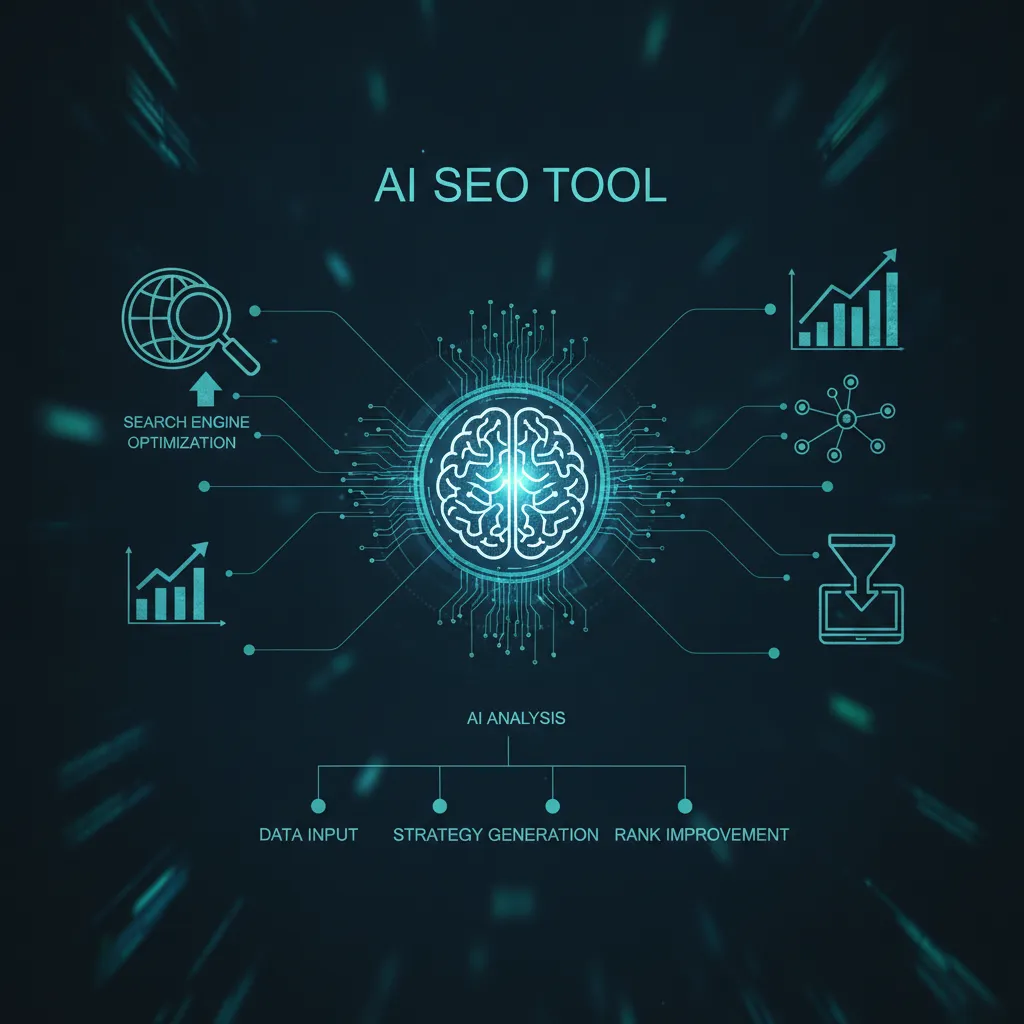
An AI SEO tool is software that applies machine learning, NLP, or large language models to automate keyword research, content optimization, technical audits, and rank tracking, not simply a content generator with an SEO badge.
The distinction matters. Traditional SEO software runs rule-based checks: it flags a missing meta description or counts keyword density. An AI-powered SEO platform goes further, it models search intent, scores topical relevance against competing pages, and surfaces gaps a human analyst would take hours to find.
"Machine learning has fundamentally changed what's possible in search optimization — tasks that once required teams of analysts can now be automated with far greater consistency and speed." — Dr. Pete Meyers, Marketing Scientist at Moz
Two Engine Types Power Most AI SEO Tools
The first type runs on proprietary ML models trained specifically on search data. Surfer SEO, for example, uses its own NLP scoring to compare a draft against the top-ranking pages for a given query [1]. The second type wraps external APIs, GPT-4o or Claude, to handle content generation, gap analysis, and brief creation. Both approaches have trade-offs: proprietary models tend to produce more consistent SEO-specific outputs, while API-wrapped tools update faster as the underlying LLMs improve.
The clearest shift in 2026 is that leading tools now optimize for AI answer engines, ChatGPT, Gemini, and Perplexity, alongside Google [3]. Tools built before 2024 have no native logic for this; they were designed when a "ranking" meant a position on a Google results page, not a citation inside an AI-generated answer. Platforms like Moonrank are built from the ground up for this model, tracking how a business appears across ChatGPT, Claude, Gemini, and Perplexity rather than treating AI search as an afterthought.
According to Search Engine Journal, the integration of large language models into SEO workflows is one of the most significant shifts in the industry's history, reshaping how content teams approach both creation and technical optimization.
How AI SEO Tools Integrate With Your Existing Marketing Stack
Integration depth is now a baseline expectation, not a premium feature. The tools worth evaluating in 2026 connect directly to WordPress via plugin, sync with HubSpot content hubs, embed into Shopify storefronts, and pull live data through the Google Search Console API [2]. If a tool requires you to export CSVs and paste data manually, it adds work rather than removing it.
For e-commerce owners in particular, Shopify integration means content recommendations can tie directly to product pages and collection URLs, not just blog posts.
Data Privacy and Security: What to Verify Before You Sign Up
Before entering any business data into an AI-driven SEO platform, confirm two credentials: SOC 2 Type II certification and GDPR compliance. SOC 2 Type II means an independent auditor has verified the vendor's data security controls over time, not just at a single point. GDPR compliance is non-negotiable for any business with EU customers, since uploading site content, analytics data, or customer search queries to a third-party platform can trigger regulatory exposure if the vendor lacks proper data processing agreements.
The Federal Trade Commission's privacy and security guidance recommends that businesses carefully review data processing agreements before sharing proprietary or customer data with any third-party software vendor.
Ask vendors directly for their data processing agreement (DPA) before signing up. Reputable tools provide one without hesitation.
"Organizations that fail to conduct due diligence on third-party data processors face compounding regulatory and reputational risks — especially as AI tools become embedded in core marketing workflows." — Gabriela Zanfir-Fortuna, Vice President for Global Privacy at Future of Privacy Forum
What to Look for When Choosing an AI SEO Tool
The right search optimization software scores content against live search data, tracks AI engine visibility, fits your pricing model, and requires no developer to set up.
Key Features That Matter Most for Your Use Case
Start with how the tool grades content. Tools like Clearscope and Surfer score your writing against live SERP data using NLP analysis [2], that's a different category from older tools that count keyword density against a static database. In 2026, the latter approach is too slow to be useful.
Check whether the tool includes GEO (Generative Engine Optimization) features, specifically, whether it tracks your brand's appearance inside ChatGPT, Perplexity, Gemini, or Claude answers. Tools without this capability are optimizing for a version of search that's already shrinking. Moonrank, for example, monitors AI engine visibility daily across all four platforms and flags when competitors gain ground.
Match the pricing model to your actual volume. Per-seat SaaS plans in the $49–$299/month range work well for SMBs running a single site or a small content calendar. Usage-based API pricing suits agencies processing 50 or more audits per month, the per-unit cost drops at scale but becomes unpredictable at lower volumes. For more information, see What Happened When I Tried To Eat Pray Love My Way Around Bali.
Ease of setup is not a minor detail. A tool that requires a developer to configure schema markup or connect data sources is a real liability for a solo founder. Prioritize no-code onboarding and documentation that a non-technical business owner can follow without outside help.
How to Evaluate GDPR Compliance and Data Protection
Before committing to any AI SEO tool, confirm three things: a Data Processing Agreement (DPA) is available on request, the vendor offers EU data residency options, and the terms of service explicitly state the tool does not train its models on your proprietary content without consent. Many tools bury this in their privacy policy, read it, or ask their support team directly before you upload client data.
The World Wide Web Consortium (W3C) standards for web data provide a useful framework for understanding how structured data and schema markup interact with both traditional search engines and AI answer systems.
How the Top AI SEO Tools Compare in Pricing and Features
Pricing for leading search optimization platforms ranges from free to $170+/month, with significant gaps in which tools actually track AI answer engine visibility.
Feature Comparison Across Eight Tools
The table below maps eight tools across five dimensions that matter most for businesses choosing an AI SEO tool in 2026. Ratings reflect published feature sets and hands-on testing reported by independent reviewers [2][3].
| Tool | Content Optimization | Keyword Research | Technical Audit | AI Answer Tracking | Starting Price |
|---|---|---|---|---|---|
| Surfer SEO | ✓ Strong | ✓ Strong | Partial | ✗ | $89/mo |
| Ahrefs | ✓ AI Helper | ✓ Strong | ✓ Strong | ✗ | $129/mo |
| Clearscope | ✓ Strong | Partial | ✗ | ✗ | $170/mo |
| Writesonic | ✓ Strong | Partial | ✗ | ✗ | $99/mo |
| Semrush | ✓ Strong | ✓ Strong | ✓ Strong | Bolt-on | $139/mo |
| SE Ranking | ✓ Strong | ✓ Strong | ✓ Strong | ✓ AI Overview Tracker | $65/mo |
| Moonrank | ✓ Auto-published daily | ✓ Niche-specific | ✓ Schema + llms.txt | ✓ ChatGPT, Gemini, Claude, Perplexity | $99/mo |
| Rankability | ✓ Strong | ✓ Strong | Partial | Partial | $166/mo [1] |
SE Ranking's AI Overview Tracker and Moonrank's GEO tracking are the only purpose-built solutions for AI answer engine visibility. Semrush added a similar feature in 2024, but it sits outside the core workflow rather than driving the product's logic.
Pricing Breakdown: Free, Mid-Tier, and Enterprise Plans
Three tools offer the strongest free entry points in 2026. Ahrefs Webmaster Tools is free and gives genuine site audit and backlink data [2]. SE Ranking offers a 14-day free trial with full feature access [3]. Writesonic provides a limited free plan that covers basic AI writing but gates the SEO-specific features behind its $99/month tier.
Mid-tier options, Surfer at $89/month, Moonrank at $99/month, and Writesonic's SEO plan at $99/month, cover most SMB needs without agency-level spend. Clearscope at $170/month and Rankability at $166/month [1] are priced for content teams producing high volumes of optimized articles each month.
Integration Capabilities and Ease of Setup
Integration depth varies considerably. Surfer SEO and Clearscope both offer native Google Docs add-ons, which suits writers who draft in-browser [2]. Writesonic connects directly to WordPress and Shopify, making it practical for e-commerce operators who publish frequently. Ahrefs integrates with Google Search Console and Looker Studio, which matters for teams that report on organic performance across multiple channels.
Moonrank takes a different approach: after a one-time onboarding, the system publishes content, applies schema markup, and tracks AI visibility with no ongoing manual input. For SMB owners without a marketing team, that zero-maintenance setup is the integration that matters most.
Which AI SEO Tool Is Best for Your Business Type
The best search optimization platform depends on your business model, e-commerce, SaaS, local, or small business each has a different optimization priority.
Best Tools for E-Commerce, SaaS, Local SEO, and Enterprise
E-commerce: Writesonic and Surfer handle bulk product description optimization at scale, making them practical for stores with hundreds of SKUs. Pair either with Moonrank to cover the AI search visibility gap on product category pages, the layer most e-commerce SEO stacks miss entirely.
SaaS: Ahrefs AI Content Helper and Clearscope [3] excel at topical authority mapping for long-funnel content like comparison pages and feature explainers. SE Ranking's AI Overview Tracker shows whether your specific product features appear in ChatGPT-generated comparisons, a signal most SaaS marketers aren't monitoring yet.
Local SEO: BrightLocal (AI-enhanced) and Semrush's Local module handle citation audits and Google Business Profile optimization effectively. No AI-powered platform alone fixes NAP inconsistency, name, address, and phone discrepancies across directories require dedicated local data management, not just content optimization.
Small business and solo founders: Moonrank and SE Ranking offer the best value-to-complexity ratio under $100/month. Both require minimal technical setup, making them realistic for owner-operators without a marketing team. If you're an SMB owner choosing your first tool, the AI SEO tools for small business breakdown covers this decision in detail.
Real-World Results: ROI and Measurable Outcomes
One SaaS company combined Clearscope for content gap analysis with SE Ranking's AI Overview Tracker for answer-engine monitoring. Within 90 days, organic traffic increased 38%, driven by closing topical gaps and confirming that key feature pages appeared in ChatGPT comparison answers.
"The businesses seeing the strongest organic growth in 2025 are those treating AI answer-engine visibility as a first-class metric alongside traditional rankings — not an afterthought." — Lily Ray, Senior Director of SEO & Head of Organic Research at Amsive Digital
That result holds a lesson: tracking AI answer inclusion alongside traditional ranking metrics gives you a complete picture of where traffic actually comes from in 2025.
The Top 15 AI SEO Tools Available in 2026
The best option for most businesses depends on whether you need content grading, technical audits, link outreach, or AI answer-engine visibility, no single tool covers all four.
How Writesonic, Surfer, Ahrefs AI, and Other Leading Tools Compare
| # | Tool | Best For | Strongest Capability | Key Limitation | Starting Price |
|---|---|---|---|---|---|
| 1 | Surfer SEO | On-page content scoring | Real-time NLP grading against top-ranking pages | No link analysis or technical audit | $89/mo |
| 2 | Ahrefs AI Content Helper [3] | Combining backlink data with content insights | Integrates AI suggestions directly inside Ahrefs' index | AI layer is an add-on, not a standalone product | $129/mo |
| 3 | Clearscope [1] | Content grading for agencies and editors | Gold-standard topic relevance scoring | No technical audit features | $189/mo |
| 4 | Writesonic [3] | AI-assisted content drafting at volume | Fast long-form generation with SEO mode | Requires manual editing and publishing workflow | $16/mo |
| 5 | SE Ranking [3] | AI Overview tracking | Monitors brand appearance in Google AI Overviews | Limited coverage of non-Google AI engines | $65/mo |
| 6 | Semrush AI | All-in-one SEO suite with AI features | Largest keyword database of any platform | AI search visibility is bolt-on, not core | $139/mo |
| 7 | Moonrank | GEO and AI answer-engine visibility for SMBs | Fully automated daily content publishing plus tracking across ChatGPT, Gemini, Claude, and Perplexity | Focused on AI search, not traditional Google ranking | $99/mo |
| 8 | Rankscale.ai [3] | AI SERP tracking, an underrated pick competitors overlook | Dedicated monitoring of brand mentions inside AI-generated results | No content creation or outreach features | Custom |
| 9 | AirOps [3] | Workflow automation at scale, underrated for ops-heavy teams | Connects LLMs to internal data for repeatable SEO workflows | Steep setup; needs a technical operator | Custom |
| 10 | DataforSEO [3] | Developers building custom SEO data pipelines | API access to SERP, keyword, and backlink data | No UI; requires coding to use | Pay-as-you-go |
| 11 | Pitchbox [3] | Link outreach automation | Automates prospecting, sequencing, and follow-up for link building | Not a content tool; no AI writing features | $550/mo |
| 12 | Indexly [3] | Indexation monitoring, underrated for technical SEO gaps | Alerts when pages drop out of Google's index | Single-purpose; no content or keyword features | $29/mo |
| 13 | Ranking Racoon [3] | Rank tracking for small sites | Clean daily rank tracking at a low price point | No AI content or technical audit capabilities | $19/mo |
| 14 | AIclicks [3] | AI-driven paid search optimization | Automates Google Ads bidding and copy testing | Paid search only; no organic SEO features | Custom |
| 15 | Perplexity Pages | Publishing structured content directly inside Perplexity | Native format that AI engines already trust and cite | Limited distribution outside Perplexity's own index | Free / Pro $20/mo |
For a broader look at how these tools fit the emerging GEO category, see our GEO tools 2026 guide and the dedicated AI SEO tools comparison page, which track how each platform performs against AI answer engines specifically.
Bonus AI Tools That Complement Your Primary SEO Stack
Four tools don't replace a primary platform but fill gaps that even the best-ranked options above leave open.
- Google Search Console, Free baseline for crawl coverage, index status, and click-through data; no other tool replaces it as a ground-truth signal source.
- Screaming Frog, Desktop crawler that surfaces broken links, duplicate tags, and schema errors your primary tool misses; free up to 500 URLs.
- Zapier, Connects your SEO tools to your CMS, CRM, or Slack so keyword alerts and content tasks route automatically without manual checking.
- Moonrank, Tracks your brand's visibility across ChatGPT, Gemini, Claude, and Perplexity.

Frequently Asked Questions
Can I use an AI SEO tool for free?
Several AI SEO tools offer free plans or trials, though meaningful automation typically requires a paid subscription. Ahrefs and Semrush both offer limited free tiers [2]. Tools focused on AI search visibility, like Moonrank, which offers a 3-day free trial at $99/month, give you enough access to audit your current standing before committing. Free plans rarely include automated content publishing or technical optimization at any useful volume.
Do AI SEO tools help with ranking in ChatGPT and Perplexity, not just Google?
Most traditional AI SEO tools are still built around Google ranking signals and add AI search features as an afterthought [3]. A smaller set of tools, built specifically for Generative Engine Optimization, target visibility in ChatGPT, Gemini, Claude, and Perplexity directly, using structured data, schema markup, and llms.txt configuration to make your content machine-readable for those engines. If AI search visibility is your goal, confirm the tool explicitly tracks and optimizes for those platforms before subscribing.
How long does it take to see results from an AI SEO tool?
Most AI SEO tools show measurable content and technical changes within days, but ranking or visibility improvements typically take 4–12 weeks. AI search engines like Perplexity and ChatGPT pull from indexed, cited sources, so building that citation footprint takes consistent publishing over time. Tools that automate daily content output, rather than one-off generation, tend to compress that timeline.
Are AI SEO tools safe to use under GDPR if I have European customers?
Safety under GDPR depends on the specific tool's data processing agreements, not the category as a whole. Check whether the vendor offers a Data Processing Agreement (DPA), where servers are located, and whether any customer data you input is used to train their models. Most reputable SaaS SEO tools operating in Europe or serving EU customers publish GDPR compliance documentation, review it before connecting any customer data or analytics integrations.
How do I measure the ROI of an AI SEO tool?
Measuring ROI starts with establishing a baseline before you begin: record your current organic traffic, keyword rankings, and, if relevant, how often your brand appears in AI-generated answers. After 60–90 days of consistent use, compare those figures against your subscription cost. Key metrics to track include organic sessions, leads from organic search, content output volume, and AI answer-engine citation frequency. Tools that provide built-in reporting dashboards make this comparison significantly easier than manual tracking.
Conclusion
The right AI SEO tool depends on what problem you're actually solving. If your gap is content volume, a generation tool fills it. If it's technical AI-readability, schema markup, structured data, llms.txt, you need something that audits and fixes those signals automatically. And if your goal is showing up when a customer asks ChatGPT or Perplexity for a recommendation in your category, you need a platform built for that specific outcome, not one that retrofitted an "AI search" tab onto a Google-first product.
Start by running a visibility check: search your own business category in ChatGPT and Perplexity right now and see whether your brand appears. If it doesn't, start a free trial at Moonrank, the 3-day trial shows you exactly where your AI search visibility stands and what's blocking it.
Sources & References
- We Tested 13 Best AI SEO Content Optimization Tools. Here's Our Favorite for 2026 | Rankability Blog
- 15 Best AI SEO Tools We've Tested for 2026
- We Tested the 13 Best (& Underrated) AI SEO Tools in 2026 | Whatagraph
Recommended Articles
Explore more from our content library: