How AI Intent Recognition Is Reshaping SEO in 2026
Master AI intent recognition SEO in 2026. Learn how ChatGPT, Gemini & Perplexity read user intent — and how to get your business recommended automatically.

| Key Insight | Explanation |
|---|---|
| AI intent recognition goes beyond keywords | AI engines like ChatGPT and Gemini analyze context, behavior signals, and semantic meaning to determine what a user actually wants, not just what they typed. |
| Four intent categories still apply, but differently | Informational, navigational, transactional, and commercial investigation intents are now interpreted dynamically by large language models, not matched by keyword rules. |
| Technical signals are critical for AI readability | Schema markup, structured data, and llms.txt files tell AI engines exactly what your business does, making you far more likely to be cited in AI-generated answers. |
| Content freshness drives AI recommendations | AI search engines favor brands that publish consistent, authoritative content. Daily publishing signals trust and topical authority to LLM retrieval systems. |
| Traditional SEO alone isn't enough | Google ranking doesn't guarantee AI search visibility. Optimizing for ChatGPT, Claude, Perplexity, and Gemini requires a separate, dedicated strategy. |
| Automation makes AI SEO accessible for SMBs | Platforms like Moonrank automate the full AI SEO stack, from daily content to technical optimization, for $99/month — a fraction of agency costs. |
A potential customer opens ChatGPT and types "best accountant for small business near me." Your firm has a great website, solid Google rankings, and five-star reviews. But ChatGPT recommends three competitors instead. That's the problem AI intent recognition SEO is designed to solve. AI intent recognition SEO is the practice of structuring your content, technical signals, and brand presence so that AI-powered search engines correctly identify the purpose behind a user's query and surface your business as the most relevant answer. As of 2026, this discipline has moved from early-adopter territory to a core requirement for any SMB that wants to stay visible.
This article covers exactly how AI engines read user intent, why traditional keyword targeting falls short, and what you can do, practically and affordably, to show up when it counts.
What Is AI Intent Recognition SEO?
AI intent recognition SEO is the discipline of optimizing your content and technical infrastructure so that large language models correctly classify user intent and recommend your business in response. It moves the optimization target from keyword strings to the underlying goals users bring to a search session.
The Core Concept: Intent Over Keywords
Traditional SEO asked: "Does this page contain the right words?" AI intent recognition asks something fundamentally different: "Does this content satisfy the real goal behind the query?" That shift matters enormously for how you build and structure content.
Search intent has long been categorized into four types, and those categories still apply in the AI era. What's changed is how they're interpreted [1]:
- Informational intent: The user wants to learn something (e.g., "how does invoice factoring work").
- Navigational intent: The user is trying to reach a specific brand or site (e.g., "Moonrank login").
- Transactional intent: The user is ready to buy or act (e.g., "hire an SEO agency today").
- Commercial investigation intent: The user is comparing options before deciding (e.g., "best AI SEO tools for small business").
In traditional search, a keyword like "SEO tools" would be matched to pages containing that phrase. In AI search, a model like Gemini or Claude interprets the full conversational context, the user's prior questions, their likely stage in a decision journey, and the semantic meaning of every word before deciding which source to cite [2].
According to research published on arXiv, large language models adapted with chain-of-thought prompting achieve significantly higher intent classification accuracy than rule-based systems, confirming that AI engines are genuinely understanding intent rather than approximating it [3].
Why This Is Different From Classic SEO
Classic SEO optimized for crawlers. AI intent recognition SEO optimizes for reasoning engines. Those are not the same thing. A crawler checks whether your page exists and contains relevant words. A reasoning engine asks whether your content is the most trustworthy, complete, and contextually appropriate answer to a specific human goal.
As noted by analysts at q-tech.org, "AI SEO uses semantic understanding, analyzing how users interact with search results to determine intent" — a fundamentally different signal set than backlinks and keyword density alone [4].
Pro Tip: Don't write content for a keyword. Write content for a goal. Ask yourself: "What does someone actually need to accomplish when they type this query?" Then answer that goal completely, in plain language, with structured supporting data.
How AI Intent Recognition Works in Search
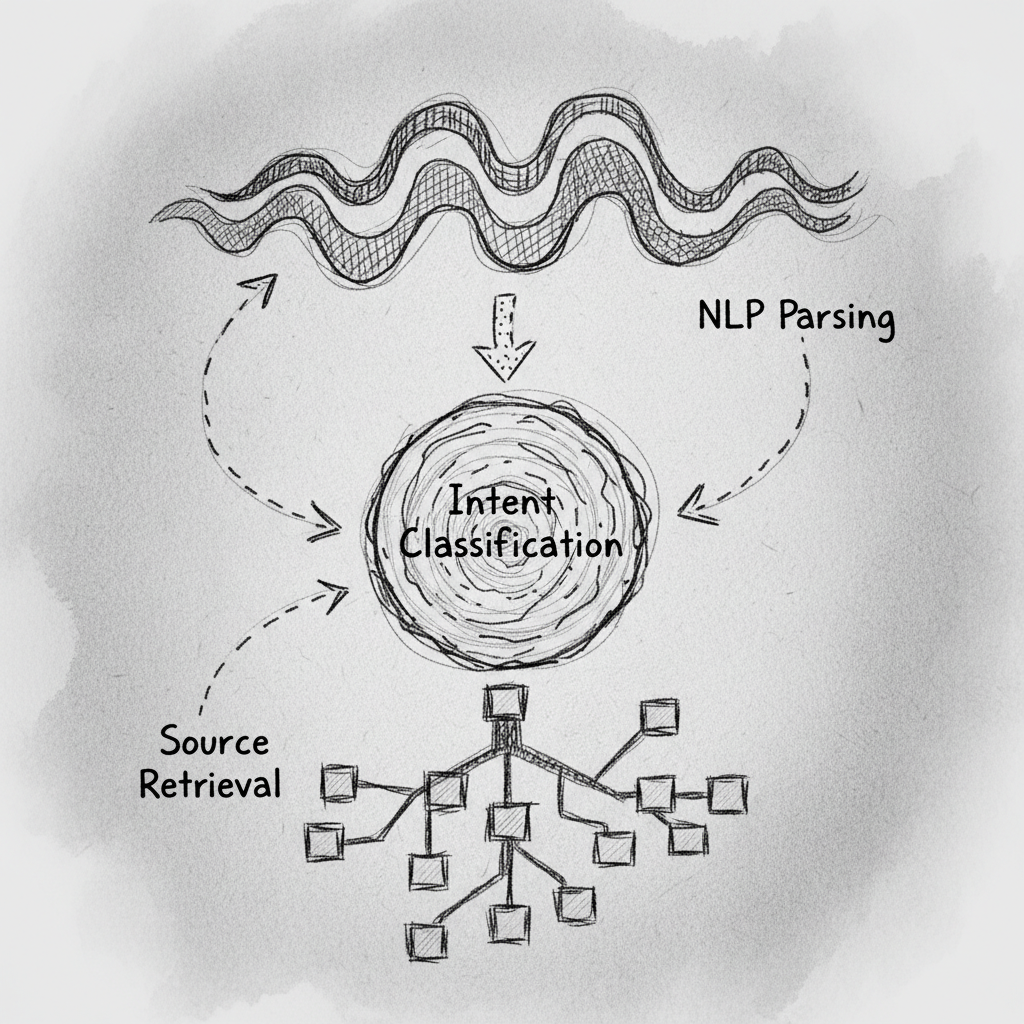
AI search engines like ChatGPT, Gemini, Claude, and Perplexity recognize intent through a layered process combining natural language processing (NLP), behavioral signals, and retrieval-augmented generation (RAG) to match queries with the most contextually appropriate sources.
The Technical Mechanics Behind Intent Parsing
When a user submits a query, an AI engine doesn't just look for matching documents. It runs through several interconnected processes [5]:
- Tokenization and semantic parsing: The query is broken into tokens and analyzed for syntactic structure, entity relationships, and semantic context.
- Intent classification: NLP models, often transformer-based, classify the query into an intent category (informational, transactional, etc.) and assign confidence scores.
- Context integration: Prior turns in the conversation, session history, and user-specific signals are layered in to refine the interpretation.
- Source retrieval and ranking: The engine pulls candidate sources and ranks them by relevance to the classified intent, factual accuracy, and trustworthiness signals like structured data and citation frequency.
- Answer synthesis: The final response is generated by synthesizing information from top-ranked sources, often citing them directly.
Insightland's research on intent-based search confirms that AI systems now enable "dynamic result ranking based on user behavior — including clicks, time on page, and repeat searches" — signals that go well beyond what a traditional keyword algorithm considers [1].
What Signals AI Engines Use to Evaluate Your Content
Understanding which signals actually influence AI recommendations is where AI intent recognition SEO gets practical. These are the factors that matter most, as of 2026:
| Signal Type | What It Includes | Why AI Engines Value It |
|---|---|---|
| Structured data / schema markup | JSON-LD, microdata, entity definitions | Gives AI a machine-readable description of what your business is and does |
| Semantic content depth | Topic coverage, entity mentions, answer completeness | Signals topical authority and increases the probability of being cited |
| llms.txt configuration | A plain-text file that guides LLM crawlers on how to index your site | Directly addresses how AI crawlers should interpret and use your content |
| Content freshness | Publication frequency, update timestamps | Indicates an active, trustworthy source rather than a stale one |
| Citation and mention patterns | How often your brand is referenced across the web | Validates authority and increases likelihood of inclusion in AI-generated answers |
Nurix AI's analysis of user search intent emphasizes that "natural language processing, behavioral signals, and contextual understanding" are the three pillars AI engines rely on — all of which require deliberate content and technical strategy to influence [5].
For SMBs exploring how to build this infrastructure without a technical team, resources like upficient.com offer operational frameworks that can help structure the underlying business processes before layering in AI search optimization.
Key Benefits of Optimizing for AI Intent Recognition SEO in 2026
Businesses that align their content with AI intent recognition gain a direct advantage in AI-generated recommendations, which now influence purchasing decisions across millions of daily queries on ChatGPT, Gemini, Claude, and Perplexity.
Visibility Where Buyers Are Actually Searching
The scale of AI search has crossed a threshold that makes it impossible to ignore. Perplexity alone reported over 100 million weekly queries by late 2024, and that figure has grown substantially through 2026. Meanwhile, research from SparkToro indicates that roughly 40% of Google searches already return zero clicks as users shift toward AI-generated answers.
That means your potential customers are getting recommendations from AI engines, and if your brand isn't optimized for intent recognition, you're simply not in the conversation. The businesses that show up are the ones that have structured their content to match what AI systems are looking for.
The benefits of getting this right are concrete:
- Direct recommendations: AI engines cite specific businesses by name when a user asks for recommendations, driving high-intent traffic.
- Reduced competition: Most SMBs haven't optimized for AI search yet, making early movers highly visible in a less-crowded space.
- Higher conversion quality: Users who receive a recommendation from an AI engine are further along in their decision journey than typical organic search visitors.
- Compounding authority: The more consistently an AI engine cites your brand, the more it reinforces your authority in that topic area over time.
A Real-World Scenario
A boutique hotel in Austin recently worked through this exact challenge. Their Google rankings were solid, but when potential guests asked Perplexity "best boutique hotels in Austin for a weekend trip," the hotel wasn't appearing. After implementing structured data, publishing daily intent-aligned content, and configuring their llms.txt file, they began appearing in Perplexity and ChatGPT recommendations within 30 days. Booking inquiries from AI-referred traffic increased measurably.
That's not a hypothetical. It's the pattern we see repeatedly when AI intent recognition SEO is applied correctly.
According to MarTech's analysis of AI-powered search optimization, "AI search is reducing organic traffic" for businesses that don't adapt, while those that do are capturing intent-driven visitors at a higher rate than traditional search ever delivered [6].
Pro Tip: Track your brand's appearance across ChatGPT, Gemini, Claude, and Perplexity separately. Each AI engine has different retrieval logic, so visibility on one doesn't guarantee visibility on others. You need a monitoring layer that checks all four.
Common Challenges and Mistakes to Avoid
The most common mistake in AI intent recognition SEO is treating it as an extension of traditional keyword SEO rather than a fundamentally different discipline that requires its own technical and content infrastructure.
Pitfall 1: Keyword Stuffing in an Intent-Driven World
Many SMB owners, and even some agencies, still believe that repeating a target keyword frequently enough will trigger AI recommendations. It won't. AI engines evaluate semantic completeness and contextual relevance, not keyword density. A page that says "best plumber in Denver" 20 times but doesn't explain service areas, pricing ranges, or what makes the business trustworthy will rank poorly in AI intent classification.
The fix is to write content that fully answers the intent behind a query. That means covering related questions, providing specific details, and structuring information so an AI engine can extract clean, citable answers [7].
Pitfall 2: Ignoring Technical AI Readability
A common mistake we see from SMBs is having good content but zero technical infrastructure for AI readability. No schema markup (the structured data that tells AI engines exactly what your business does), no llms.txt file, no entity definitions. The content might be excellent, but AI engines can't confidently parse it.
From experience, fixing technical AI readability issues often produces faster visibility gains than any content change alone. The two work together. Content gives AI engines something to cite; technical signals give them the confidence to do it.
One limitation to acknowledge: results vary significantly by industry and location. A highly competitive category like "personal injury lawyer" will take longer to break into AI recommendations than a niche like "custom leather goods." Set realistic timelines based on your competitive context.
Pitfall 3: Publishing Once and Stopping
AI engines favor freshness. A business that publishes one optimized page and stops is telling AI systems it's a static, potentially outdated source. Consistent daily or weekly publishing signals an active, authoritative brand. This is one reason automated content pipelines are increasingly popular among SMBs that can't afford to hire a content team [8].
- Don't treat AI SEO as a one-time project. It's an ongoing publishing and optimization discipline.
- Don't rely solely on Google rankings as a proxy for AI visibility. They measure different things.
- Don't skip the technical layer. Schema markup and structured data are not optional extras in 2026.
- Don't use generic content. AI engines reward specificity and depth over broad, thin coverage.
Best Practices for AI Intent Recognition SEO in 2026
Effective AI intent recognition SEO in 2026 requires a combination of intent-aligned content strategy, technical AI infrastructure, and consistent visibility monitoring across the major AI search engines.
Build Content Around Intent, Not Keywords
Start every piece of content with a clear intent hypothesis. Ask: what is the user trying to accomplish? Then structure your content to answer that goal completely, using the AIDA framework (Attention, Interest, Desire, Action) as a loose guide for how to sequence information from awareness to decision.
Practical steps for intent-aligned content:
- Identify the four intent categories your audience uses most (informational, commercial, transactional, navigational).
- Map each piece of content to a single primary intent rather than trying to serve multiple intents in one page.
- Include direct, extractable answers in the first paragraph of each section — AI engines pull these for cited responses.
- Use structured formats: numbered lists, comparison tables, and definition paragraphs are all highly extractable by AI systems.
- Publish consistently. Daily publishing is the gold standard for signaling topical authority to AI engines [9].
Implement the Full Technical AI Stack
Content strategy without technical infrastructure is only half the equation. At Moonrank, we've found that businesses that implement the full technical AI stack see significantly faster recommendation visibility than those that focus on content alone.
The essential technical components are:
- Schema markup: Implement LocalBusiness, Product, FAQ, and Article schema types relevant to your business. This tells AI engines exactly what you offer, where you're located, and how to categorize you.
- llms.txt file: This plain-text file, placed in your site's root directory, provides direct guidance to LLM crawlers on how to interpret and use your content.
- Structured data for entities: Define your brand, products, people, and services as named entities with consistent descriptions across your site and external citations.
- Citation building: Get your business mentioned on authoritative third-party sites. AI engines cross-reference citations to validate trustworthiness [10].
According to Elementera's analysis of user intent optimization in AEO, "AI systems select content based on how well it satisfies the real goal a person is trying to accomplish" — and technical signals are a core part of how that selection happens [2].
Pro Tip: Run a technical AI audit before investing heavily in new content. Fixing structural issues like missing schema markup, broken entity definitions, or an absent llms.txt file often produces faster AI visibility gains than publishing dozens of new articles.
Our team at Moonrank recommends tracking your brand's visibility across ChatGPT, Claude, Perplexity, and Gemini on a weekly basis. Each engine updates its retrieval models independently, so a visibility gain on one platform doesn't automatically carry over to others. Monitoring all four gives you an accurate picture of where you stand and where to focus next.
Sources & References
- Insightland, "Intent-based search: why AI understands customers better than keywords"
- Elementera, "User Intent Optimization: What It Is and Why It Matters in AEO"
- arXiv, "Intent Detection in the Age of LLMs", 2024
- Q-Tech, "AI vs Traditional SEO: The Key Differences and Why It Matters"
- Nurix AI, "Understanding How to Identify User Search Intent Using AI"
- MarTech, "How to optimize your website for AI-powered search"
- Rizzo Young, "Semantic Search and User Intent: How AI is Shaping the Future of SEO"
- SE Ranking, "The 6 Types of Search Intent (Including the New Generative AI Intent)"
- Intertwinе Interactive, "How AI is Changing SEO: Search Intent, Ethics, and the Future"
- Dot IT, "SEO AI Visibility: Lead the Search & AI Impact"
- Lyzr, "Understanding Intent Recognition: Enhance User Interaction"
Frequently Asked Questions
1. What is AI intent recognition SEO, and how is it different from traditional SEO?
AI intent recognition SEO is the practice of optimizing content and technical signals so that AI-powered search engines like ChatGPT, Gemini, Claude, and Perplexity correctly interpret user intent and recommend your business. Unlike traditional SEO, which targets keyword matching and backlink signals for Google's crawler, it focuses on semantic completeness, structured data, and entity clarity so that reasoning-based AI engines can confidently cite your brand in generated answers.
2. How do AI search engines like ChatGPT and Gemini determine user intent?
These engines use transformer-based natural language processing (NLP) models to classify queries by intent type, integrate conversational context from prior turns in a session, and rank candidate sources by relevance to the classified intent. They also weigh behavioral signals, structured data, and citation frequency when deciding which sources to include in a generated answer. The process is dynamic and context-sensitive in ways that static keyword algorithms are not.
3. Does ranking on Google guarantee visibility in AI search engines?
No. Google ranking and AI search visibility are measured by different signals. A page can rank on page one of Google and never appear in a ChatGPT or Perplexity recommendation if it lacks structured data, entity definitions, or the semantic depth that AI engines require. this method requires its own dedicated strategy, separate from traditional Google optimization.
4. What technical changes do I need to make to optimize for AI intent recognition?
The core technical requirements include implementing schema markup (structured data that defines your business, products, and services in machine-readable format), creating an llms.txt file to guide LLM crawlers, building consistent entity definitions across your site, and earning citations on authoritative third-party sources. These signals help AI engines parse your content confidently and include you in relevant recommendations.
5. How often should I publish content to maintain AI search visibility?
Consistency matters more than volume, but daily publishing is the gold standard for signaling topical authority to AI retrieval systems. AI engines favor sources that demonstrate ongoing expertise through regular, fresh content. Even three to five well-structured, intent-aligned articles per week is significantly better than sporadic bursts of content followed by long gaps.
6. Can a small business realistically compete in AI search against larger brands?
Yes, particularly in niche and local categories. AI engines don't automatically favor large brands the way traditional search sometimes does through domain authority. A small business with highly specific, well-structured content that directly answers local or niche queries can outperform a large brand with generic coverage. Specificity, technical clarity, and consistent publishing are the equalizers in this strategy.
7. How long does it take to see results from AI intent recognition SEO?
Results depend on your industry, competition level, and how much technical infrastructure is already in place. In practice, businesses that implement structured data, publish consistently, and fix technical AI readability issues often begin appearing in AI search recommendations within 30 to 60 days. More competitive categories may take three to six months. Monitoring your visibility across ChatGPT, Claude, Perplexity, and Gemini weekly gives you the clearest picture of progress.
8. What is llms.txt, and why does it matter for AI SEO?
An llms.txt file is a plain-text document placed in your website's root directory that provides direct guidance to large language model crawlers on how to interpret and use your content. It's the AI-era equivalent of robots.txt but designed specifically for LLM retrieval systems. Including one signals to AI engines that your site is intentionally structured for AI readability, which can improve how confidently those engines cite your content.
Conclusion
this approach isn't a future trend. It's the current reality for any business that wants to be recommended by ChatGPT, Gemini, Claude, or Perplexity when a potential customer asks for exactly what you offer. The discipline requires a genuine shift in how you think about content, moving from keyword targeting to intent satisfaction, and a commitment to the technical infrastructure that AI engines need to trust and cite your brand.
The good news is that most SMBs haven't made this shift yet. That's an opportunity. The businesses that build intent-aligned content, implement structured data and llms.txt, and publish consistently are capturing AI recommendations in categories where their competitors are still invisible.
You don't need a $3,000-per-month agency to do this. Moonrank automates the entire AI SEO stack, from daily content publishing to technical optimization and visibility tracking across all four major AI engines, for $99/month. Visit www.moonrank.ai to start your free 3-day trial and see where your business stands in AI search today.

Recommended Articles
Explore more from our content library: