How Small Businesses Can Rank on ChatGPT in 2026
Learn how to rank on ChatGPT small business style — with structured data, daily content, and AI visibility tactics that get you recommended in 2026. Discover.

| Key Insight | Explanation |
|---|---|
| AI search is a separate channel from Google | ChatGPT, Gemini, Claude, and Perplexity use different ranking signals than Google's crawler — traditional SEO alone won't get you recommended. |
| Structured data is non-negotiable | Schema markup and llms.txt files help AI engines parse and trust your business information accurately, directly influencing recommendation likelihood. |
| Content freshness matters more than volume | AI models are updated regularly. Businesses that publish consistently are more likely to appear in current training and retrieval data. |
| Reviews and citations build AI trust signals | Multi-platform reviews and consistent NAP (name, address, phone) citations across directories signal authority to AI recommendation systems. |
| Automation is the only scalable path for SMBs | Daily content publishing and technical optimization are too time-intensive to do manually — purpose-built tools make AI visibility achievable at $99/month. |
| Visibility tracking closes the feedback loop | Monitoring how ChatGPT, Claude, Gemini, and Perplexity mention your brand lets you measure progress and adjust strategy based on real AI engine behavior. |
A potential customer types "best accounting software for freelancers" into ChatGPT. Your competitor gets recommended. You don't. That's the problem this article solves. Understanding how to rank on ChatGPT small business style is now one of the most urgent marketing questions for SMB owners in 2026. AI search engines including ChatGPT, Gemini, Claude, and Perplexity are handling hundreds of millions of queries every week [1], and the businesses appearing in those answers are capturing customers before they ever reach Google. This guide explains exactly what signals drive ChatGPT recommendations, what technical foundations you need, and how to build a sustainable AI search presence without hiring an agency or writing a single word yourself.
What Is ChatGPT Ranking for Small Businesses?: how to rank on ChatGPT small business
ChatGPT ranking for small businesses means your brand, product, or service gets recommended by AI language models when users ask relevant questions. Unlike Google's blue-link results, AI engines synthesize answers from multiple sources and name specific brands as recommendations. Being "ranked" means being cited in those answers. This is particularly relevant for how to rank on ChatGPT small business.
Why This Is Different From Traditional SEO
Traditional SEO targets Google's crawler, which scores pages based on backlinks, keyword density, and page speed. AI search engines like ChatGPT and Perplexity use a different mechanism entirely. They draw on large language model (LLM) training data, real-time web retrieval, and structured signals to decide which businesses are credible enough to recommend [2].
According to research cited by Lemonade Stand, relevance of content and authority signals are the primary factors influencing ChatGPT visibility — not raw keyword placement alone [2]. That's a meaningful shift for any SMB owner who has spent years chasing Google rankings.
The stakes are real. Industry analysts note that AI-generated answers now intercept buying decisions that used to require a Google search, a click, and a website visit. If your business isn't in the answer, it doesn't exist in that moment.
Who Needs to Care About This Right Now
Any small business that relies on online discovery needs to pay attention. That includes:
- Local service businesses (restaurants, salons, plumbers, accountants)
- Shopify and e-commerce store owners competing on product discovery
- B2B SaaS founders whose prospects research tools in ChatGPT before booking demos
- Solo consultants and freelancers who need to appear in "best [service] provider" queries
SCORE, the nonprofit small business mentoring organization, notes that ChatGPT is already being used by small business owners to boost search engine rankings and visibility [3]. The next step is making sure those same AI engines recommend your business to others.
How ChatGPT Ranking Works in 2026
ChatGPT surfaces business recommendations by combining its base training data with real-time web retrieval, then applying trust and relevance filters to decide which brands to name. Understanding this process is the foundation of any effective AI search strategy.
The Three-Layer Ranking Mechanism
As of 2026, ChatGPT's recommendation logic operates across three layers: When considering how to rank on ChatGPT small business, this point stands out.
- Training data inclusion: Businesses mentioned frequently in authoritative web content during model training have a baseline presence in the model's knowledge. This is why consistent content publishing over time matters.
- Real-time retrieval (RAG): Retrieval-Augmented Generation (RAG) allows ChatGPT to pull current web content when answering queries. Fresh, structured, crawlable pages feed directly into this layer [4].
- Trust signal weighting: The model weights sources by authority. Businesses with consistent citations, structured data, reviews across multiple platforms, and mentions in credible publications score higher in recommendation probability [5].
According to Demand Sage's 2026 analysis, covering long-form conversational queries and building healthy trust signals are the two most tested practices for improving ChatGPT visibility [4].
What Signals ChatGPT Actually Reads
| Signal Type | What It Includes | Impact on AI Ranking |
|---|---|---|
| Structured Data | Schema markup, JSON-LD, llms.txt | High — helps AI parse business identity |
| Content Authority | Depth, accuracy, topical coverage | High — signals expertise to LLMs |
| Citation Consistency | NAP data across directories, reviews | High — verifies business legitimacy |
| Content Freshness | Publication frequency, update dates | Medium-High — feeds RAG retrieval |
| Review Volume | Google, Yelp, Trustpilot, industry sites | Medium — social proof for AI trust |
| Brand Mentions | Press, blogs, forums, social | Medium — reinforces entity recognition |
Pro Tip: Add an llms.txt file to your website's root directory. This file, similar to robots.txt but designed for large language models, tells AI crawlers exactly what your business does, what pages to prioritize, and what you want to be known for. It's one of the highest-leverage technical changes you can make in under an hour.
How to Rank on ChatGPT: Small Business Tactics That Work
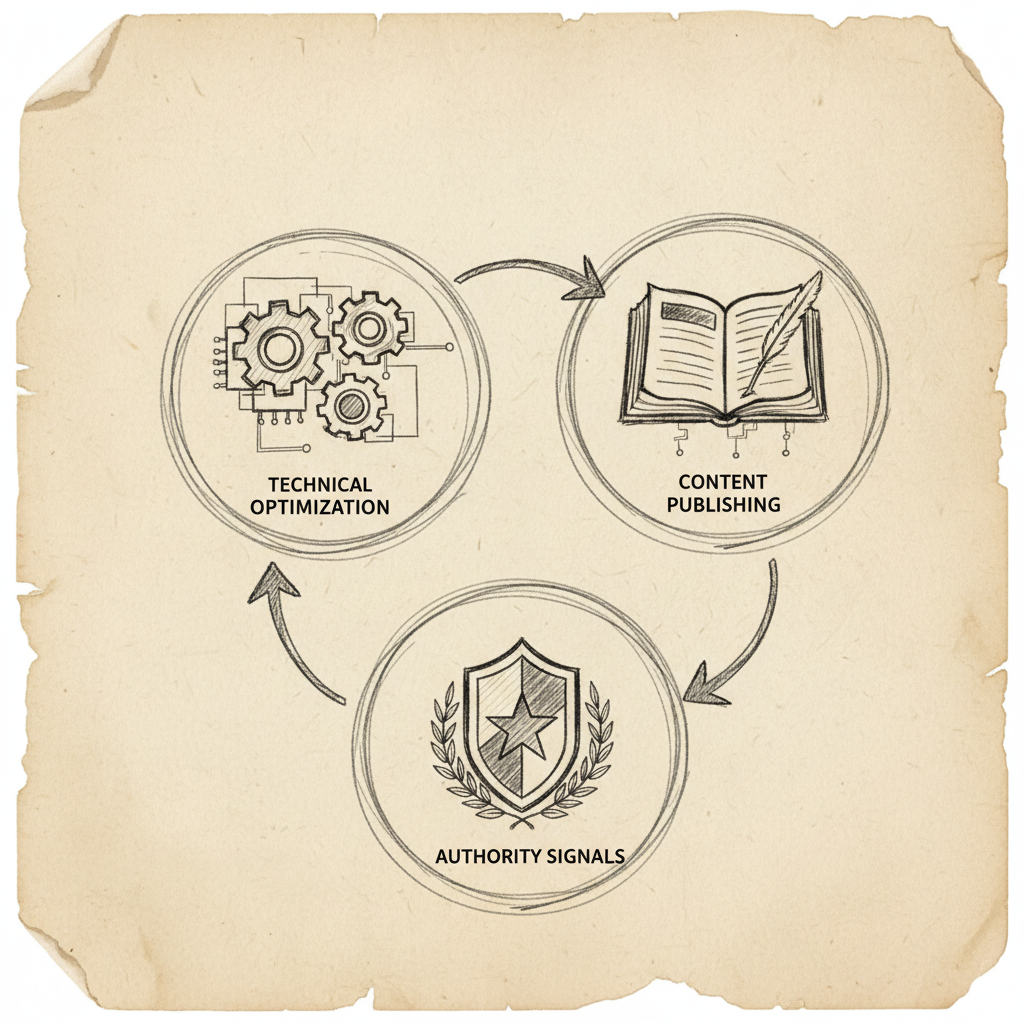
To rank on ChatGPT as a small business, you need to combine technical optimization, consistent content publishing, and multi-platform authority building — all working together as a system, not as one-off tasks.
Step-by-Step: Building Your ChatGPT Visibility Foundation
- Implement schema markup on every key page. Schema markup is structured data that tells AI engines exactly what your business does, who it serves, and where it operates. Use LocalBusiness, Product, FAQ, and Review schema types as relevant to your niche [5].
- Create and configure an llms.txt file. This signals to LLM crawlers which content is authoritative and how to interpret your brand. It's a relatively new technical standard that most small businesses haven't adopted yet, giving early movers a real edge.
- Publish content that answers conversational queries. ChatGPT users ask questions in natural language. Your content needs to mirror that. Write pages that answer "What is the best [your product] for [specific use case]?" rather than just targeting short-tail keywords [6].
- Build citations and reviews across multiple platforms. A widely discussed thread in the local SEO community confirms that reviews on multiple platforms — not just Google — are a critical trust signal for ChatGPT recommendations [6]. Target Google, Yelp, Trustpilot, and any industry-specific review sites.
- Maintain NAP consistency. Your business name, address, and phone number must be identical across every directory listing, social profile, and website. Inconsistencies confuse AI entity resolution systems and reduce recommendation likelihood.
- Publish content daily or as frequently as possible. Freshness feeds retrieval. AI engines that use real-time web access favor recently updated content when generating answers [4].
- Track your AI search visibility. You can't improve what you don't measure. Monitor how ChatGPT, Gemini, Claude, and Perplexity mention your brand and adjust your strategy based on real data.
From experience working with SMBs across multiple niches, the businesses that see results fastest are those that address technical gaps (schema, llms.txt) first, then layer in content consistently. Trying to publish content without fixing the technical foundation is like building on sand.
Forbes contributor Jodie Cook notes that creating consistently valuable content and building authoritative brand mentions are two of the seven most effective ways to make ChatGPT recommend your business [7]. Both require sustained effort — which is exactly why automation matters for resource-constrained SMBs.
The Role of Automation in AI Search Optimization
Manual execution of these tactics is genuinely difficult for a solo founder or small team. Publishing fresh content daily, maintaining schema markup, monitoring AI mentions across four platforms — it adds up fast. That's where purpose-built AI search optimization tools change the equation entirely.
At Moonrank, we've found that SMBs who automate daily content publishing and technical optimization start appearing in AI search recommendations significantly faster than those who try to manage it manually. The consistency that automation provides is itself a ranking signal.
Common Mistakes Small Businesses Make With AI Search
Most small businesses that struggle with ChatGPT visibility are making the same set of avoidable errors. Identifying them is the fastest way to close the gap on competitors who are already getting recommended. For those exploring how to rank on ChatGPT small business, this matters.
Mistake 1: Treating AI Search Like Google SEO
This is the most common and most costly mistake. Google ranks pages. ChatGPT recommends businesses. The signals are different, the content formats are different, and the technical requirements are different. Businesses that simply apply traditional SEO practices to AI search tend to see little improvement in recommendation frequency [2].
Specifically, high-DR backlinks matter less to ChatGPT than they do to Google. What matters more is whether your business is mentioned consistently across trusted sources, whether your content directly answers the types of questions users ask AI engines, and whether your technical setup makes your business easy for LLMs to understand.
Mistake 2: Ignoring Structured Data and Technical Signals
A surprising number of SMBs have no schema markup at all. Without it, AI engines have to guess what your business does, who it serves, and whether it's legitimate. That guessing introduces uncertainty, and uncertain sources don't get recommended.
Common technical gaps include:
- No LocalBusiness or Organization schema on the homepage
- Missing FAQ schema on content pages (a direct feed for AI answer extraction)
- No llms.txt file configured for LLM crawlers
- Inconsistent structured data across pages (conflicting business names or addresses)
- No Review schema despite having genuine customer reviews
Pro Tip: Run a quick schema audit using Google's Rich Results Test tool. If your homepage returns zero structured data, that's your first fix. AI engines rely on the same structured signals that Google uses to understand business entities — so fixing this gap improves visibility across both channels simultaneously.
Mistake 3: Inconsistent or Infrequent Content Publishing
Publishing one blog post a month and expecting ChatGPT to recommend you is like opening a shop one day a week and wondering why foot traffic is low. AI engines with real-time retrieval capabilities favor businesses that publish regularly. Inconsistency signals low authority.
One pitfall to watch for: publishing generic content that doesn't match how users actually phrase questions to AI engines. Content written for short-tail Google keywords ("best CRM software") performs differently than content structured around conversational queries ("What CRM software is best for a 5-person sales team?"). The latter is what ChatGPT users actually type [4].
Best Practices for ChatGPT Visibility in 2026
The most effective ChatGPT visibility strategies in 2026 combine technical precision, conversational content, and cross-platform authority building into a repeatable system that compounds over time. This directly impacts how to rank on ChatGPT small business outcomes.
Content Strategy for AI Search
Structure your content around the questions your target customers ask AI engines, not just the keywords they type into Google. Practical steps:
- Write in Q&A format where possible. AI engines extract direct answers from well-structured Q&A content. FAQ sections with genuine, detailed answers are particularly valuable [8].
- Cover topics with depth, not just breadth. A single comprehensive page on "best accounting software for freelancers under $50/month" outperforms five shallow pages on related terms.
- Use your business name naturally throughout your content. AI entity recognition improves when your brand name appears in context alongside the services you offer and the problems you solve.
- Publish "best of" lists and comparison content in your niche. These formats are highly cited by AI engines when users ask recommendation-style questions [9].
- Update existing content regularly. A timestamp refresh alone can improve retrieval probability in real-time AI search systems.
According to Wellows' 2026 AI search guide, freshness and structure are the two data-backed factors with the most consistent impact on ChatGPT ranking [8]. Both are achievable through systematic content operations.
Technical and Authority-Building Checklist
Our team at Moonrank recommends working through this checklist before investing heavily in content:
- Implement LocalBusiness schema on your homepage with complete address, hours, and service area data
- Add FAQ schema to any page that answers common customer questions
- Configure an llms.txt file at your domain root describing your business, services, and target audience
- Audit NAP consistency across Google Business Profile, Yelp, Bing Places, and at least five industry directories
- Set up review generation workflows to collect ratings on Google, Trustpilot, and relevant niche platforms
- Monitor brand mentions across ChatGPT, Gemini, Claude, and Perplexity using an AI visibility tracking tool
- Publish fresh content at least three to five times per week, ideally daily
Pro Tip: Don't just optimize for ChatGPT in isolation. Gemini, Claude, and Perplexity each have overlapping but distinct ranking signals. A strategy that addresses all four AI engines simultaneously — through consistent structured data, multi-platform citations, and daily content — delivers compounding returns that single-engine tactics can't match.
In one scenario we've seen repeatedly: a Shopify store owner in the home goods space had decent Google rankings but zero presence in ChatGPT recommendations. After implementing schema markup, an llms.txt file, and a consistent content publishing schedule, the brand started appearing in Perplexity and ChatGPT responses within 30 days. The key wasn't doing more — it was doing the right things systematically.
The Coursera AI SEO with ChatGPT course framework describes this as "AI-native content architecture" — designing your entire content and technical setup around how language models retrieve and evaluate information, rather than retrofitting traditional SEO practices [10].
Sources & References
- Reddit r/smallbusiness, "How do you guys rank in ChatGPT? Do you have a playbook for this?", 2026
- Lemonade Stand, "Should I Worry About Ranking on ChatGPT?", 2026
- SCORE.org, "5 Ways ChatGPT Can Boost Your Small Business", 2026
- Demand Sage, "How to Rank on ChatGPT 2026 (Five Tested Practices)", 2026
- Two99, "How to Rank Your Website on ChatGPT", 2026
- Reddit r/localseo, "Want to rank on ChatGPT? You need reviews on multiple platforms.", 2026
- Forbes, Jodie Cook, "How To Rank First In ChatGPT Even If You're New To AI", 2025
- Wellows, "How to Rank in ChatGPT: The Complete 2026 Guide to AI Search", 2026
- Connor Gillivan, LinkedIn, "How to Rank on ChatGPT Cheat Sheet", 2026
- Coursera, "AI SEO with ChatGPT: Keywords, Content & Rankings", 2026
Frequently Asked Questions
1. How do you get your business to rank on ChatGPT?
Getting your business recommended by ChatGPT requires a combination of technical optimization and content authority. Implement schema markup and an llms.txt file so AI engines can accurately parse your business identity. Then publish consistent, conversational content that answers the specific questions your customers ask, build reviews across multiple platforms (not just Google), and maintain consistent NAP citations across directories. This multi-signal approach is far more effective than any single tactic, and it's the foundation of how to rank on ChatGPT for small business owners in 2026.
2. Is ChatGPT good for small business owners?
ChatGPT is valuable to small business owners in two distinct ways. First, as a productivity tool, it helps generate content drafts, analyze customer feedback, and brainstorm marketing ideas — saving hours of work each week. Second, and more strategically, ChatGPT is now a customer discovery channel: people use it to find product recommendations, local services, and software tools. Small businesses that optimize for ChatGPT recommendations gain access to a high-intent audience that competitors ignoring AI search are completely missing. This is particularly relevant for how to rank on ChatGPT small business.
3. How do you rank a local business on ChatGPT?
Ranking a local business on ChatGPT requires combining local SEO fundamentals with AI-specific technical signals. Start by claiming and fully optimizing your Google Business Profile, then implement LocalBusiness schema markup on your website with complete address, hours, and service area data. Build reviews on Google, Yelp, and any local or industry-specific platforms your customers use. Publish locally relevant content that answers conversational queries (e.g., "best Italian restaurant in [city] for a business lunch") and maintain consistent NAP data across every directory listing. ChatGPT cross-references all of these signals when deciding which local business to recommend.
4. How do you rank #1 on ChatGPT?
Ranking first in ChatGPT recommendations isn't a single-variable problem — it's the result of stacking multiple authority signals over time. The businesses that consistently appear first tend to have deep topical content coverage in their niche, clean structured data (schema markup, llms.txt), strong multi-platform review profiles, and frequent fresh content that feeds real-time retrieval systems. Competitive intelligence also matters: monitoring how your competitors appear across ChatGPT, Gemini, Claude, and Perplexity reveals gaps you can exploit. Consistency and technical precision beat one-time optimization every time.
5. How long does it take to rank on ChatGPT as a small business?
Results vary depending on your starting point and how aggressively you implement AI search optimization. Businesses that fix critical technical gaps (schema markup, llms.txt, NAP consistency) and begin publishing fresh content consistently often start seeing brand mentions in Perplexity and ChatGPT responses within 30 to 60 days. Competitive niches may take longer. One limitation is that base training data updates on model release cycles, so some visibility improvements only materialize when models are retrained — making real-time retrieval optimization (content freshness, structured data) the highest-priority lever for near-term results.
6. Do I need a different strategy for ChatGPT vs. Gemini vs. Perplexity?
The core signals (structured data, content authority, citation consistency, review volume) translate across all four major AI engines — ChatGPT, Gemini, Claude, and Perplexity. That said, each engine has nuances. Perplexity leans heavily on real-time web retrieval, so content freshness matters especially there. Gemini integrates tightly with Google's knowledge graph, making Google Business Profile optimization particularly important. Claude tends to favor well-structured, factually dense content. A unified strategy that addresses all four simultaneously is more efficient than optimizing for each engine separately, and it's the approach that delivers the most durable visibility gains.
Conclusion
The question of how to rank on ChatGPT as a small business has a clear answer in 2026: it takes structured technical foundations, consistent content publishing, and multi-platform authority signals working together as a system. None of these elements is optional. Ignore structured data and AI engines can't parse your business. Ignore content freshness and you drop out of real-time retrieval. Ignore reviews and citations and you lose the trust signals that drive recommendations.
The good news is that most of your competitors haven't figured this out yet. The businesses showing up in ChatGPT, Gemini, Claude, and Perplexity recommendations right now are the ones that moved early on AI search optimization. That window is still open, but it's closing.
If managing all of this manually sounds like more than your team can handle, that's exactly the problem Moonrank was built to solve. For $99/month, Moonrank automates daily content publishing, handles your technical AI optimization (schema markup, llms.txt, structured data), and tracks your visibility across all four major AI engines — no agency, no technical skills required. Visit www.moonrank.ai to start your free 3-day trial and see where your business currently stands in AI search.
Recommended Articles
Explore more from our content library: