How Small Businesses Get Recommended by Perplexity
Learn how to get recommended by Perplexity small business searches in 2026. Actionable tips, technical fixes, and AI optimization strategies that work.
| Key Insight | Explanation |
|---|---|
| Perplexity uses citation-based ranking | Perplexity surfaces businesses that appear in trusted, well-structured online sources — not just those with high Google rankings. |
| Structured data is critical | Schema markup and llms.txt files help Perplexity's AI parse exactly what your business does, increasing recommendation likelihood. |
| Content freshness matters | Perplexity favors sources with regularly updated, authoritative content — daily publishing signals credibility to the AI engine. |
| Traditional SEO alone isn't enough | Ranking on Google doesn't guarantee Perplexity recommendations. AI search engines use different signals, including semantic clarity and citation density. |
| Automation levels the playing field | SMBs can now compete with larger brands in AI search through automated optimization tools priced far below traditional agency costs. |
| Visibility tracking is essential | You can't improve what you don't measure. Monitoring your brand's appearance in Perplexity answers is the first step to improving it. |
Understanding get recommended by Perplexity small business is essential. A potential customer opens Perplexity and types "best accounting software for freelancers" or "top coffee shops near downtown Austin." Perplexity generates a confident, cited answer. Your business isn't in it. To get recommended by Perplexity, small business owners need to understand that this AI search engine operates on entirely different signals than Google — and most SMBs haven't caught up yet. This article explains exactly how Perplexity decides what to recommend, what technical and content steps you need to take, and how to track whether you're making progress.
What Is Perplexity Recommendation for Small Businesses?: get recommended by Perplexity small business
Getting recommended by Perplexity means your business appears as a cited source or named entity in Perplexity's AI-generated answers when users ask relevant questions. It's not a paid placement. It's earned through signals that Perplexity's AI retrieval system trusts. This is particularly relevant for get recommended by Perplexity small business.
Why Perplexity Is Different from Google
Perplexity AI is an answer engine, not a traditional search engine. Instead of returning a list of blue links, it synthesizes information from multiple web sources and delivers a direct answer with inline citations [1]. The businesses that appear in those citations are the ones Perplexity effectively recommends to users.
As of 2026, Perplexity processes hundreds of millions of queries weekly. According to the U.S. Small Business Administration, AI tools including Perplexity have become practical, everyday resources for business research and purchasing decisions [2]. That makes your presence in Perplexity answers a genuine revenue opportunity, not just a vanity metric.
The distinction between traditional SEO and AI search optimization (also called GEO, or Generative Engine Optimization, and AEO, Answer Engine Optimization) is significant:
- Google ranks pages based on backlinks, keyword density, and page authority
- Perplexity surfaces sources based on semantic clarity, citation trustworthiness, and content structure
- A business can rank on page one of Google and still be invisible in Perplexity answers
- Conversely, a well-structured SMB website with strong schema markup can outperform larger competitors in AI recommendations
According to research highlighted by the Small Business Association of Michigan, tools like Perplexity and ChatGPT have fundamentally changed how customers discover and evaluate local businesses and service providers [3].
Pro Tip: Search your own business category in Perplexity right now. If you're not in the cited sources, that's your baseline. Screenshot it and revisit monthly to track progress.
The Stakes for SMBs
Roughly 40% of Google searches now end without a click, as users shift to AI-generated answers. For SMBs, that means the old playbook — rank on Google, get traffic — is losing effectiveness. The businesses winning in 2026 are the ones showing up inside AI answers, not just below them.
How Perplexity Selects Businesses to Recommend
Perplexity selects businesses to recommend by crawling and evaluating web sources for authority, semantic clarity, and relevance to the user's query — then synthesizing that information into a cited answer.
The Citation and Source Quality Framework
Perplexity's retrieval system evaluates sources against several criteria before pulling them into an answer. Understanding these criteria is the foundation of any strategy to get recommended by Perplexity for small business visibility [4]. When considering get recommended by Perplexity small business, this point stands out.
- Source authority: Is your website cited by other reputable sources? Third-party mentions in trade publications, directories, and news sites carry weight.
- Semantic clarity: Does your content clearly answer specific questions? Perplexity favors pages structured around clear questions and direct answers.
- Structured data: Schema markup (the structured data that tells AI engines exactly what your business does) helps Perplexity parse your entity correctly.
- Content freshness: Regularly updated pages signal an active, trustworthy source.
- Citation density: Pages that are referenced across multiple sources are treated as more authoritative.
According to analysis from Alhena AI's research on Perplexity's product recommendation algorithm, the top three recommendation slots are dominated by sources that combine structured product or business data with consistent third-party citation signals [4].
How Perplexity's Retrieval Process Works Step by Step
- A user submits a query (e.g., "best CRM for small law firms")
- Perplexity's retrieval layer identifies relevant web sources in real time
- The AI evaluates source authority, recency, and semantic match
- It synthesizes a response and pulls citations from the highest-scoring sources
- The cited businesses or products appear as the de facto recommendations
One important nuance: Perplexity doesn't just crawl your homepage. It indexes individual pages, blog posts, and structured data. A single well-optimized FAQ page or product comparison article can earn you a citation even if your overall domain authority is modest [5].
| Signal Type | What Perplexity Looks For | SMB Action |
|---|---|---|
| Structured Data | Schema markup for business type, services, location | Implement LocalBusiness and Service schema on your site |
| Content Quality | Clear, direct answers to specific questions | Publish FAQ pages and topic-focused blog posts |
| Third-Party Citations | Mentions in directories, press, industry sites | Build citations in Yelp, Google Business, industry directories |
| Content Freshness | Recently published or updated pages | Publish new content consistently (daily or weekly) |
| llms.txt Configuration | Machine-readable file guiding LLM crawlers | Add an llms.txt file to your site root |
How to Get Recommended by Perplexity: Small Business Optimization Steps
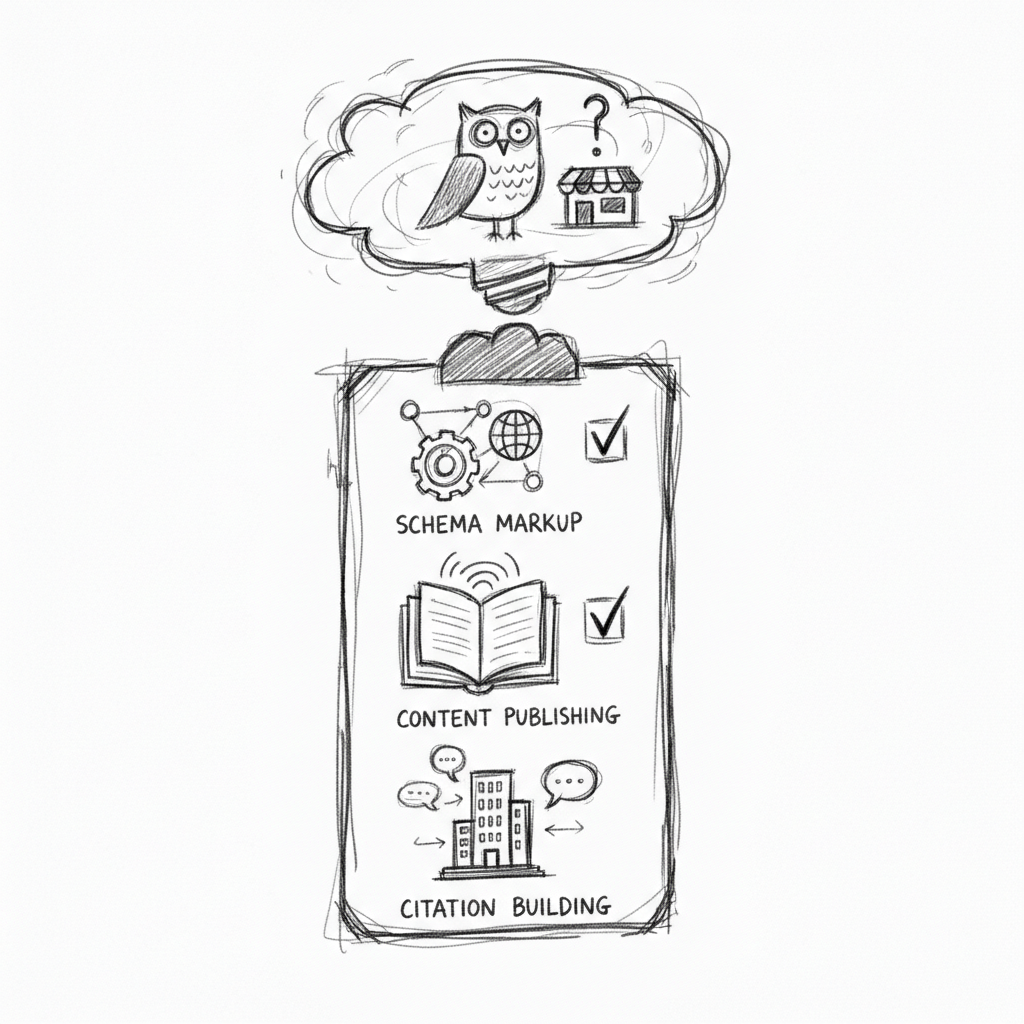
To get recommended by Perplexity, small business owners need to take a combination of technical, content, and citation-building actions that collectively signal authority and relevance to Perplexity's AI retrieval system.
Technical Optimization: The Foundation
Technical signals are the fastest wins. They don't require writing talent or a marketing budget. They require configuration.
- Add schema markup: Implement LocalBusiness, Product, or Service schema on every relevant page. This tells Perplexity's crawler exactly what your business offers, where you're located, and who you serve.
- Create an llms.txt file: This is a relatively new file format (similar to robots.txt) that gives large language models explicit guidance on how to understand and index your content. Place it at your site's root directory.
- Optimize your Google Business Profile: Perplexity pulls data from multiple sources, including local business directories. A complete, accurate GBP improves your entity recognition across AI engines.
- Fix technical crawl errors: Broken links, slow page loads, and missing meta descriptions all reduce the likelihood of Perplexity indexing your pages effectively.
- Ensure mobile responsiveness: AI crawlers prioritize well-structured, accessible pages.
For SMBs operating under legal or compliance frameworks, maintaining a clear and accessible business legal structure on your website also contributes to entity trustworthiness signals that AI engines evaluate.
Content Strategy: Earning Citations
Perplexity recommends sources it can cite. That means your content needs to be structured as citable answers, not just promotional copy.
- Write FAQ pages that directly answer the questions your customers search for
- Publish comparison articles (e.g., "X vs. Y for small businesses") — Perplexity loves these for recommendation queries
- Create category-specific guides that establish your expertise in a defined niche
- Use clear H2 and H3 headings that mirror likely search queries
- Keep paragraphs short and answers direct — Perplexity extracts clean, quotable passages
According to Learn Prompting's comprehensive guide to Perplexity AI, small business owners who structure content around specific, answerable questions see significantly higher citation rates in AI-generated responses [5]. For those exploring get recommended by Perplexity small business, this matters.
Pro Tip: Take your top 10 customer questions from support emails or reviews and turn each one into a dedicated page or FAQ entry. Each one is a potential Perplexity citation opportunity.
At Moonrank, we've found that SMBs publishing fresh, question-focused content daily see measurable improvements in AI search citations within 30 to 60 days. The compounding effect of consistent publishing is real.
Common Mistakes SMBs Make in 2026
The most common mistake SMBs make is assuming that good Google rankings automatically translate into Perplexity recommendations. They don't. AI search engines evaluate signals that traditional SEO largely ignores.
Mistake 1: Treating AI Search Like Google
A common mistake is optimizing exclusively for Google's crawler while neglecting the structured data and semantic signals that AI engines like Perplexity prioritize. In practice, we've seen businesses with strong domain authority and thousands of backlinks remain completely invisible in Perplexity answers because their content isn't structured for AI extraction.
The fix is straightforward: audit your content for AI readability, not just keyword density. Ask whether each page answers a specific question clearly in its first two sentences. If it doesn't, Perplexity won't cite it.
Mistake 2: Ignoring Third-Party Citation Building
Perplexity weights sources it sees cited across multiple platforms. An SMB that only maintains its own website, without building presence in directories, trade publications, or review sites, gives Perplexity very little to cross-reference.
- Claim and complete profiles on Yelp, Google Business, and industry-specific directories
- Pursue press mentions, even in local publications
- Encourage customers to leave detailed reviews that mention your specific services
- Get listed in niche directories relevant to your category
As noted in research on strategies for getting mentioned by AI engines including Perplexity, building a distributed citation footprint across multiple platforms is one of the four most effective tactics for SMBs [6].
Mistake 3: Publishing Inconsistently
One pitfall to watch for is the "burst and pause" content pattern. Many SMBs publish a flurry of blog posts, then go silent for months. Perplexity's retrieval system favors consistently active sources. A site that publishes once a week, every week, will outperform a site that publishes 20 posts in January and nothing after. This directly impacts get recommended by Perplexity small business outcomes.
Consistency signals that a source is maintained and trustworthy. That's a direct input into Perplexity's recommendation logic.
Pro Tip: If you can't commit to consistent manual publishing, automate it. Tools that publish daily SEO content on your behalf solve the consistency problem without adding to your workload.
Best Practices for AI Search Visibility in 2026
The best practices for getting recommended by Perplexity as a small business in 2026 center on three pillars: technical AI readability, content authority, and cross-platform citation density.
Build an AI-Readable Technical Foundation
Technical optimization for AI search is distinct from traditional technical SEO. The goal isn't just to help Google crawl your site. It's to help Perplexity's language model understand your business as a trusted entity.
- Schema markup: Implement at minimum LocalBusiness, FAQPage, and HowTo schema where relevant
- llms.txt: Configure this file to guide AI crawlers on your site's structure and key content
- Structured data for products/services: Every service or product page should have machine-readable structured data
- Clear entity signals: Your business name, address, phone number (NAP), and category should be consistent and explicit across every page
According to GSD Council's guide on mastering Perplexity AI, businesses that invest in structured, well-organized content achieve faster and more consistent citation rates in AI-generated answers [1].
Content and Citation Strategy That Compounds Over Time
The businesses that dominate Perplexity recommendations in 2026 aren't necessarily the biggest. They're the most consistently cited. Here's what that looks like in practice:
- Identify 20 to 30 specific questions your target customers ask about your category
- Create a dedicated page or detailed FAQ entry for each question
- Publish at least one new piece of content per week addressing these questions
- Build citations in five or more external directories per month
- Monitor your Perplexity visibility monthly and adjust content based on what's getting cited
Our team at Moonrank recommends treating AI search optimization as a compound investment. Each piece of content and each citation adds to a growing body of evidence that Perplexity's AI uses to decide whether to recommend your business. The first 90 days feel slow. The next 90 feel exponential.
For SMBs that don't have time to execute this manually, platforms like Moonrank automate the entire process: daily content publishing, technical optimization, citation building, and visibility tracking across Perplexity, ChatGPT, Gemini, and Claude — all for $99/month, compared to the $3,000+ per month that traditional SEO agencies charge. This is particularly relevant for get recommended by Perplexity small business.
| Approach | Cost | AI Search Focus | Automation Level | Time to Results |
|---|---|---|---|---|
| Traditional SEO Agency | $3,000+/month | Low (Google-first) | Manual | 6-12 months |
| DIY Content Marketing | Time cost only | Variable | None | Unpredictable |
| Moonrank (AI Search Autopilot) | $99/month | High (GEO/AEO-first) | Fully automated | 30-60 days |
| Generic AI Writing Tools | $49-$125/month | None | Partial (writing only) | N/A (no publishing) |
Industry analysts suggest that by the end of 2026, AI search engines will account for a majority of zero-click discovery events — moments where a user gets an answer and acts on it without ever visiting a website. For SMBs, being cited in that answer is the new version of ranking on page one.
According to Dan Cumberland Labs' analysis of Perplexity AI for business, the engine's real-time citation model makes it particularly valuable for businesses in competitive local and niche markets, where being the cited source creates a durable trust advantage [7].
The Perplexity Enterprise platform also signals how seriously the company takes business use cases — and how much more prominent business recommendations will become as enterprise adoption grows [8].
Sources & References
- GSD Council, "Search Smarter and Faster: Master Perplexity AI for Rapid, Accurate Results," 2026
- U.S. Small Business Administration, "AI Made Practical for Small Business: The Right Tool for the Right Job," 2026
- Small Business Association of Michigan, "Everyday AI in Business," 2026
- Alhena AI, "How Perplexity Picks Top 3 Product Recommendations," 2026
- Learn Prompting, "A Complete How-To Guide to Perplexity AI," 2026
- Christina Martin, "Getting Perplexed, The Good Way: 4 New Strategies That Help Small Businesses Get Mentioned By AI," Medium, 2026
- Dan Cumberland Labs, "Perplexity AI for Business," 2026
- Perplexity AI, "Perplexity Enterprise," 2026
Frequently Asked Questions
1. How do I get my small business recommended by Perplexity?
To get recommended by Perplexity, small business owners should focus on three areas: technical optimization (schema markup, llms.txt, structured data), content strategy (FAQ pages, question-focused blog posts, comparison articles), and citation building (directories, press mentions, reviews). Perplexity cites sources it can verify across multiple platforms, so distributing your business's presence beyond your own website is essential. Consistency in publishing new content is equally important, as Perplexity favors active, regularly updated sources.
2. How to get the best out of Perplexity AI as a business owner?
Getting the best out of Perplexity AI for your business means using it both as a research tool and as a visibility target. As a research tool, structure your queries around specific business questions — competitor analysis, market sizing, customer pain points — and use Perplexity's cited sources to verify every finding before acting on it. As a visibility target, optimize your website and content so Perplexity cites your business in answers relevant to your category. According to GSD Council's guide, businesses that treat Perplexity as both a tool and a channel see compounding benefits in research efficiency and brand visibility.
3. How to use Perplexity AI for small business marketing?
Perplexity AI serves small business marketing in two ways: as a research accelerator and as a discovery channel. For research, use it to analyze competitors, identify trending customer questions, and synthesize market data quickly. For discovery, optimize your website so that Perplexity recommends your business when users ask category-relevant questions. The Learn Prompting guide to Perplexity AI notes that small business owners who structure content around specific, answerable questions achieve significantly higher citation rates in AI-generated responses.
4. Does Perplexity use Google rankings to decide what to recommend?
Not directly. Perplexity uses its own real-time retrieval system that evaluates source authority, semantic clarity, content freshness, and structured data signals — not Google's PageRank. A business can rank on page one of Google and still be absent from Perplexity recommendations if its content isn't structured for AI extraction. Conversely, a smaller business with well-implemented schema markup, an llms.txt file, and consistently published question-focused content can outperform larger competitors in Perplexity citations. When considering get recommended by Perplexity small business, this point stands out.
5. How long does it take to appear in Perplexity recommendations?
Results vary depending on your starting point, niche competitiveness, and the consistency of your optimization efforts. In practice, SMBs that implement technical fixes (schema markup, llms.txt) and begin publishing question-focused content regularly typically start seeing citations within 30 to 60 days. Businesses in less competitive niches may see results faster. One limitation is that there's no direct submission process for Perplexity — you're building signals that its crawler evaluates over time, not submitting a listing.
6. Is there a free way to get recommended by Perplexity as a small business?
Yes, the core optimization steps are free to implement: adding schema markup, creating an llms.txt file, building directory citations, and publishing FAQ content all cost time rather than money. However, executing these consistently and at the volume needed to compete in active categories is where most SMBs struggle. Automated platforms like Moonrank handle all of this for $99/month — a fraction of what a traditional agency charges — and remove the manual burden entirely. The Perplexity Enterprise plan is a separate product for internal business use, not a paid placement channel.
7. What is GEO (Generative Engine Optimization) and why does it matter for Perplexity?
GEO, or Generative Engine Optimization, is the practice of optimizing your content and technical infrastructure so that AI search engines like Perplexity, ChatGPT, and Gemini recommend your business in their generated answers. It differs from traditional SEO in that it targets how large language models retrieve, evaluate, and cite sources rather than how Google's crawler indexes and ranks pages. As AI search grows as a discovery channel in 2026, GEO is becoming as important as traditional SEO for SMBs that want to stay visible to new customers.
Staying visible as AI search continues to grow isn't optional for small businesses that depend on new customer discovery. To get recommended by Perplexity, small business owners need to act on technical signals, content structure, and citation building simultaneously. The good news: these steps are achievable without a large budget or a technical team. Tools like Moonrank automate every layer of this process — from daily content publishing to schema markup to cross-platform visibility tracking — so you can focus on running your business while the AI search optimization runs on autopilot. Start with a 3-day free trial and see where your business currently stands in Perplexity, ChatGPT, Gemini, and Claude. Then watch it improve.

Recommended Articles
Explore more from our content library: