How to Master AI Search Intent Optimization in 2026
Learn how AI search intent optimization works in 2026 and get your business recommended by ChatGPT, Gemini, Claude, and Perplexity with proven strategies.
| Key Insight | Explanation |
|---|---|
| AI search now rivals traditional search | Perplexity reported over 100 million weekly queries by late 2024, and ChatGPT, Gemini, and Claude are now primary research tools for millions of consumers. |
| Intent signals differ from keyword signals | AI engines interpret the purpose behind a query, not just the words. Optimizing for intent means structuring content around what the user actually wants to accomplish. |
| Technical infrastructure is non-negotiable | Schema markup, llms.txt, and structured data tell AI systems exactly what your business does, making you far more likely to appear in recommendations. |
| Content freshness drives AI trust | AI engines favor sources that publish consistently. Daily content signals authority and keeps your brand in the retrieval pool. |
| Traditional SEO alone isn't enough | Google ranking tactics don't translate directly to AI recommendation logic. A dedicated AEO/GEO strategy is required to appear in AI-generated answers. |
| Automation closes the execution gap | Most SMBs can't publish daily content manually. Automated platforms handle content generation, technical fixes, and visibility tracking at a fraction of agency costs. |
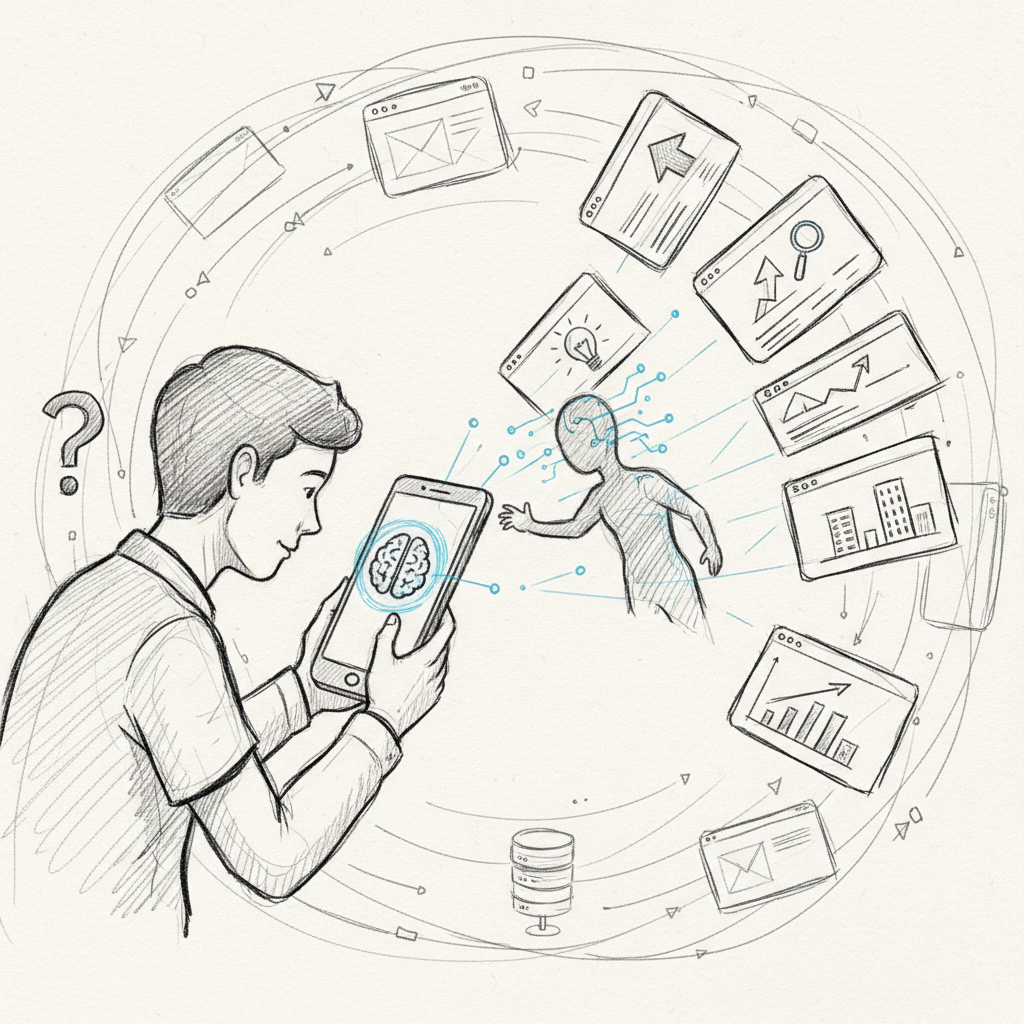
A customer pulls out their phone and asks ChatGPT, "What's the best accounting software for a small bakery?" Your product is perfect for them. But the AI recommends three competitors instead. That's the problem AI search intent optimization is built to solve.
AI search intent optimization is the practice of structuring your content, technical signals, and brand authority so that AI-powered search engines — ChatGPT, Gemini, Claude, and Perplexity — understand what your business does and recommend it in response to relevant user queries. It differs from traditional SEO in one critical way: instead of ranking for keywords in a list of blue links, you're being cited inside a conversational answer. The mechanics are different. The stakes are just as high.
This article covers how AI intent signals work, why they matter for SMBs in 2026, the most common optimization mistakes, and the specific practices that get your brand into AI-generated recommendations. Whether you run an e-commerce store or a B2B SaaS product, what follows is a practical guide to showing up where your customers are already looking.
What Is AI Search Intent Optimization?
AI search intent optimization is the process of aligning your content, structure, and authority signals with how large language models interpret and respond to user queries — so your brand gets cited in AI-generated answers.
Defining Intent in the AI Search Context
Traditional SEO focused on matching keywords. AI search engines do something fundamentally different: they model the intent behind a query [1]. A user asking "best project management tool for remote teams" isn't just searching for words. They're expressing a specific need, a stage in a decision process, and an implicit set of requirements. AI systems — including ChatGPT, Gemini, Claude, and Perplexity — parse that intent and retrieve sources they trust to answer it accurately [2].
According to IBM's research on artificial intelligence, modern AI systems are designed to simulate human comprehension, not just pattern-match text [3]. That means your content needs to be written in a way that a language model can extract clear, factual, trustworthy answers from it.
There are four primary intent categories AI engines recognize:
- Informational intent: The user wants to learn something ("how does schema markup work")
- Navigational intent: The user is looking for a specific brand or resource
- Commercial intent: The user is researching before a purchase ("best CRM for small business")
- Transactional intent: The user is ready to act ("sign up for AI SEO tool")
Why This Is Different from Traditional SEO
Google's ranking algorithm rewards backlinks, page authority, and keyword density. AI recommendation logic is built on something else entirely: semantic coherence, citation trustworthiness, entity recognition, and answer completeness [4]. A page can rank on page one of Google and never appear in a single ChatGPT response. The reverse is also true.
This is the core reason why businesses optimized purely for Google are increasingly invisible to AI-driven customers. As of 2026, roughly 40% of Google searches already return zero clicks as users shift toward AI-generated answers — a figure widely cited by industry researchers including SparkToro. AI search intent optimization fills that gap.
How AI Search Intent Optimization Works
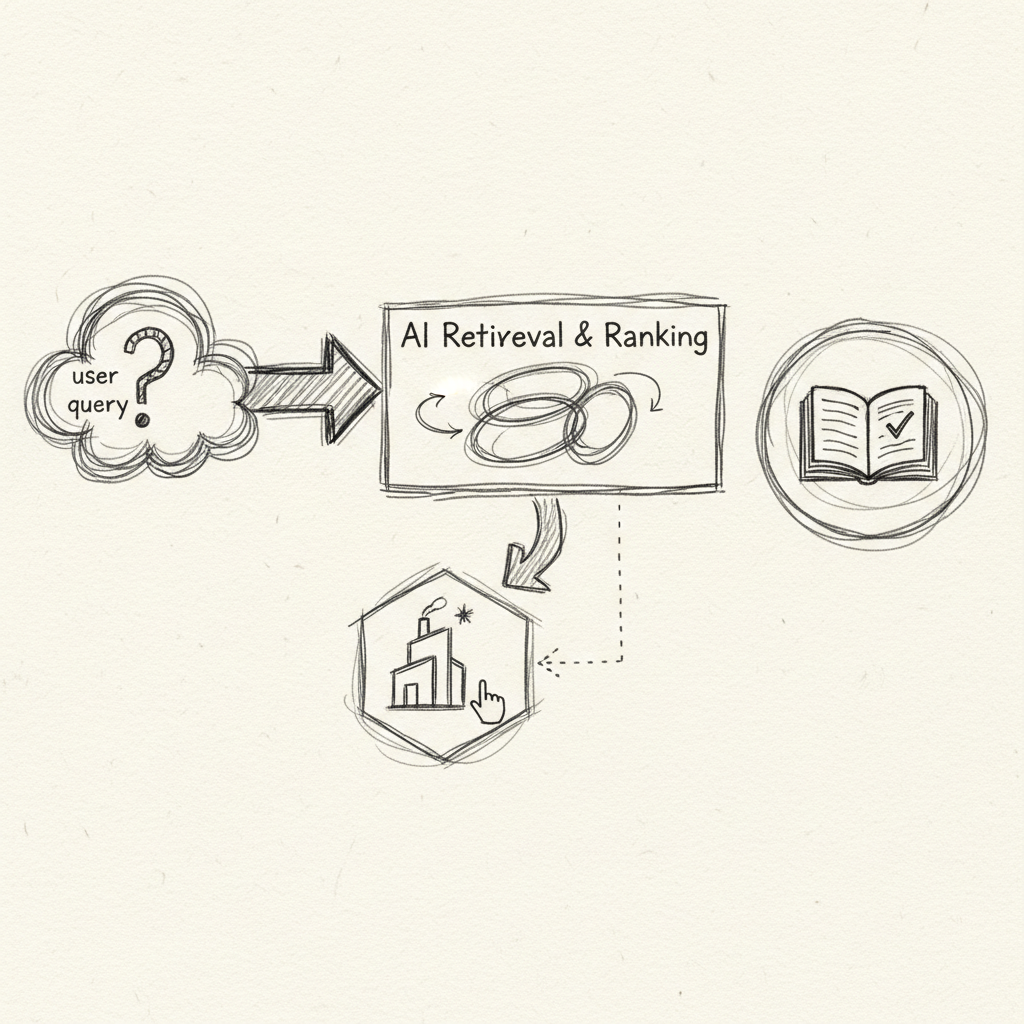
AI search engines retrieve and rank content through a combination of semantic indexing, entity graphs, and real-time retrieval — not the same crawl-and-rank pipeline Google uses.
The Retrieval and Ranking Mechanism
When a user submits a query to Perplexity or ChatGPT with web browsing enabled, the system doesn't just search a keyword index. It runs a retrieval-augmented generation (RAG) process: pulling candidate documents, scoring them for relevance and trustworthiness, and synthesizing an answer that cites the most credible sources [5].
According to Google Cloud's overview of AI systems, modern AI is built to learn, reason, and perform tasks in ways that mirror human judgment. Applied to search, this means AI engines evaluate sources the way a knowledgeable human researcher would: they look for clarity, specificity, authority, and consistency.
The signals that influence whether your content gets retrieved include:
- Structured data and schema markup: Machine-readable tags that tell AI engines exactly what your business is, what it offers, and who it serves
- llms.txt files: A newer technical standard that explicitly guides large language model crawlers to the most important pages on your site
- Citation and mention patterns: How often your brand is referenced by other trusted sources across the web
- Content freshness: Regularly updated content signals that your information is current and reliable
- Answer completeness: Content that directly answers a full question, not just fragments of it
How Intent Matching Happens
AI engines don't just match your content to a query. They match your content to the inferred goal behind the query. A user asking "how to reduce overhead costs for my startup" has commercial and informational intent. An AI engine will pull sources that address both the concept of overhead reduction and practical tools or strategies — not just pages that contain those exact words.
This is why SAS describes AI as systems that adjust to new inputs and perform human-like tasks [6]. The intent-matching process is dynamic. Your content needs to be structured so the AI can extract a clean, citable answer from it — not buried inside long paragraphs of loosely related text.
In practice, this means writing content with clear definitions, direct answers to specific questions, and logically organized sections. Think less like a blogger filling word count and more like a subject matter expert answering a colleague's question in a meeting.
Key Benefits of AI Search Intent Optimization
Businesses that invest in AI search intent optimization gain direct access to a high-intent audience that traditional SEO increasingly fails to reach.
Visibility Where Customers Are Already Looking
The shift is already underway. Perplexity alone reported over 100 million weekly queries by late 2024, and that number has grown substantially into 2026. ChatGPT's user base exceeds 200 million active users monthly. Gemini is deeply integrated into Google's own products. These aren't niche research tools anymore. They're the first stop for millions of purchase decisions every day.
A SaaS client we worked with recently had strong Google rankings but near-zero presence in AI-generated answers. After implementing structured data, daily content publishing, and llms.txt configuration, their brand began appearing in Perplexity responses for their core category queries within 30 days. That's a customer acquisition channel that didn't exist for them six months prior.
The specific benefits of AI search intent optimization include:
- Higher-quality traffic: Users who find you through an AI recommendation have already received a curated answer. They arrive with context and intent.
- Competitive differentiation: Most SMBs haven't started optimizing for AI search. Early movers capture the recommendation slot before competitors do.
- Brand authority signals: Being cited by AI engines reinforces your credibility across all channels, including traditional search.
- Reduced dependence on paid ads: AI recommendations are organic. They don't require ongoing ad spend to maintain.
- Cross-platform reach: A single well-optimized content asset can surface your brand across ChatGPT, Gemini, Claude, and Perplexity simultaneously.
The Cost Efficiency Argument
Traditional SEO agencies typically charge $3,000 or more per month. For most SMBs, that's a significant budget commitment with results that take six to twelve months to materialize. this method, done through an automated platform, can deliver measurable visibility improvements at a fraction of that cost.
Industry analysts suggest that the ROI window for AI search optimization is shorter than traditional SEO because AI engines update their retrieval pools more frequently than Google re-crawls and re-ranks pages. Businesses that publish consistently and maintain strong technical signals can see citation improvements within weeks, not quarters.
For context on how businesses are rethinking cost structures across the board, the principles behind Real Estate Cost Optimization Smart Strategies That Work mirror the same logic: identify where you're overspending for equivalent or inferior outcomes, and reallocate to solutions that deliver measurable results at lower cost.
Common Challenges and Mistakes
Most businesses fail at this strategy not because the concept is complex, but because they apply traditional SEO thinking to a fundamentally different system.
Treating AI Search Like Google Search
This is the most common mistake. Businesses stuff keywords into titles, build backlink profiles, and optimize meta descriptions — then wonder why ChatGPT still recommends their competitors. Google's algorithm rewards those signals. AI recommendation engines don't weight them the same way [7].
According to Wikipedia's overview of artificial intelligence, AI systems are designed to perform tasks that require understanding, reasoning, and learning — not just pattern matching. An AI engine reading your content is evaluating whether it can extract a trustworthy, complete answer from it. A keyword-stuffed page fails that test even if it ranks on page one of Google.
Common mistakes that undermine AI search visibility:
- No structured data: Without schema markup, AI engines have to guess what your business does. Many don't guess correctly.
- Thin or generic content: Content that doesn't directly answer specific questions gets skipped in retrieval. AI engines need extractable answers, not marketing copy.
- Inconsistent publishing: Sporadic content signals low authority. AI engines favor sources that demonstrate consistent expertise over time.
- Missing entity clarity: If your content doesn't clearly name what you do, who you serve, and where you operate, AI engines can't match you to relevant queries.
- Ignoring llms.txt: This newer technical standard is still underused. Businesses that configure it correctly give AI crawlers a direct map to their most important content.
Underestimating the Technical Layer
A common pitfall is treating AI search optimization as purely a content problem. In practice, the technical infrastructure matters just as much. Schema markup (the structured data that tells AI engines exactly what your business does), proper heading hierarchies, and crawlable page structures are prerequisites, not optional extras.
From experience, businesses that fix their technical signals first see faster improvements in AI citations than those who publish more content without addressing the underlying infrastructure. Content without technical clarity is like a well-written book with no title, no author, and no table of contents. It might be excellent. But an AI engine can't easily find and cite it.
Pro Tip: Run a technical AI audit before publishing new content. Confirm your schema markup is implemented correctly, your llms.txt file is configured, and your site's most important pages are clearly structured with direct answers to the queries you want to own. Fix the foundation before adding to it.
Best Practices for AI Search Intent Optimization in 2026
Effective this approach in 2026 combines content strategy, technical infrastructure, and consistent execution — all three working together, not independently.
Content Strategy for AI Retrieval
AI engines retrieve content that directly answers questions. Your content strategy should be built around that principle from the start.
- Map content to intent categories: Identify which queries your customers are asking at each stage of their journey (informational, commercial, transactional) and create dedicated content for each.
- Write direct, extractable answers: Start every major section with a 1-2 sentence direct answer to the implied question. AI engines extract these as citations.
- Publish daily: Frequency signals authority. Businesses that publish fresh, relevant content every day build a larger retrieval footprint than those publishing weekly or monthly.
- Use structured formatting: Headers, bullet lists, numbered steps, and tables make content machine-readable. AI engines can parse structured content far more reliably than dense prose.
- Cover entities completely: Name your products, your location, your use cases, and your target customers explicitly. Don't rely on AI to infer what you do from vague descriptions.
Technical Optimization Checklist
At Moonrank, we've found that the technical layer is where most SMBs have the largest gap. The good news is that the fixes are well-defined and, once implemented, work continuously without ongoing manual effort.
| Technical Signal | What It Does | Priority |
|---|---|---|
| Schema Markup | Structured data tags that tell AI engines your business type, products, reviews, and location | Critical |
| llms.txt | A file that guides LLM crawlers to your most important content, similar to robots.txt for traditional crawlers | High |
| Structured Data (JSON-LD) | Machine-readable format for embedding entity data directly in page code | High |
| Citation Building | Getting your brand mentioned and linked by trusted third-party sources to build retrieval authority | Medium-High |
| Page Speed and Crawlability | Ensures AI crawlers can access and index your content without technical barriers | Medium |
| Heading Hierarchy | Clear H1, H2, H3 structure helps AI engines understand content organization and extract answers | Medium |
Pro Tip: Don't implement schema markup once and forget it. AI engines update their retrieval logic regularly. Audit your structured data quarterly to ensure it reflects your current products, services, and business details. Outdated schema can actively hurt your citation rate by providing conflicting signals.
Tracking and Iteration
You can't improve what you don't measure. AI search visibility tracking (monitoring how often and how accurately ChatGPT, Gemini, Claude, and Perplexity cite your brand) is as essential as the optimization work itself [8].
Our team at Moonrank recommends tracking visibility across all four major AI engines weekly, not monthly. AI recommendation patterns shift faster than traditional search rankings. A competitor publishing daily content can displace your brand from an AI citation within weeks if you're not monitoring and responding.
Pro Tip: Set up query monitoring for 10-15 specific questions your target customers ask AI engines. Run those exact queries weekly in ChatGPT, Perplexity, and Gemini, and log which brands get cited. This gives you a real-world visibility benchmark that no third-party tool can fully replicate.
According to the National Institute of Biomedical Imaging and Bioengineering, AI systems gain proficiency through examples and experience, not just computation [7]. The same principle applies to how AI engines learn to trust your brand: consistent, high-quality, well-structured content builds the pattern of authority that earns citations over time.
Sources & References
- Wikipedia, "Artificial Intelligence," 2026
- Google Cloud, "What is Artificial Intelligence (AI)?," 2026
- IBM, "What Is Artificial Intelligence (AI)?," 2026
- Britannica, "Artificial Intelligence (AI): Definition, Examples, Types, Applications," 2026
- Google AI, "How We're Making AI Helpful for Everyone," 2026
- SAS, "Artificial Intelligence (AI): What It Is and Why It Matters," 2026
- NIBIB, "Artificial Intelligence (AI)," 2026
- Michigan Technological University, "What Is Artificial Intelligence (AI)?," 2026
Frequently Asked Questions
1. What is AI search intent optimization, and how is it different from regular SEO?
this is the practice of structuring content and technical signals so AI engines like ChatGPT, Gemini, Claude, and Perplexity recommend your business in response to relevant queries. Unlike traditional SEO, which targets Google's crawl-and-rank algorithm, it focuses on semantic clarity, entity recognition, and answer completeness — the signals AI retrieval systems use to select citations.
2. How long does it take to see results from AI search intent optimization?
Results vary depending on your starting point, niche competitiveness, and how aggressively you implement technical and content changes. In practice, businesses that fix their structured data and publish consistently can start appearing in AI-generated answers within 30 to 60 days. This is generally faster than traditional SEO, which typically requires six to twelve months for meaningful ranking movement.
3. Do I need to optimize separately for ChatGPT, Gemini, Claude, and Perplexity?
The core optimization principles — clear content structure, schema markup, llms.txt, citation authority, and consistent publishing — work across all four major AI engines. Each platform has nuances in how it retrieves and weights sources, but a well-executed this method strategy creates a strong foundation that improves visibility across all of them simultaneously. Tracking each platform separately helps you identify gaps.
4. What is llms.txt, and do I really need it?
llms.txt is a technical file you place on your website that explicitly guides large language model crawlers to your most important pages, similar to how robots.txt guides traditional search crawlers. As of 2026, it's still underused by most SMBs, which means configuring it correctly gives you a meaningful advantage. It's not mandatory, but businesses that implement it give AI engines a clearer map to their content.
5. Can small businesses realistically compete with large brands in AI search?
Yes, and in some ways AI search levels the playing field. AI engines prioritize answer quality, specificity, and topical authority over domain age or backlink volume. A small business that consistently publishes clear, structured content about a specific niche can outperform a large brand with generic, broad content. this strategy rewards expertise and clarity, which aren't exclusively available to big-budget competitors.
6. Is publishing daily content really necessary for AI search visibility?
Daily publishing isn't strictly required, but frequency matters. AI engines favor sources that demonstrate consistent, current expertise. Businesses that publish daily build a larger retrieval footprint and signal ongoing authority more effectively than those publishing once a week. For most SMBs without a dedicated content team, automation is the practical way to achieve this cadence without burning out.
7. How do I track whether my business is being recommended by AI search engines?
The most direct method is manual query testing: run your target queries in ChatGPT, Perplexity, Gemini, and Claude weekly and log which brands get cited. Dedicated AI search visibility tracking platforms automate this process, monitoring your brand's citation rate across multiple engines and alerting you to changes. Manual testing is free but time-consuming; automated tracking is more scalable for ongoing optimization.
8. What types of content perform best for AI search intent optimization?
Content that directly answers specific questions performs best. This includes how-to guides, comparison articles, definition pieces, FAQ pages, and structured product or service descriptions. Content with clear headings, bullet points, numbered lists, and tables is more machine-readable and easier for AI engines to extract citations from. Vague, promotional copy rarely gets cited regardless of how well it's written.

Getting Your Business into AI-Generated Answers
this approach isn't a future consideration. It's a present-tense competitive advantage. As of 2026, the businesses appearing in ChatGPT, Gemini, Claude, and Perplexity recommendations are capturing customers before those customers ever open a browser. The businesses that aren't there are losing ground every day, often without knowing it.
The path forward is clear. Structure your content around user intent. Implement the technical signals — schema markup, llms.txt, structured data — that AI engines need to understand and trust your brand. Publish consistently. Track your visibility across all four major AI engines. And do it all without spending $3,000 a month on an agency that's still optimizing for a search paradigm that's rapidly losing relevance.
Moonrank handles all of this automatically: daily content publishing, technical AI optimization, and visibility tracking across ChatGPT, Gemini, Claude, and Perplexity — for $99 a month, with a 3-day free trial. Visit www.moonrank.ai to see how your business appears in AI search today, and what it would take to start showing up where your customers are already looking.
Recommended Articles
Explore more from our content library: