How to Optimize Product Descriptions for AI Search Discovery
To optimize product descriptions with AI, feed your product data into a tool like Jasper, Copy.ai, or Describely, generate drafts tuned to your brand...

Understanding optimize product descriptions AI is essential. To optimize product descriptions with AI, feed your product data into a tool like Jasper, Copy.ai, or Describely, generate drafts tuned to your brand voice, then edit for accuracy and platform fit before publishing. AI cuts description writing time by up to 80% and can lift conversion rates 10–30% when descriptions are tailored to three distinct audiences: human shoppers, traditional search engines, and AI shopping assistants like ChatGPT and Perplexity.
Optimize Product Descriptions with AI: Choose the Right Tool First: optimize product descriptions AI
Pick your AI description tool based on three criteria: bulk generation speed, brand-voice training capability, and native platform connector availability. This is particularly relevant for optimize product descriptions AI.
How Jasper, Copy.ai, and Describely Compare in Features and Pricing
Describely is purpose-built for ecommerce bulk generation [1] and connects natively with Shopify and WooCommerce, making it the most direct option when you need to optimize product descriptions with AI across hundreds of SKUs at once. Its entry plan starts at roughly $19/month for 100 SKUs.
Jasper and Copy.ai are general-purpose writing tools, but both include product description templates that work for smaller catalogs. Jasper's Creator plan runs $49/month; Copy.ai offers a free tier covering 2,000 words per month, with paid plans starting at $49/month. Neither offers a dedicated ecommerce connector out of the box.
When comparing the three, weight your decision on these factors:
- Bulk generation speed: Describely processes entire catalogs in batch; Jasper and Copy.ai generate one description at a time unless you use their API.
- Brand-voice training: Jasper's "Brand Voice" feature lets you upload sample copy so outputs match your tone; Describely and Copy.ai offer lighter customization.
- Native platform connectors: Describely wins here, Jasper and Copy.ai require manual export or third-party automation.
Which AI Description Tools Work Best with WooCommerce, BigCommerce, and Custom Platforms
WooCommerce users can push AI-generated copy into their store via CSV import or plugins like Bulk Product Editor, no direct API integration required. BigCommerce supports API-based content injection, which suits teams running custom publishing workflows at scale.
Custom storefronts built on headless CMS setups, Contentful, Sanity, or similar, have no plug-and-play option. You will need to make direct API calls to OpenAI or Anthropic, then pipe the output into your content layer through custom code. Budget developer time for this before committing to a headless approach. When considering optimize product descriptions AI, this point stands out.
Write Descriptions That Satisfy Three Audiences at Once
Every product description in 2026 must satisfy a human shopper, a search crawler, and an AI shopping assistant, or it risks failing all three.
Who Are the Three Audiences Reading Your Product Descriptions
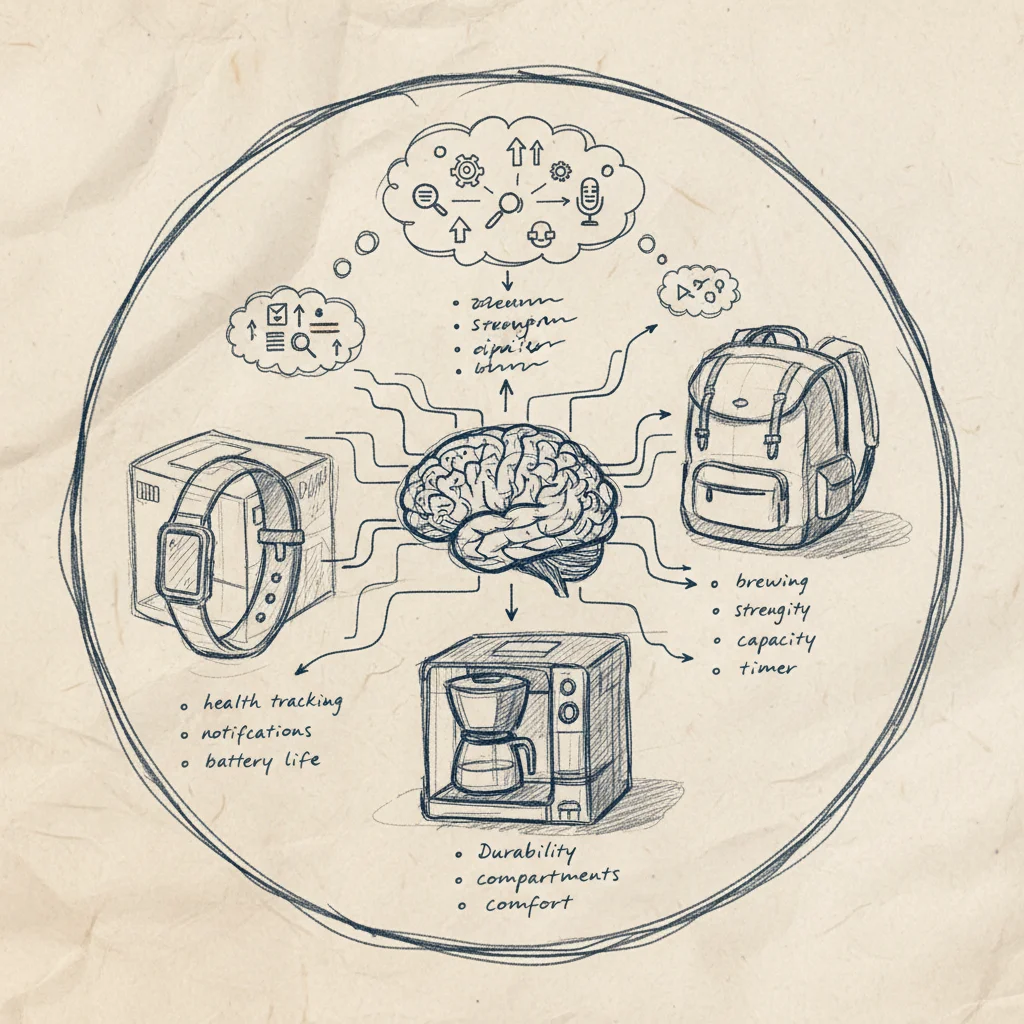
The same product page is read simultaneously by three distinct audiences, each with different priorities [3]. Human shoppers decide within the first two sentences whether a product is worth their attention. Search crawlers from Google and Bing scan for keyword signals and structured data. AI shopping assistants, ChatGPT, Perplexity, and Google's AI Overviews, pull from your page to answer buyer queries in real time.
A single SKU therefore needs three layers built into one description: a benefit-led opening sentence for the human, keyword-anchored mid-copy for crawlers, and a factual spec summary formatted so AI systems can extract and cite it cleanly.
What Each Audience Actually Evaluates When Reading a Description
Human shoppers evaluate emotional resonance, benefit clarity, and social proof signals, "trusted by 4,200 runners" lands harder than "high-quality shoe." Google and Bing crawlers still reward keyword density, structured headings, and schema markup; the product description field feeds directly into rich snippet eligibility [2]. AI assistants skip vague descriptions entirely and favor pages where structured data matches the natural-language copy [3].
The table below shows how to optimize product descriptions for AI and human readers using a flat spec-only description versus an integrated three-audience version for the same product. For those exploring optimize product descriptions AI, this matters.
| Version | Copy | What It Misses |
|---|---|---|
| Flat spec-only | "Running shoe. Weight: 240g. Drop: 8mm. Mesh upper." | No benefit hook for humans; no keyword context for crawlers; no citable claim for AI |
| Integrated three-audience | "Cut 30 seconds off your 5K with the lightest daily trainer in its class, trusted by 4,200 runners. Lightweight running shoe with 8mm drop and breathable mesh upper. Weight: 240g." + schema markup for product weight and rating. | Nothing, each layer serves one audience without disrupting the others |
Generate and Customize AI Descriptions to Match Your Brand Voice
To optimize product descriptions with AI and keep them on-brand, start every session by pasting 3–5 sentences of your best existing copy directly into the tool as a style anchor before generating anything new.
That style anchor, your brand-voice brief, tells the model what register, rhythm, and vocabulary to match. Without it, most tools default to generic catalog language that sounds like every other store in your category.
After setting the style anchor, use structured input fields instead of open-ended prompts. Feed the tool four discrete inputs: product name, key specs, target customer, and 3–4 tone adjectives (e.g., "warm, direct, ingredient-forward"). Structured inputs cut generic output far more reliably than a single paragraph prompt.
How to Edit AI Descriptions Differently for Different Product Categories
Category shapes what the AI draft needs most. Apparel descriptions need sensory language, texture, drape, fit guidance, that the model often omits in favor of dry spec lists. Electronics need spec accuracy and compatibility callouts checked against the actual product sheet before publication. Consumables need ingredient transparency: if the AI writes "natural extracts," replace it with the exact ingredient name every time [3].
Run this three-point checklist on every draft before it leaves your queue: This directly impacts optimize product descriptions AI outcomes.
- Does the first sentence name a benefit, not a feature?
- Are all brand-banned words absent? (Maintain a shared list your team updates monthly.)
- Does the closing sentence include a clear next action, "Shop the full range," "Check compatibility," or similar?
What an Integrated Multi-Audience Description Looks Like in Practice
A single SKU now gets read by a human shopper, an AI shopping assistant, and, in some channels, an autonomous purchasing agent [3]. Each audience evaluates different signals, so your edited draft must satisfy all three: a benefit-led opening for the human, structured data attributes for the AI, and clear eligibility criteria for the agent.
Before bulk upload, run a find-and-replace pass across the entire batch to enforce consistent brand terminology, product line names, material callouts, proprietary technology names. One inconsistent term repeated across 400 SKUs creates catalog-wide trust problems that are expensive to fix after the fact.
Common Mistakes to Avoid When Using AI for Product Descriptions
The five mistakes below account for most of the wasted effort teams experience when they try to optimize product descriptions with AI.
Publishing without a human review pass. No AI draft should go live without at least one edit cycle. AI output defaults to generic phrasing that flattens brand voice, the kind of drift that compounds quietly across hundreds of SKUs until your catalog reads like every competitor's.
Ignoring plagiarism risk. AI tools trained on public web data can reproduce near-duplicate phrasing from existing competitor listings. Run every output through a checker like Copyscape before publishing. A matching passage on a rival's page hurts both trust and search visibility. This is particularly relevant for optimize product descriptions AI.
Treating optimization as a one-time project. AI assistant behavior and ranking signals shift continuously. Schedule quarterly description audits tied specifically to your top 20% revenue SKUs, the products where copy quality has the highest dollar impact.
Publishing hallucinated specs. Generative AI invents plausible-sounding details: wrong dimensions, false material claims, incorrect compatibility notes. Always cross-reference AI output against your product data sheet before the copy goes live. A single wrong spec triggers returns and erodes buyer trust.
Skipping schema markup after updating copy. Great copy that AI assistants like ChatGPT or Perplexity can't parse is invisible copy. Pair every updated description with Product schema, at minimum the name, description, offers, and aggregateRating fields, so AI engines can read, cite, and recommend your product accurately.
Measure the ROI of AI-Optimized Product Descriptions
Brands that optimize product descriptions with AI report 10–30% conversion rate lifts on updated SKUs within 60–90 days, based on published case studies from Describely and Jasper customers [1].
What ROI Metrics and Case Studies Show Real Conversion Improvements
Track four metrics per SKU to isolate the impact of rewritten copy: organic click-through rate, add-to-cart rate, bounce rate on the product page, and AI assistant citation frequency. For the last metric, run manual queries on Perplexity and ChatGPT monthly, search for your product category and check whether your SKUs appear in the response. When considering optimize product descriptions AI, this point stands out.
A/B test AI descriptions against your existing control copy using your ecommerce platform's native split-testing tool or Google Optimize. Run each test for at least two weeks and 200 sessions per variant before drawing conclusions; smaller sample sizes produce unreliable results.
Time savings compound quickly at scale. Teams writing 500 descriptions manually average 4–6 minutes per SKU, roughly 33–50 hours of work. AI-assisted workflows cut that to under 60 seconds per SKU, freeing approximately 33 hours per 500 SKUs for higher-value tasks like merchandising strategy or campaign planning.
How Enterprise Content Teams Should Approach Always-On Description Optimization
Build a standing optimization queue rather than treating AI description work as a one-time project [3]. Each month, pull SKUs with below-average conversion rates from your analytics dashboard and route them automatically through your AI optimization workflow, rewrite, test, measure, repeat.
Set a conversion threshold, for example, any product page with an add-to-cart rate more than 15% below your catalog average, as the trigger for re-optimization. This keeps your catalog improving continuously without requiring manual editorial triage every cycle.
Tools like Moonrank complement this workflow by tracking how your optimized pages perform inside AI search engines, ChatGPT, Gemini, Claude, and Perplexity, so you can connect on-page conversion gains to upstream AI citation frequency in a single dashboard, all at $99/month. For those exploring optimize product descriptions AI, this matters.
Frequently Asked Questions
Can AI product descriptions hurt your SEO if Google detects them?
AI-generated descriptions don't automatically hurt SEO, Google's 2023 spam policy targets low-quality, unhelpful content regardless of how it was produced. If your AI output is accurate, specific, and written for a real buyer rather than keyword stuffing, it meets Google's "helpful content" standard. The risk comes from publishing raw, unedited AI drafts at scale: thin, repetitive copy across hundreds of SKUs can trigger quality signals. Review every batch for accuracy, remove duplicate phrasing across similar products, and add brand-specific detail the AI couldn't know.
How many product descriptions can AI tools generate in bulk at once?
Most AI description tools process anywhere from 50 to 10,000 SKUs per batch, depending on the platform and your data feed quality [2]. Shopify-native tools like Avada AI Product Description generate copy for an entire catalog in a single run [2]. The practical ceiling is usually your product data, incomplete attributes produce weak output regardless of batch size, so clean your CSV before you run a bulk job.
Do AI-generated descriptions work for highly technical or regulated products?
AI handles technical products well when you supply structured input data, specs, certifications, materials, compliance codes, but it cannot verify regulatory accuracy on its own. For products in categories like medical devices, supplements, or electrical equipment, treat every AI draft as a first pass that a subject-matter expert must review before publishing. The AI speeds up the writing; the human ensures the claims are legally defensible and technically correct.
How often should you refresh AI-optimized product descriptions?
Refresh descriptions whenever your product specs change, a competitor repositions, or your keyword data shows a significant shift in search intent, at minimum, review top-revenue SKUs every quarter. AI search engines like ChatGPT and Perplexity weight recency when deciding which sources to cite, so stale copy on high-priority products can cost you recommendations over time. A quarterly audit of your 20 best-selling SKUs is a practical starting point.

Conclusion
The clearest takeaway from this guide: AI cuts the time cost of writing product descriptions dramatically, but the output quality is only as good as the structured data you feed in. Start by auditing your existing product attributes, titles, specs, materials, use cases, before you run a single generation job.
Second, write for three readers at once: the human scanning on mobile, the Google crawler reading your schema markup, and the AI assistant deciding whether to cite your product in a recommendation. Descriptions that satisfy all three convert better and surface more often in ChatGPT, Gemini, and Perplexity results.
If you want your optimized descriptions to actually appear in AI search recommendations, visit www.moonrank.ai and start a 3-day free trial, Moonrank handles the technical AI-readability layer your product pages need to get cited.
Sources & References
- 7 reasons to use ai-generated product descriptions for eCommerce - Describely
- Avada AI Product Description - Generate product descriptions in bulk & optimize SEO with AI | Shopify App Store
- Product Descriptions for AI Shopping Assistants in 2026: The Enterprise Tactical Guide | Genrise
Recommended Articles
Explore more from our content library: