SEO for Small Business: The Complete Step-by-Step Guide
Learn SEO for small business with this complete guide covering keyword research, local SEO, on-page optimization, and realistic timelines for ranking growth.

SEO for small business means optimizing your website so it appears in Google search results when local customers look for what you sell. The core activities, keyword research, on-page optimization, and building local citations, are learnable without an agency. Most small businesses see measurable ranking movement within 3–6 months. Done consistently, SEO delivers compounding traffic that paid ads can't match at the same cost.
Understand What SEO for Small Business Actually Requires
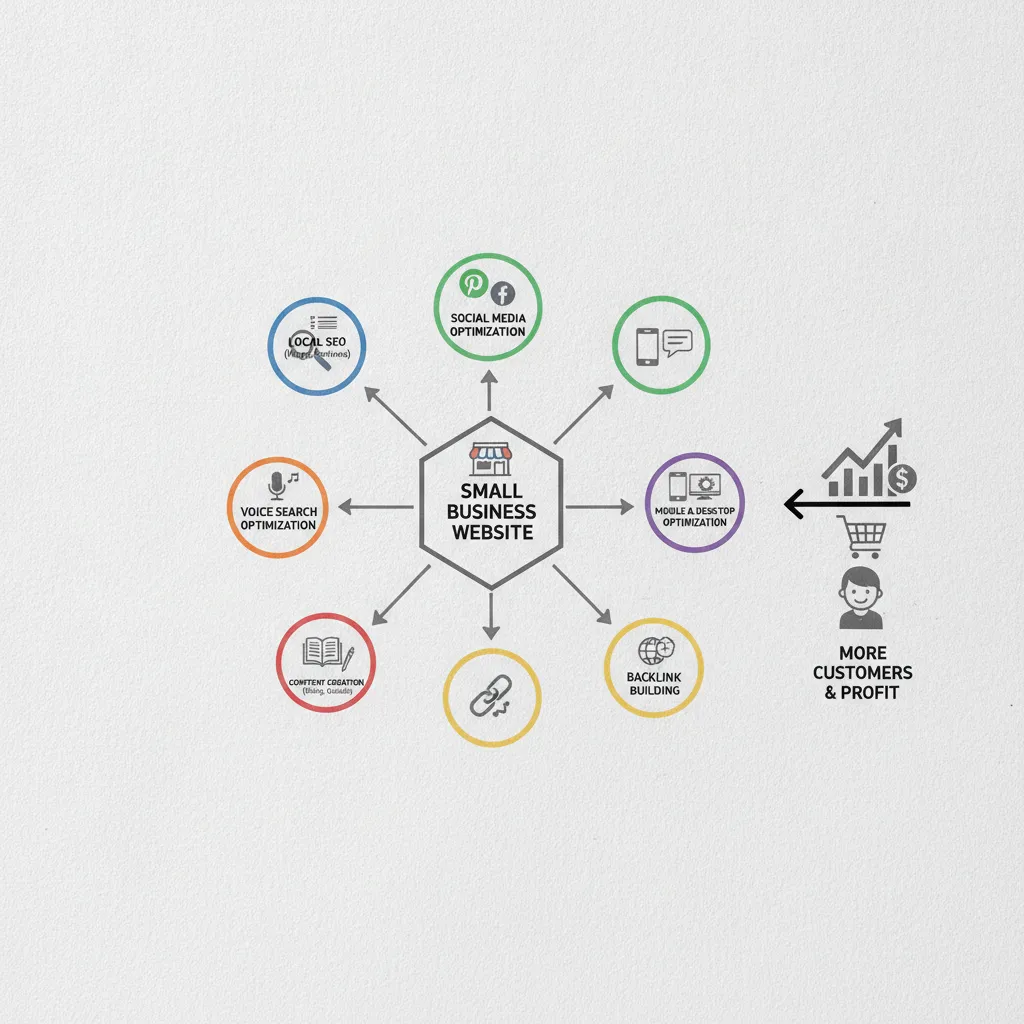
Small business SEO covers three distinct work areas, on-page, off-page, and technical, each with different effort levels and budget implications.
On-page SEO means optimizing the content, title tags, and meta descriptions on each page so search engines understand what you offer. Off-page SEO builds your site's authority through backlinks from other websites and citations in local directories. Technical SEO ensures your site loads fast, works on mobile, and can be crawled and indexed without errors.
"Small businesses that focus on local SEO and consistent content creation consistently outperform those chasing broad, high-competition keywords they can never realistically rank for." — Neil Patel, Co-Founder at NP Digital
On-Page vs. Off-Page SEO: What the Difference Means for Your Budget
On-page work costs mostly time, you control it directly and can start without spending a dollar. Off-page work, particularly earning quality backlinks, takes longer and often requires outreach or content worth linking to. Small businesses can compete on relevance and local authority even without a large budget, because Google's ranking algorithm weighs relevance, authority, and experience signals, and a well-optimized local page can outrank a national brand for a specific neighborhood query.
Search intent shapes which pages you build. Informational intent covers queries like "how to fix a leaking pipe"; navigational intent covers branded searches like "Acme Plumbing Chicago"; transactional intent covers high-purchase-readiness queries like "emergency plumber near me." Each type needs a different page structure and call to action.
Why Local SEO Is a Different Game for Service Businesses
Local SEO, ranking in Google's map pack through your Google Business Profile, is separate from organic SEO and follows its own ranking logic based on proximity, relevance, and review signals. A restaurant, contractor, or boutique hotel should prioritize local SEO first, because map pack clicks convert at a higher rate than standard organic results for service-area searches. According to the U.S. Chamber of Commerce's guide to SEO for small business, local search optimization is one of the highest-return activities a small business can invest time in.
For the full tactical breakdown of each pillar, see our DIY SEO for Small Business: Complete 2026 Guide.
Set Up Your SEO Foundation in Five Steps
Before publishing a single page of content, complete these five setup steps, they determine whether your SEO for small business efforts build on solid ground or stall out.
- Claim and fully complete your Google Business Profile. Fill in your business name, address, phone number, hours, primary category, and upload at least 10 photos. The Google Map Pack drives 30–40% of local clicks, so an incomplete profile directly costs you visibility.
- Install Google Search Console (free) and verify your site. Search Console shows which search queries already generate impressions for your pages, giving you a real baseline before you change anything. Verification takes under 10 minutes via a DNS record or HTML tag.
- Run keyword research using free tools. Google Keyword Planner and the Ahrefs free tier both surface search volume and competition data at no cost. Target 5–10 keywords with clear buyer intent and under 1,000 monthly searches, that's the range where a small site can realistically rank against established competitors.
- Audit your homepage title tag and meta description. Both must include your primary keyword. If you serve a specific area, add a location signal, city or region, directly in the title tag, not just the body copy.
- Check mobile page speed with Google PageSpeed Insights. Google uses mobile-first indexing, meaning it ranks the mobile version of your site, not the desktop version. A slow mobile load time is a ranking ceiling no amount of content quality can overcome.
Choose the Right SEO Tools for a Small Business Budget
Start with free tools: Google Search Console, Google Keyword Planner, and PageSpeed Insights cover steps 2, 3, and 5 above at zero cost. For businesses that want keyword tracking and technical audits without a $200/month platform, Moonrank's $99/month plan handles daily content publishing, schema markup, the structured data that tells AI engines like ChatGPT and Gemini exactly what your business does, and AI search visibility tracking across all four major AI engines in one place.
"The biggest mistake small business owners make with SEO is expecting results in 30 days. SEO is a long-term investment — businesses that commit to 6–12 months of consistent effort are the ones that see compounding returns." — Rand Fishkin, Founder at SparkToro
Local Service Business vs. E-Commerce: Where to Focus First
Local businesses, restaurants, salons, contractors, should prioritize steps 1 and 4 first; your Google Business Profile and location-optimized title tags drive the fastest visibility gains. E-commerce stores should weight steps 3 and 5 more heavily: product-intent keywords and mobile page speed directly affect both Google rankings and conversion rates on the same visit. According to Salesforce's guide to maximizing small business SEO, e-commerce businesses that optimize for mobile page speed see measurably higher conversion rates alongside improved search rankings.
Decide Whether to Do SEO Yourself or Hire Help
Your budget and available time determine which SEO path fits, DIY tools cost $50–$150/month, freelancers run $500–$1,500/month, and agencies start at $2,000–$3,000/month.
Cost-Benefit Analysis: DIY SEO vs. Agency for Budgets Under $1,000/Month
DIY SEO with tools like Google Search Console (free), Ahrefs Starter ($29/month), or Semrush's basic plan ($139/month) gives you keyword research, site audits, and rank tracking. It's a workable option for SEO for small business owners who can commit 10–20 hours per month and run a site under 50 pages. The main risk is slow progress, not harm, as long as you follow Google's published guidelines, you won't damage your site.
A freelance SEO consultant ($500–$1,500/month) typically handles on-page optimization and monthly reporting but rarely produces daily content or technical fixes at scale. Full-service agencies ($2,000–$3,000/month and up) make sense when your market is dense, personal injury law or real estate, for example, where ranking requires serious link-building and content volume. The break-even logic is straightforward: if your time is worth $150/hour, spending 20 hours/month on SEO costs you $3,000 in opportunity cost, the same as an agency retainer.
A middle path worth considering: AI-assisted SEO tools and the best SEO tools for small business in 2026 automate the repetitive work, content generation, technical audits, schema markup, at a fraction of agency pricing. Moonrank, for instance, handles daily automated content publishing and technical AI optimization for $99/month, replacing tasks that would otherwise consume your weekly hours or require a $3,000+ agency retainer. If you want professional output without locking into a long-term contract, SEO agency alternatives are worth exploring before you sign anything.
Avoid the Most Common SEO Mistakes Small Businesses Make
The five SEO mistakes that hurt small businesses most are broad keywords, ignored reviews, thin content, spammy backlinks, and zero tracking.
Fixing these errors costs nothing but time, and each one has a direct, repeatable solution.
Mistake 1: Targeting Keywords That Are Too Broad
Ranking for "shoes" is not a realistic goal for an independent retailer. Add location modifiers and long-tail qualifiers to every target keyword, "women's running shoes Austin TX" attracts buyers, not browsers, and faces far less competition. For more information, see Beyond The Ribbons Why And How To Support Disabled Veteran Owned Businesses.
Mistake 2: Ignoring Google Business Profile Reviews
Businesses with fewer than 10 reviews rank lower in the Google map pack. The fix is a single post-purchase email asking customers to leave a review, automate it once and it runs indefinitely.
Mistake 3: Publishing Thin Service Pages
Google's Helpful Content system demotes pages that don't fully answer a searcher's question [2]. Pages under 400 words rarely qualify. Each service page needs 600–800 words with specific details: pricing ranges, process steps, and real customer outcomes. The FTC's guidance on endorsements and testimonials is also worth reviewing if your service pages include customer reviews, ensuring your content meets both SEO and legal standards.
Mistake 4: Building Backlinks From Spammy Directories
One link from a local newspaper or industry association outweighs 50 generic directory listings. If you've already accumulated low-quality links, Google's Disavow Tool lets you flag them so they don't drag down your rankings.
Mistake 5: Not Tracking Anything
SEO for small business fails most often not from bad tactics but from no feedback loop. Owners who skip Google Search Console miss ranking drops before they become traffic crises. Block 15 minutes each month to review GSC, treat it as a non-negotiable calendar item, not an optional task.
"You can't improve what you don't measure. Small business owners who track even four basic SEO metrics monthly make better decisions and see faster results than those optimizing by gut feel alone." — Aleyda Solis, International SEO Consultant and Founder at Orainti
Track Your SEO Results and Set Realistic Timelines
Most small business SEO strategies take 3–4 months to show ranking movement for low-competition keywords, and 6–12 months in competitive local markets.
New domains take longer still, domain authority builds slowly, and Google needs time to establish trust in a site it hasn't seen before. Set your expectations accordingly before you judge whether your strategy is working. The U.S. Small Business Administration also recommends that small business owners treat their digital presence, including SEO, as an ongoing operational priority rather than a one-time project.
Realistic ROI Metrics and What Good Looks Like at 6 Months
Track four numbers every month, not just keyword rankings. Open Google Search Console for organic impressions and organic clicks, check your Google Business Profile views, and record conversion events, calls, form fills, and booking requests. Rankings alone tell you position; these four metrics tell you whether position translates to revenue.
A local service business that reaches page 1 for three buyer-intent keywords typically sees a 20–40% increase in inbound leads within 6 months, based on industry case study averages. That benchmark is a useful sanity check: if impressions are climbing but calls aren't, your landing pages or calls-to-action need attention, not your keyword targeting.
AI search visibility is now a separate layer to monitor. When a potential customer asks ChatGPT or Perplexity "best [service] near me," your Google rankings don't determine whether you appear, your structured data, citations, and content authority do. Readers who want to track that channel should look at GEO tools 2026 and SaaS AI search visibility for monitoring options. Moonrank, for example, tracks your brand's presence across ChatGPT, Gemini, Claude, and Perplexity automatically, without requiring you to run manual queries each week.
Set a 90-day checkpoint with three concrete targets before you start: rank in the top 20 for two target keywords, earn 5 new Google reviews, and publish 4 optimized service pages. Specific targets make it easy to distinguish a strategy that needs more time from one that needs to change. Businesses that document their SEO goals and review them monthly are significantly more likely to maintain the consistency that SEO requires to deliver compounding results over time.
Frequently Asked Questions
How much does SEO cost for a small business?
Small business SEO costs range from $0 (DIY with free tools) to $3,000–$10,000 per month for a full-service agency. Most small businesses hiring a freelancer pay $500–$1,500 per month. Automated SEO platforms like Moonrank sit at $99/month, covering daily content publishing, technical optimization, and AI search visibility tracking across ChatGPT, Gemini, Claude, and Perplexity. The right budget depends on how competitive your niche is and how fast you need results.
Can a small business do SEO without a website developer?
Yes, most foundational SEO tasks require no coding skills. Platforms like WordPress, Shopify, and Squarespace let you edit page titles, meta descriptions, and URL slugs directly. Technical tasks like schema markup and structured data are harder without developer help, but tools that handle these automatically remove that barrier entirely, letting a non-technical owner cover both content and technical SEO from one dashboard.
What is the fastest way to improve local SEO for a small business?
Claiming and fully completing your Google Business Profile is the single fastest local SEO move you can make. Add your business category, hours, phone number, and at least five photos. Then audit your name, address, and phone number (NAP) across every directory, Yelp, Apple Maps, Bing Places, to make sure the details match exactly. Consistent NAP data is one of the strongest local ranking signals Google uses.
Does SEO still work in 2026 with AI search engines like ChatGPT and Perplexity?
SEO works in 2026, but the definition has expanded beyond Google rankings. Perplexity reported over 100 million weekly queries by late 2024, and ChatGPT now surfaces business recommendations directly in conversation, meaning your content needs to be readable by AI engines, not just Google's crawler. Traditional on-page SEO remains the foundation, but businesses that also add structured data, schema markup, and llms.txt configuration are the ones AI engines cite and recommend. Ignoring AI search now means ceding ground to competitors who don't.
How long does it take for SEO to work for a small business?
Most small businesses begin to see measurable ranking movement within 3–6 months for low-to-medium competition keywords. Highly competitive local markets, such as legal services or real estate, can take 9–12 months before significant organic traffic arrives. New domains typically take longer because Google builds trust in a site gradually. The key is consistent effort: publishing optimized content, earning reviews, and fixing technical issues every month rather than in sporadic bursts.

Conclusion
The businesses that win at SEO in 2026 treat it as a system, not a one-time task: consistent keyword-targeted content, clean technical signals, and a Google Business Profile that stays current. Start with the steps that compound fastest, keyword research, on-page optimization, and local citations, before moving to link building and content scaling.
One thing most small business guides skip: Google rankings are no longer the only scoreboard. ChatGPT, Gemini, and Perplexity now send customers directly to businesses they can read and trust. If you want to show up in those recommendations without hiring an agency or writing daily content yourself, take a 3-day free trial at moonrank.ai and see where your business stands in AI search today.
Sources & References
- SEO for Beginners: A Small Business Guide to Getting Found Online | CO- by US Chamber of Commerce
- Maximize Your Small Business SEO With These 5 Tips — Salesforce
- Strengthen Your Digital Presence — U.S. Small Business Administration
- FTC Endorsement Guides: What People Are Asking — Federal Trade Commission
Recommended Articles
Explore more from our content library: