Small Business SEO on a Limited Budget: A Complete Guide
Master seo for small business budget with proven strategies. Learn how to spend $500–$2,500/month on local SEO, content, and technical fixes that drive real results.

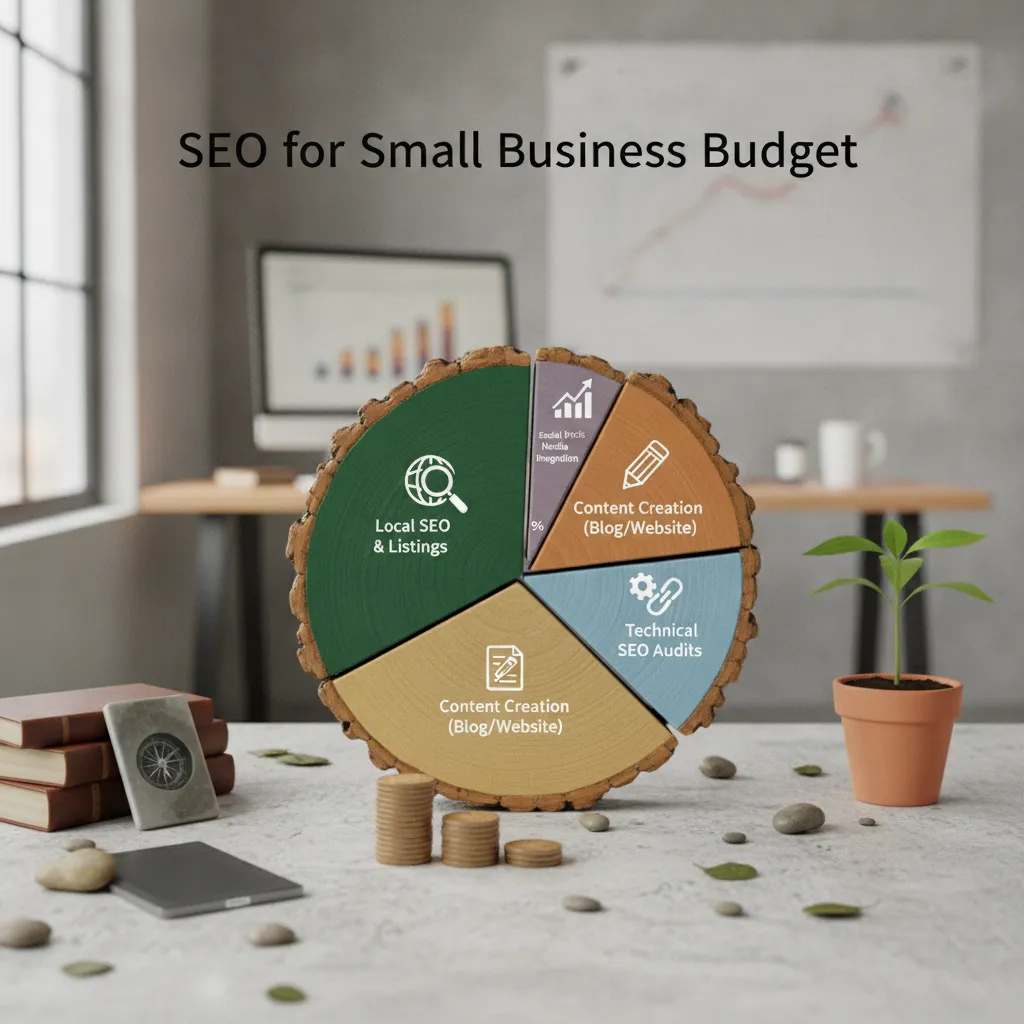
Understanding seo for small business budget is essential. Small businesses should typically spend between $500 and $2,500 per month on SEO, depending on their industry, competition level, and revenue targets. Local service businesses can often see results at the lower end, while e-commerce stores competing nationally need closer to $2,000–$5,000 monthly. The smartest approach: focus 80% of your budget on the handful of activities, technical fixes, local listings, and content targeting buyer-intent keywords, that drive the majority of organic traffic gains.
How Much Should a Small Business Spend on SEO for a Tight Budget?: seo for small business budget
Your SEO budget should equal 25–40% of your total marketing spend, and that total should sit at 7–8% of gross revenue, per U.S. Small Business Administration guidance on managing business finances.
For a business generating $500,000 annually, that means a total marketing budget of roughly $35,000–$40,000 per year, or about $3,000 per month. At a 25–40% SEO allocation, your seo for small business budget lands between $750 and $1,200 per month, a realistic range that aligns with what most small businesses actually spend.
"Small businesses that invest consistently in SEO — even at modest budget levels — outperform those relying solely on paid advertising over a 12-month horizon. The compounding nature of organic search rewards patience and consistency above all else." — Rand Fishkin, Founder of SparkToro and Moz
Industry-Specific Budget Recommendations: E-Commerce vs. Service-Based vs. Local
Budget requirements vary significantly by business type, competition level, and geographic scope. Use these ranges as starting benchmarks, not ceilings.
- Local service businesses (plumbers, dentists, salons): $500–$1,500/month. Local SEO, Google Business Profile optimization, local citations, and neighborhood-specific content, delivers strong returns at this price point.
- E-commerce stores competing regionally or nationally: $2,000–$5,000/month. Product page optimization, category content, and technical site health require more sustained investment at scale.
- B2B service firms (consultants, agencies, SaaS): $1,500–$3,000/month. Longer sales cycles mean content targeting mid-funnel and bottom-funnel keywords earns a premium over time.
Businesses at the lowest budget tier, under $750/month, should prioritize DIY execution before outsourcing. Our DIY SEO for Small Business: Complete 2026 Guide covers exactly where to start.
What the 70/20/10 Marketing Budget Rule Means for Your SEO Allocation
The 70/20/10 rule gives small businesses a practical framework for splitting a fixed marketing budget across channels with different risk profiles.
- 70% goes to proven, traction-established channels, SEO qualifies here once you have six or more months of ranking history.
- 20% goes to emerging tactics, AI search optimization (getting your business recommended by ChatGPT, Gemini, and Perplexity) belongs in this bucket right now.
- 10% goes to experiments, new platforms, content formats, or distribution tests.
Applied to a $3,000/month total marketing budget: $2,100 to proven SEO activity, $600 to AI search visibility, and $300 to experiments. That $600 AI search allocation, for context, covers a full month of automated optimization through a platform like Moonrank, which tracks and improves your visibility across ChatGPT, Gemini, Claude, and Perplexity for $99/month, with budget left over.
Skipping SEO entirely is not a neutral choice. Businesses that rely solely on paid ads spend 3–5x more per visitor than those with established organic rankings, making SEO the lower long-term cost even at $1,500 per month.
The 80/20 Rule of SEO: Which Activities Deliver Results on a Small Business Budget?
Four SEO activities, GBP optimization, technical fixes, buyer-intent content, and quality backlinks, generate the majority of organic results for most small businesses.
Which 20% of SEO Activities Deliver 80% of Results for Small Businesses
When managing SEO for a small business budget, four activities consistently outperform everything else at low spend:
- Google Business Profile (GBP) optimization. A complete, regularly updated GBP profile drives local pack rankings and map visibility, the highest-converting real estate in local search, at zero direct cost beyond time.
- Fixing critical technical errors. Core Web Vitals failures and crawlability blocks prevent Google from indexing your pages at all. Fixing these first removes a ceiling on every other SEO effort.
- Creating 5–10 pieces of buyer-intent content per quarter. Pages targeting searches like "emergency plumber [city]" or "best accounting software for freelancers" convert at far higher rates than broad informational articles. Fewer, more targeted pages beat a high volume of generic ones.
- Earning 3–5 quality backlinks per month. A small number of relevant, authoritative links moves rankings faster than dozens of low-quality directory submissions.
What to cut: broad informational content, social signals, and chasing domain authority as a standalone metric. These consume budget without moving revenue-linked rankings.
A local plumber spending $800/month on GBP optimization and two buyer-intent blog posts routinely outperforms a competitor spending $2,000/month on generic content and social media, because the spend targets decisions, not awareness.
According to Search Engine Land, businesses that align their SEO investment with specific buyer-intent keywords consistently see higher conversion rates than those pursuing broad traffic volume strategies.
Is SEO Still Worth It in 2026, and How Does AI Search Change Your Spending Priorities?
SEO remains worth the investment in 2026, but the definition of "optimized" has expanded to include AI search engines alongside Google.
ChatGPT, Perplexity, and Gemini now surface business recommendations directly in their answers. To be cited by these engines, your content needs schema markup, the structured data that tells AI systems exactly what your business does, where it operates, and who it serves, and clear entity signals that establish your brand as a recognizable, trustworthy source. These are no longer advanced tactics reserved for large budgets; they are baseline requirements even at $500/month. For more information, see Enso.
"The businesses winning in AI-powered search are not necessarily the ones with the biggest budgets — they are the ones with the clearest, most structured content that answers specific questions completely. Schema markup and entity clarity have become table stakes for any serious SEO effort." — Lily Ray, Senior Director of SEO at Amsive Digital
Tools like Moonrank handle schema markup, llms.txt configuration, and structured data automatically, making AI-readability accessible without technical expertise. For a full breakdown of tools that execute these high-ROI activities, see our guide to AI SEO tools for small business.
DIY SEO vs. Hiring an Agency: ROI Comparison for Small Business Budgets
For most small businesses, DIY SEO costs $600–$1,050/month in real economic terms, while agencies run $500–$10,000+/month depending on scope and deliverables.
How DIY SEO Costs Compare to Agency Services in Time and Money
DIY SEO is not free. Tool subscriptions alone, Ahrefs, Semrush, or AI SEO tools, run $100–$300/month. Add 10–15 hours of owner or staff time each month, and at a $50/hour opportunity cost, the true economic cost reaches $600–$1,050/month before you see a single ranking move.
Agency pricing breaks into three tiers. Freelancers charge $500–$1,500/month but typically cover one or two deliverables, on-page optimization or content, not a full strategy. Boutique agencies at $1,500–$3,000/month offer full-service SEO including technical audits, content, and link building. Large agencies start at $3,000 and run past $10,000/month, adding dedicated account management and multi-channel reporting.
When planning seo for small business budget decisions, timeline matters as much as price. Agencies typically deliver first measurable ranking improvements in 3–6 months. DIY timelines run 6–12 months because of the learning curve, a real cost when every month without traffic is a month without leads.
What Results Can You Realistically Expect at Different Budget Tiers?
For businesses under $500K in annual revenue, the hybrid model produces the best return. Handle technical and content work yourself using AI SEO tools, Moonrank automates daily content publishing and technical optimization for $99/month, then pay a consultant $500–$800/month for strategy and link building.
This split keeps total spend under $1,000/month while covering the two areas where expertise matters most. Readers weighing each path can explore SEO agency alternatives and AI SEO tools for small business for a deeper breakdown of both options.
Hidden Costs and Budget Pitfalls That Derail Small Business SEO Spending
Most small businesses waste their SEO budget on tools they don't use, services that backfire, and timelines too short to show results.
Common SEO Budget Mistakes Small Businesses Make and How to Avoid Them
Five mistakes account for the majority of wasted SEO spending in small business budgets:
- Paying for tools they don't use. Small businesses average 4–6 overlapping SEO tools at $50–$200/month each. A consolidated AI SEO platform at $99/month, such as Moonrank, typically covers 80% of the same functionality.
- Buying cheap link-building services. Link farms charge $200–$500 upfront, but the resulting Google penalty can require $3,000–$8,000 in disavow work and manual recovery, a budget disaster no small business can absorb.
- Canceling before month four. SEO compounds over time. Businesses that expect results in 30–60 days and cancel early forfeit all the authority they built.
- Ignoring technical debt. Slow load times and broken mobile layouts cancel out content investment. Google's Core Web Vitals directly affect ranking, fixing them is not optional.
- Tracking rankings, not conversions. A page-one ranking that drives zero purchases is a vanity metric. Conversion tracking reveals what actually moves revenue.
Which Tools and Software Costs Should You Factor Into Your SEO Budget?
Every seo for small business budget should include four baseline tools from day one:
- Google Search Console, free; monitors indexing, clicks, and manual penalties
- Rank tracker, $15–$30/month for a basic plan (e.g., Wincher or SerpRobot)
- Content optimization tool, $30–$79/month (e.g., Clearscope or Frase)
- Local citation manager, $20–$40/month (e.g., BrightLocal or Whitespark)
According to the SCORE Association, a nonprofit small business mentoring organization, small businesses that use even a basic set of digital marketing tools consistently outperform those relying on intuition alone when it comes to online visibility and lead generation.
If AI search visibility is part of your 2025–2026 plan, and it should be, budget separately for GEO-specific tooling. Our GEO tools 2026 guide breaks down the best options at every price point for businesses tracking visibility across ChatGPT, Gemini, Claude, and Perplexity.
How to Calculate Your SEO Budget Using Revenue Targets and Customer Lifetime Value
Set your SEO budget by working backward from customer lifetime value and revenue goals, not by copying what competitors spend or picking a round number.
This five-step formula gives any small business a defensible, math-backed monthly SEO spend tied directly to business outcomes.
- Calculate customer lifetime value (CLV). Multiply average order value by purchase frequency and average customer lifespan.
- Set a monthly organic customer target. Decide how many new customers per month you want SEO to deliver.
- Apply your organic conversion rate. Divide your customer target by your site's organic conversion rate to find the visitor volume you need.
- Estimate cost-per-organic-visitor for your niche. Typical ranges run $0.50–$3.00 per visitor, depending on content production and technical work required.
- Multiply visitors needed by cost-per-visitor. The result is your justified monthly SEO budget.
A Concrete Worked Example
A home services company with a $2,400 CLV wants 5 new customers per month from organic search. At a 2% organic conversion rate, that requires 250 organic visitors per month. At a cost-per-visitor of $1.50, the justified minimum SEO budget is $375/month, a figure that scales upward as traffic compounds over time.
For e-commerce-specific ROI benchmarks, see our guide to AI SEO for e-commerce. For a proven content investment tactic that feeds this traffic model, read How to Optimize Product Descriptions With AI in 2026.
How to Measure SEO ROI and Justify Your Spending to Stakeholders
Track four numbers monthly: organic sessions, leads from organic, close rate, and average deal value. Then apply this formula:
SEO ROI % = (Organic Revenue Generated ÷ Monthly SEO Spend) × 100
If organic traffic generated $4,500 in revenue against a $375 spend, your SEO ROI is 1,100%, a number any stakeholder can evaluate without understanding keyword rankings.
Real-world benchmarks give this context: businesses spending $1,000–$2,000/month on focused SEO for 12 months typically see 40–120% increases in organic traffic, and e-commerce stores that fund both content and technical SEO see 3–8x ROI over 18 months. Those are the benchmarks a well-structured SEO budget for a small business should be measured against, not month-one rankings.
Tools like Moonrank compress this timeline by automating daily content publishing and technical optimization, schema markup, structured data, citation building, for $99/month, a fraction of the $3,000+ agencies charge for the same outputs.

Frequently Asked Questions
Can a small business do SEO with a $300/month budget?
Yes, $300/month can fund a meaningful SEO effort if you concentrate it on one or two high-impact activities. The most effective allocation at this level is local SEO: keeping your Google Business Profile current, building citations on directories like Yelp and Bing Places, and publishing one well-researched blog post per week. Paid tools like Google Search Console and Google Analytics are free. Automated platforms such as Moonrank ($99/month) can handle daily content publishing and technical optimization, leaving room in a $300 budget for targeted link-building or a freelance content review.
How long does it take to see results from SEO on a small business budget?
Most small businesses see measurable organic traffic gains within 3 to 6 months of consistent SEO work. Local SEO signals, Google Business Profile updates, citation consistency, and review volume, can move rankings faster, sometimes within 4 to 8 weeks. Competitive national keywords take longer, often 6 to 12 months. Budget constraints slow results mainly because they limit content output and link acquisition speed; daily automated publishing compresses that timeline by keeping your site active without requiring manual effort each week.
What is the minimum SEO budget for a local business to rank on Google?
A local business can start ranking with as little as $100 to $200/month if it focuses exclusively on local SEO signals. That means a fully optimized Google Business Profile, consistent NAP (name, address, phone) data across directories, and a steady stream of customer reviews. Adding even one optimized location page per month accelerates results. Businesses in competitive local markets, multi-location restaurants, hotels, or specialty retail, typically need $300 to $500/month to outpace established competitors with stronger domain authority and review counts.
Should a small business invest in SEO or Google Ads first?
SEO first is the better long-term choice for most small businesses with limited budgets. Google Ads stops generating traffic the moment you stop paying; SEO compounds over time. That said, Ads make sense when you need leads within days, a new product launch or a seasonal promotion, while SEO builds. A practical split for a $500/month budget: spend $150 on Ads for immediate visibility on your highest-intent keyword, and put the remaining $350 into SEO content and technical optimization for durable organic growth.
How should a small business prioritize SEO spending when the budget increases?
When your seo for small business budget grows, invest additional funds in this order: first, expand content production targeting new buyer-intent keywords; second, increase link-building outreach to earn higher-authority backlinks; third, invest in conversion rate optimization so existing organic traffic generates more revenue. Avoid spreading a budget increase across too many new tools simultaneously. Each incremental dollar should deepen your presence in one channel before funding another, ensuring measurable returns at each stage of growth.

Conclusion
A tight budget does not disqualify a small business from ranking, it demands sharper prioritization. The businesses that get the most from limited SEO spend share three habits: they fix technical foundations before chasing new content, they concentrate on local signals where competition is thinner, and they publish consistently rather than in bursts.
If you take one action today, audit your Google Business Profile for completeness and fix any NAP inconsistencies across your top five directory listings. That single step costs nothing and produces measurable local ranking improvements within weeks.
For businesses ready to go further, including showing up in AI-powered searches on ChatGPT, Gemini, and Perplexity, visit www.moonrank.ai to start a 3-day free trial and see where your brand currently stands in AI search results.
Recommended Articles
Explore more from our content library: