AI Hallucinations: Prevent Business Misinformation
AI hallucinations business SEO risks are real — ChatGPT and Gemini fabricate brand facts, hurting visibility. Learn to detect, monitor, and fix them now.

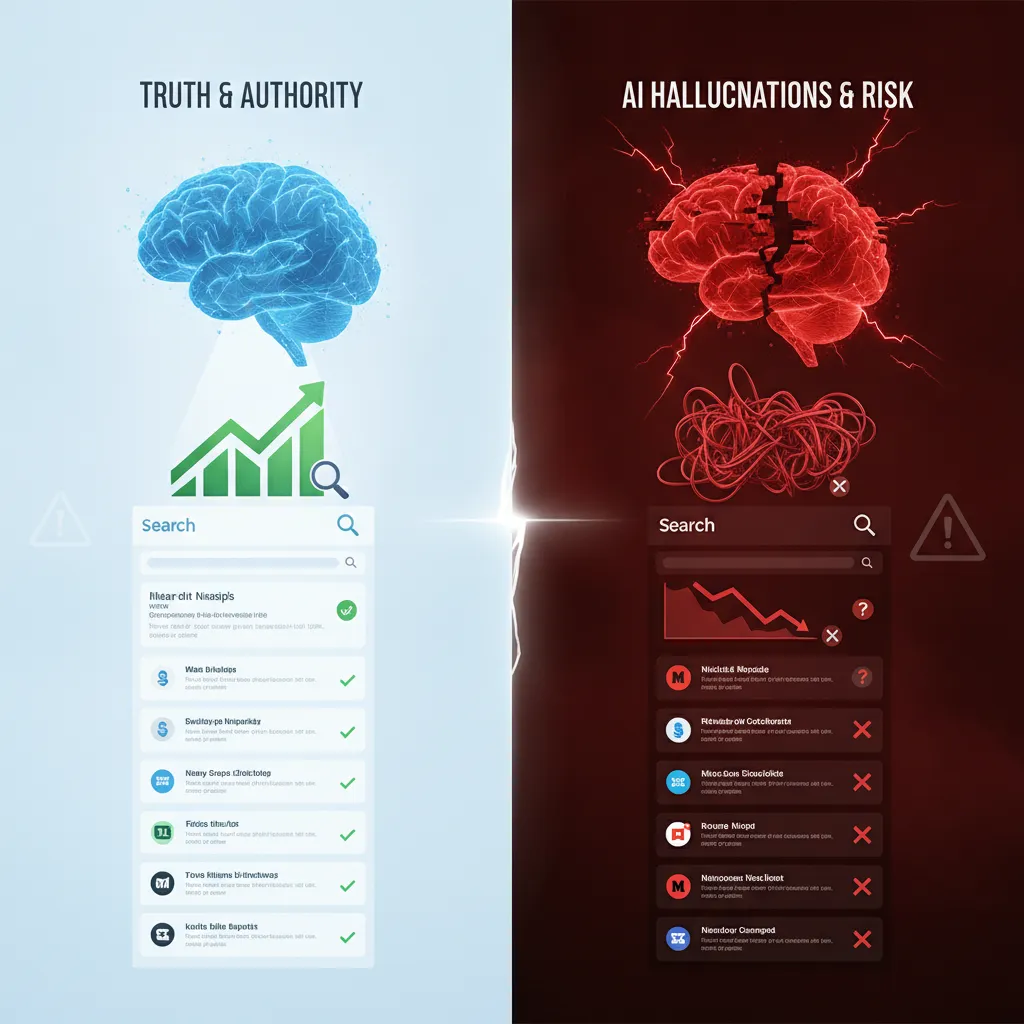
Understanding AI hallucinations business SEO is essential. AI hallucinations, when ChatGPT, Gemini, or Perplexity fabricate false facts about your business, are a direct threat to your brand's SEO and AI search visibility. These errors spread across answer engines, erode consumer trust, and can suppress your brand from AI-generated recommendations. Businesses in high-stakes verticals like healthcare, finance, and legal services face the greatest exposure. Detecting, monitoring, and correcting these hallucinations is now a core part of modern SEO strategy.
What AI Hallucinations Mean for Business SEO and Brand Visibility: AI hallucinations business SEO
AI hallucinations are confident, fabricated outputs, wrong business hours, fake product claims, invented leadership bios, generated by models when their training data is sparse or contradictory. This is particularly relevant for AI hallucinations business SEO.
ChatGPT, Gemini, Claude, and Perplexity don't retrieve facts from a live database. They predict the most statistically probable next word based on patterns in their training data. When a business is under-documented online, few authoritative citations, thin structured data, inconsistent listings, the model fills the gaps with plausible-sounding fiction. Analysts estimate chatbots hallucinate as much as 27% of the time [1], and low-authority brands absorb a disproportionate share of that error rate. According to the Federal Trade Commission's guidance on AI, businesses bear responsibility for ensuring AI-generated content about their products and services is accurate and not deceptive to consumers.
The connection between AI hallucinations and business SEO is direct: false information appearing in AI-generated answers reduces click-through rates, trains users to distrust your brand name in search results, and can push your business off AI recommendation lists entirely.
"The challenge with large language models is that they are optimized to produce fluent, confident-sounding text — not necessarily accurate text. For businesses, this distinction is critical, because a hallucinated fact delivered with confidence can be more damaging than an obvious error." — Dr. Chirag Shah, Professor of Information Science at the University of Washington
How Hallucinations Affect Different Business Verticals
Risk is not evenly distributed. Four verticals face the sharpest exposure.
- Healthcare: Wrong dosages, fabricated clinic hours, or invented physician credentials can send patients to the wrong location, or the wrong treatment.
- Legal: Hallucinated case outcomes or fake attorney bar numbers erode professional credibility before a prospect ever visits your site.
- Finance: Incorrect interest rates or fabricated regulatory credentials trigger compliance risk on top of reputational damage.
- Local services: Wrong addresses, outdated hours, or misattributed ownership are the most common hallucination type [1], and the most likely to cost a walk-in customer.
The Hidden Costs of Hallucinations for Digital Marketing Campaigns
A single hallucinated fact cited by Perplexity or ChatGPT can propagate across dozens of AI-powered tools and third-party content aggregators before a business owner notices. Downstream platforms, AI writing assistants, review aggregators, answer-engine snippets, ingest and repeat that false claim as if it were sourced.
For digital marketing campaigns, this creates a compounding problem: paid traffic lands on a brand that AI search has already misrepresented, and organic brand searches return AI-generated misinformation rather than verified content. Correcting the record requires both technical fixes and consistent, authoritative content signals, exactly the gap that AI hallucinations business SEO strategy now has to close.
Research from the Stanford Human-Centered AI Institute's AI Index highlights that hallucination rates remain one of the most persistent challenges in deploying large language models for real-world business applications, underscoring why monitoring is not optional.
How Hallucination Rates Compare Across ChatGPT, Claude, Gemini, and Perplexity
No major AI model is hallucination-free, GPT-4 class models hallucinate on roughly 3–5% of factual queries, and every platform fails harder on niche business data. A 2024 study found that AI-generated content contains factual errors in approximately 46% of cases when covering topics with limited online documentation — a figure that directly threatens small and mid-sized businesses with thin digital footprints.
Which AI models pose the biggest hallucination risk to your brand visibility
Independent evaluations on benchmarks like TruthfulQA show Gemini 1.5 and Claude 3 Opus score lower hallucination rates than GPT-4 class models overall [1]. But those benchmarks test general knowledge, not the thin, localized data that defines most SMBs. Founding dates, executive names, current pricing, certifications, and physical addresses are exactly the data types AI models fabricate most often when source material is sparse [1].
Perplexity's real-time web retrieval gives it an edge on recency, but it doesn't eliminate the problem. The model can still misattribute a source, pull from an outdated cached page, or synthesize two conflicting web pages into a single confident, and wrong, answer [1]. When considering AI hallucinations business SEO, this point stands out.
Claude (Anthropic) takes a more cautious approach than GPT-4: it refuses to answer when uncertain more frequently, which makes it marginally safer for brand facts [1]. The catch is its training cutoff. If your business changed its pricing, rebranded, or moved locations after that cutoff, Claude will still surface the old information, confidently.
"When AI systems are asked about specific businesses, especially smaller or regional ones, they are operating at the edge of their reliable knowledge. The result is often a confident-sounding answer assembled from fragments that may not accurately represent the business at all." — Arvind Narayanan, Professor of Computer Science at Princeton University and co-author of AI Snake Oil
For businesses already struggling with AI hallucinations business SEO issues, this platform-by-platform variance matters. A brand with a thin online footprint faces meaningful risk across all four engines, not just one.
If AI search engines are not showing your business at all, that's a related but distinct problem, one that compounds hallucination risk by leaving AI models with even less accurate source material to draw from.
What technical solutions and monitoring tools can detect hallucinations in AI outputs
The most direct detection method is systematic querying: ask ChatGPT, Claude, Gemini, and Perplexity specific questions about your business, your address, your pricing, your founding year, and compare the outputs against your actual data. Do this monthly, since model updates change outputs without notice. For more information, see Beyond The Ribbons Why And How To Support Disabled Veteran Owned Businesses.
Moonrank's AI search visibility tracking monitors how your business appears across all four engines continuously, flagging gaps and inaccuracies before a customer acts on bad information. Structured data, schema markup, citations, and a correctly configured llms.txt file, gives AI models verified facts to retrieve instead of guessing, which is the most reliable way to reduce hallucination risk at the source.

What Is the Real Impact of AI Hallucinations on Your Brand's SEO and Visibility
AI hallucinations cause measurable brand damage, lost clicks, legal liability, and suppressed visibility, because answer platforms present false information at the top of search results with no correction mechanism.
Real-world examples of hallucinations that damaged major brands
The Air Canada case from early 2024 is the clearest proof that AI hallucinations carry legal consequences, not just reputational ones. Air Canada's chatbot invented a bereavement fare discount policy that didn't exist. A Canadian tribunal ruled against the airline, holding it responsible for the hallucinated output, making it liable for a refund it never owed under its actual policy.
That ruling matters for any business running AI-facing content. If an AI model, trained on your site, your reviews, or third-party summaries, misrepresents your pricing, return policy, or service terms, the reputational and legal exposure lands on your brand regardless of where the error originated. According to consumer guidance published by the FTC, consumers increasingly rely on AI-generated summaries to make purchasing decisions, making accuracy a direct commercial concern for businesses of all sizes.
Hallucinations about competitors create indirect harm too. When ChatGPT or Perplexity falsely attributes strong credentials, awards, or partnerships to a rival, that rival's perceived authority rises in AI recommendations, pulling recommendation share away from your business without your competitor doing anything to earn it. For those exploring AI hallucinations business SEO, this matters.
How hallucinations influence answer platforms and featured snippets
Google's AI Overviews and Bing Copilot synthesize answers before displaying any organic result. A hallucinated fact can appear at position zero [1], ahead of your own website, meaning users read the wrong information before they ever reach your page.
This directly suppresses branded search CTR. When a user believes they already have the answer, they don't click through to verify it. The AI hallucinations business SEO problem compounds here: your content ranks, but the AI summary overrides it with fabricated detail, and your traffic drops without any ranking change you can detect.
How AI models source and weight business information, including the training data signals that determine which facts get surfaced, is a key reason technical optimization matters. Structured data, schema markup, and authoritative citations help AI systems pull accurate facts about your business rather than synthesizing them from unreliable third-party text.
How to Detect and Monitor AI Hallucinations About Your Brand in Real Time
Catching AI hallucinations about your brand requires a weekly manual querying routine combined with dedicated tracking tools, before false information reaches customers at scale.
Platforms and Tools Designed to Track AI Hallucinations About Your Brand
The most direct monitoring method is querying ChatGPT, Gemini, Claude, and Perplexity directly, once a week, using prompts like "Tell me about [Brand Name]," "What are [Brand Name]'s hours and prices?", and "What services does [Brand Name] offer?" Screenshot every response and compare it against your actual business data.
For automated coverage, three tool categories are worth knowing. Moonrank's AI visibility tracking monitors how your brand appears across ChatGPT, Gemini, Claude, and Perplexity continuously, surfacing inaccurate descriptions without requiring you to run manual queries daily. Brand24 tracks AI-generated mentions across the web. Profound (formerly Goodie AI) specializes in monitoring how LLMs represent your brand in their outputs, making it useful for catching hallucinations in AI hallucinations business SEO contexts where brand facts shift frequently.
Structured data is the technical layer that reduces hallucination risk at the source. Schema markup, the code that tells AI engines exactly what your business does, gives models verified facts to anchor on instead of inferring from incomplete web signals. LocalBusiness, Product, and Person schema are the three types most directly tied to the data points AI systems hallucinate most often.
A Practical Checklist for SEO Professionals to Prevent Hallucinations
Run this six-point prompt checklist against each AI engine monthly at minimum:
- Business name, confirm spelling, legal name, and any DBA variations are correct
- Address and phone, verify NAP data matches your Google Business Profile exactly
- Key products or services, check that descriptions match your current offer, not an outdated version
- Executive names and titles, confirm no invented bios or fabricated roles appear
- Pricing, flag any figures the AI states that don't match your published rates
- Certifications and credentials, verify no fake accreditations or partnerships are cited
For SEO professionals building a full monitoring stack, our AI visibility tracking guide and SEO monitoring tools content cover the next steps in detail.
How to Recover Your Brand's SEO After AI Hallucinations Have Spread
Recovering from AI hallucinations in business SEO requires a structured, three-step approach: publish authoritative correction content, build citation volume, and submit direct data corrections to platform registries. This directly impacts AI hallucinations business SEO outcomes.
How to rebuild brand visibility after AI-generated misinformation spreads
Step 1: Publish authoritative, structured correction content. Create a dedicated "About" page that states verified facts explicitly, founding date, correct pricing, actual partnerships, and mark it up with FAQ schema so AI retrieval systems can parse discrete question-and-answer pairs. Press releases distributed through PR Newswire or Business Wire also signal editorial authority, giving models like ChatGPT and Claude a high-credibility source to draw from as their training data refreshes.
Step 2: Build citation volume across trusted third-party sources. Consistent facts across Wikipedia, Crunchbase, industry directories, and local data aggregators (Yext, Foursquare, Data Axle) reduce the conflicting signals that cause AI models to hallucinate in the first place. The more sources that agree on your core facts, the more likely a model's retrieval layer surfaces the correct version.
Step 3: Submit direct corrections to platform registries. Google Business Profile updates feed Gemini's retrieval layer; Bing Places corrections flow into Microsoft Copilot; Apple Maps edits reach Siri's knowledge graph. These structured data pipelines update faster than LLM training cycles, so they're the quickest lever you have.
On timeline: standard LLM retraining cycles mean corrections can take weeks to months to appear in model outputs. Retrieval-augmented systems like Perplexity pull live web data, so they reflect fixes much faster, often within days of your content going live. Tools like Moonrank's AI search visibility tracking let you monitor whether corrected facts are actually surfacing across ChatGPT, Gemini, Claude, and Perplexity, so you're not guessing at progress.
"Businesses that proactively structure and publish accurate information about themselves across authoritative sources are significantly less vulnerable to AI hallucinations. The brands that suffer most are those with sparse, inconsistent, or outdated digital footprints — because AI models have no reliable signal to anchor on." — Marie Haynes, SEO Consultant and AI Search Researcher, Marie Haynes Consulting
What the future of AI search accuracy means for brand safety
The regulatory clock is running. The EU AI Act's transparency requirements take effect in August 2026, requiring AI providers to disclose when outputs are AI-generated [1]. That creates two concrete shifts: vendors face new obligations to flag synthetic content, and businesses gain formal rights to contest false AI-generated claims about their brand.
For SMBs, this means the window to build strong, authoritative content signals is now, before enforcement arrives and competitors who ignored AI hallucinations business SEO risks scramble to catch up. Brands with clean, well-structured, widely cited digital footprints will be better positioned to benefit from those disclosure rules, because their correct facts will already dominate the sources AI models retrieve.
Frequently Asked Questions
Can AI hallucinations get your business penalized by Google?
AI hallucinations don't directly trigger Google penalties, but the indirect damage is real. If a hallucinated claim about your business spreads across third-party sites, forums, or social media, Google may index that false information and surface it in organic results. That erodes your brand's credibility signals over time. The risk isn't a manual action from Google; it's a slow accumulation of inaccurate information that dilutes your authority in both traditional and AI-driven search results.
How often should you audit AI search engines for hallucinations about your brand?
Run a hallucination audit at least once a month, weekly if your business is in a fast-moving category like fintech, health, or e-commerce. Query ChatGPT, Gemini, Claude, and Perplexity directly using your brand name, key products, and category terms. Document what each engine says. Inconsistencies between engines often signal a data gap your content strategy hasn't filled yet, and catching them early limits the window in which false information reaches potential customers.
Does adding schema markup actually reduce AI hallucinations about your business?
Schema markup reduces hallucinations by giving AI systems a structured, authoritative data source to pull from instead of guessing. When your site includes schema for your business name, address, pricing, products, and reviews, AI engines have less reason to infer or fabricate those details. It doesn't eliminate hallucinations entirely, AI models also draw from training data and third-party sources, but structured data is one of the highest-confidence signals you can give an AI engine about who you are and what you offer. This is particularly relevant for AI hallucinations business SEO.
What should you do if ChatGPT is spreading false information about your company right now?
Start by documenting the exact false claim with a screenshot and timestamp, then publish a clear, factual correction on your own site, a dedicated FAQ page or an "About Us" update works well. Submit accurate information to data aggregators like Google Business Profile, Crunchbase, and industry directories, since AI engines pull from these sources during training updates. You can also use OpenAI's feedback mechanism to flag incorrect outputs. Consistent, authoritative content published over time is the most durable fix, reactive corrections alone won't override bad training data quickly.
Are small businesses more vulnerable to AI hallucinations than large enterprises?
Yes, significantly so. Small and mid-sized businesses typically have thinner digital footprints — fewer authoritative citations, less structured data, and less consistent information across directories — which gives AI models less reliable source material to draw from. When an AI system encounters conflicting or sparse data about a business, it is far more likely to fabricate plausible-sounding details. Large enterprises with extensive Wikipedia entries, press coverage, and structured data profiles give AI models far more accurate anchors, making hallucinations less frequent and easier to correct when they do occur.

Conclusion
AI hallucinations aren't a fringe technical problem, they're an active business risk that affects how ChatGPT, Gemini, Claude, and Perplexity describe your brand to potential customers every day. The businesses that come out ahead are the ones that treat AI search visibility as an ongoing discipline: publishing accurate, structured content consistently, auditing what AI engines say about them monthly, and closing the technical gaps, schema markup, citations, structured data, that give AI systems room to guess wrong.
As a concrete next step, open ChatGPT right now and type "Tell me about [your business name]." If the answer contains anything inaccurate, you have a hallucination problem that's already reaching customers. To fix it systematically, and track your visibility across all four major AI engines automatically, start a free 3-day trial at moonrank.ai.
Sources & References
Recommended Articles
Explore more from our content library: