Understanding AI Search Engine Algorithms
AI search engine algorithms are the layered systems — combining crawling, indexing, ranking models, and increasingly large language models (LLMs) — that...
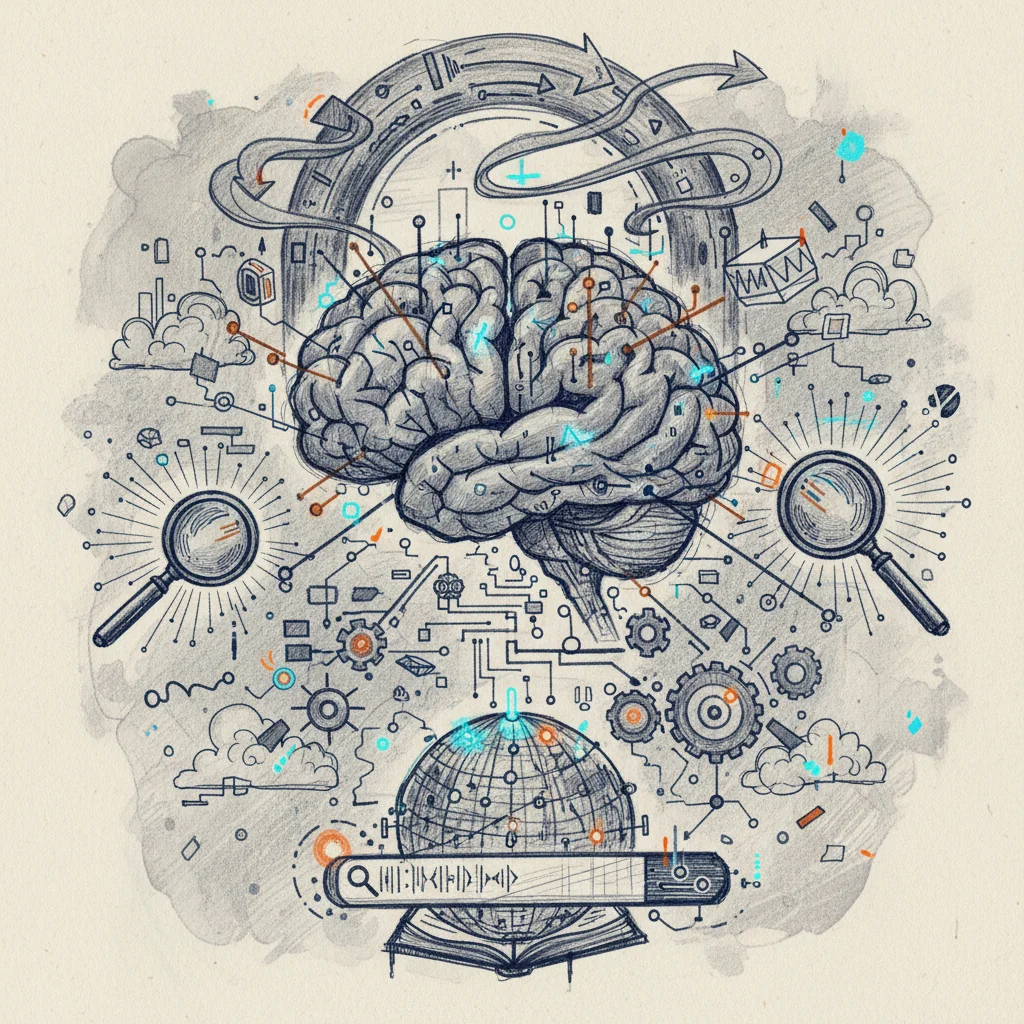
AI search engine algorithms are the layered systems, combining crawling, indexing, ranking models, and increasingly large language models (LLMs), that decide which results appear when you search. Traditional engines like Google use three core stages: crawl, index, and rank. Modern AI-native engines like Perplexity skip the blue-link model entirely, synthesizing answers directly from indexed sources using LLMs. Understanding how these systems work helps your business get found by both classic search and AI-generated recommendations.
What Are AI Search Engine Algorithms and How Do They Work?
AI search engine algorithms are rule-based or model-driven procedures that locate, score, and present information from a large data space in response to a query.
The term actually covers two distinct definitions that readers frequently conflate. In computer science, a search algorithm is a graph-traversal procedure, a method for finding a path through a problem space. In industry, the same phrase refers to the full retrieval-and-ranking pipeline inside engines like Google or Perplexity. Both definitions are correct; the context determines which one applies.
Virtually every AI search system, classical or modern, shares three core components: a retrieval layer that fetches candidate documents, a ranking and scoring model that orders them by relevance, and a result-presentation layer that formats what the user sees. Modern AI-native engines add a fourth step: an LLM synthesis layer that converts ranked sources into a direct answer.
Informed vs. Uninformed Search Algorithms: The Core Difference
Uninformed search algorithms, such as Breadth-First Search (BFS) and Depth-First Search (DFS), explore a problem space without any domain knowledge, testing every possible path until they find a solution. BFS, for example, checks every node at the current depth before moving deeper, making it complete but memory-intensive on large graphs.
Informed search algorithms use domain knowledge, called a heuristic, to prioritize which paths to explore first. A*, the most widely cited example, estimates the total cost of a path by combining the actual cost traveled so far with a heuristic estimate of the remaining distance, skipping paths that look unpromising. This makes informed algorithms far more efficient on the large-scale graphs that underpin real search systems.
Modern AI search engine algorithms layer neural ranking models, Google's BERT (released October 2019) and MUM, on top of classical retrieval. These models score semantic relevance rather than keyword frequency, meaning a page about "running shoes for flat feet" can rank for "best sneakers for overpronation" without containing that exact phrase.
A Simple Implementation Example: How Heuristic Search Picks a Path
The logic behind heuristic search is easier to follow in pseudocode than in prose. The block below shows the core decision loop of an A*-style algorithm:
open_list = [start_node]
while open_list is not empty:
 current = node in open_list with lowest f(n) = g(n) + h(n)
 if current == goal: return path
 expand neighbors of current; update open_list
At each step, the algorithm picks the node with the lowest combined score, actual path cost g(n) plus heuristic estimate h(n), rather than blindly checking every option. Search ranking pipelines apply the same principle: candidate documents are scored and re-ordered at each stage, with the most promising results surfaced first.
How Google's Three-Stage Search Process Actually Works
Google's search pipeline runs in three sequential stages, crawling, indexing, and serving, with AI models intervening at the ranking stage to score relevance at scale.
Crawling and Indexing: What Google Actually Stores About Your Page
Googlebot discovers pages by following links and reading XML sitemaps, then fetches each page's HTML and places it in an indexing queue [2]. JavaScript-heavy pages face an additional hurdle: Google pushes them into a secondary rendering queue, which can delay indexing by several days [2].
During indexing, Google extracts three categories of data from each page: raw text content, structured data (schema markup, the machine-readable code that tells Google exactly what a page is about), and quality signals grouped under E-E-A-T, Experience, Expertise, Authoritativeness, and Trustworthiness [2]. All of this feeds into an inverted index, which maps terms and entities back to the pages that contain them.
Schema markup matters here in a direct, practical way. Pages with correctly implemented structured data are more likely to qualify for rich results and Google's AI Overviews, because the indexing stage can parse their content with higher confidence. Tools like Moonrank implement schema markup automatically as part of their technical optimization layer, removing the need for business owners to touch the code themselves.
How Google Ranks and Serves Results Using AI Models
When a query arrives, Google applies 200+ ranking signals to select and order results [2]. Two AI models do the heaviest semantic work: BERT, introduced in October 2019, interprets the intent behind natural-language queries; MUM, launched in 2021, handles multimodal and multilingual queries that require synthesizing information across sources.
PageRank, Google's original link-authority score, still feeds into the ranking stack as a foundational signal. But neural models like BERT and MUM now dominate relevance scoring, which is why understanding AI search engine algorithms requires looking beyond link counts to content quality, entity clarity, and structured signals that machines can parse without ambiguity.
How LLMs and Generative AI Are Changing Search Algorithm Design
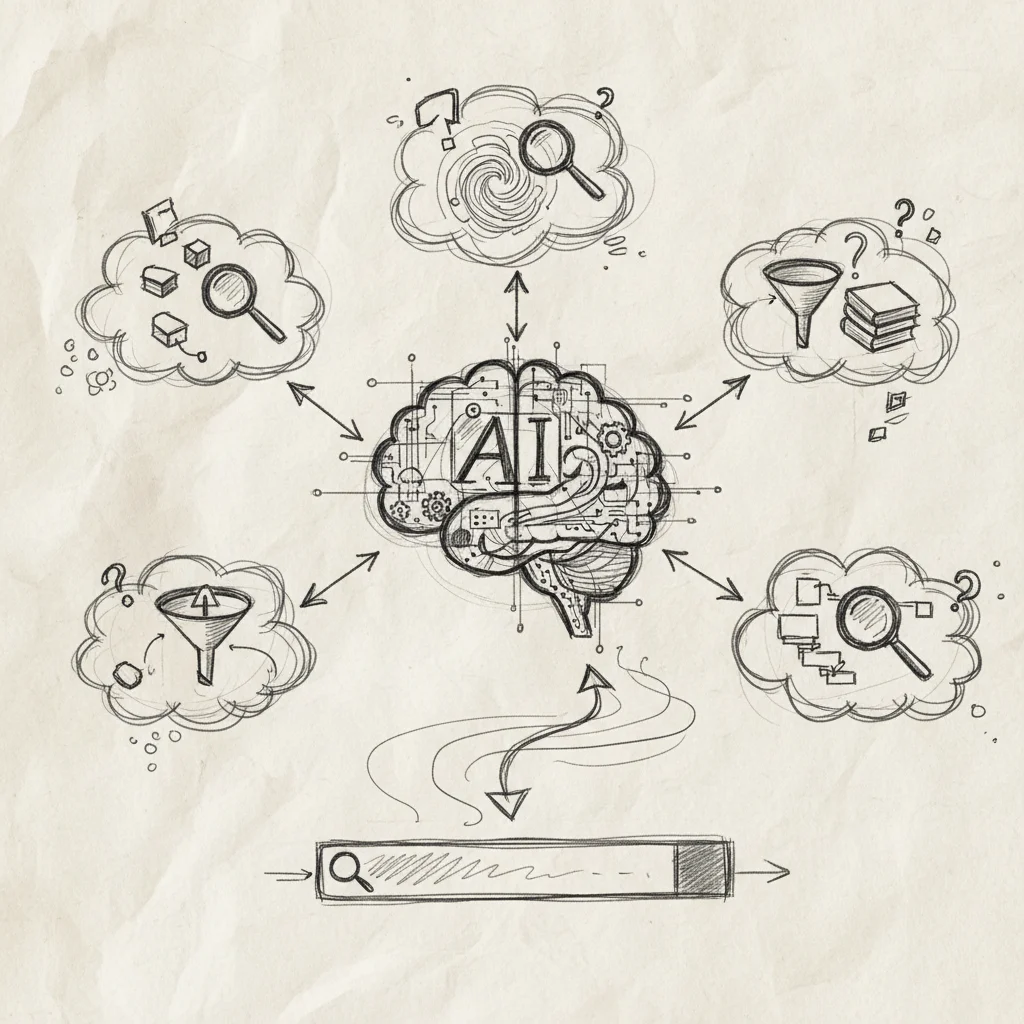
LLMs have replaced the retrieve-and-rank pipeline with a retrieve-then-synthesize model, fundamentally changing how AI search engine algorithms surface and present information.
How Large Language Models Improve Search Relevance Beyond Traditional ML
Traditional ML-based ranking systems required engineers to hand-craft signals, click-through rate, dwell time, anchor text, and weight them against each other. LLMs reduce that dependency by modeling semantic intent directly from the text itself, using dense vector embeddings to match a query's meaning rather than its exact words.
The architecture driving this shift is Retrieval-Augmented Generation (RAG): an LLM first retrieves a set of relevant documents from an index, then synthesizes those documents into a single direct answer rather than returning a ranked list of links. Google's AI Overviews and Perplexity's answer engine both run on RAG-based pipelines. OpenAI's GPT-4o powers ChatGPT's search mode, Google's Gemini drives AI Overviews, Anthropic's Claude appears in enterprise search integrations, and Perplexity deploys its own fine-tuned retrieval models on top of this same pattern.
Because the LLM reads and synthesizes documents, rather than just scoring them, content structure matters more than keyword density. A page that states a clear fact in the first sentence is more likely to be cited than one that buries the answer in paragraph four.
Real-World Case Studies: Companies That Improved Visibility With AI-Optimized Content
Shopify reported measurable gains in merchant product discoverability after encouraging sellers to rewrite descriptions for semantic clarity, plain, specific language that describes what a product does, rather than repeating target keywords. That aligns directly with how LLM-based retrieval scores content on meaning rather than term frequency.
The New York Times and comparable publishers observed a spike in AI Overview citations on pages that led with dense, factually precise summary paragraphs, the same format LLMs prefer when constructing a synthesized answer. Pages without a clear opening summary were cited far less often, regardless of their overall authority.
For SMBs, tools like Moonrank address this shift directly: the platform structures and publishes content daily using the factual, semantically clear format that RAG-based engines, ChatGPT, Gemini, Claude, and Perplexity, are most likely to retrieve and cite.
How AI-Native Search Engines Like Perplexity Compare to Google
Perplexity and Google serve different retrieval models, one synthesizes live results into prose answers, the other ranks indexed pages, making each better suited to specific query types.
The structural difference matters most. Google crawls and indexes the web independently, then ranks existing pages against a query. Perplexity retrieves live results via Bing's API and synthesizes them into a single answer, meaning its freshness depends entirely on Bing's crawl schedule, not its own. Understanding this distinction helps explain why the two engines respond so differently to the same AI search engine algorithms under the hood.
Performance Benchmarks: Accuracy, Speed, and User Satisfaction Compared
Accuracy is the sharpest dividing line. A 2024 WIRED analysis found that Perplexity cited sources incorrectly or fabricated details in roughly 30% of tested queries. Google's AI Overviews showed comparable hallucination rates during their early rollout, later reduced through grounding improvements that tether generated text more tightly to indexed source content.
Speed favors AI-native engines. Perplexity returns synthesized answers in 1–3 seconds. Google's AI Overviews add approximately 0.5–1 second of latency over standard results because the LLM inference layer runs on top of the existing retrieval pipeline.
User preference splits by intent. A 2024 BrightEdge study found 68% of users preferred direct AI-synthesized answers for informational queries, but reverted to traditional results when the task involved buying or booking. Transactional queries still drive users back to ranked pages they can evaluate and click.
For businesses, the practical implication is consistent across both engines: write factually dense, clearly attributed content. That signal earns Perplexity citations and Google AI Overview inclusion through the same mechanism, content an AI can verify and quote with confidence. Tools like Moonrank build exactly this kind of structured, citation-ready content daily, without requiring the business owner to write a word.
Ethical Considerations and Bias Issues in AI Search Algorithms
AI search engine algorithms embed the biases of their training data, creating fairness, privacy, and transparency problems that affect every business and user who depends on them.
How Companies Can Mitigate Bias and Fairness Issues in Search
Bias in AI search is rarely intentional, it's structural. A 2019 MIT study found that image search results for "CEO" returned 89% male images, a direct consequence of training data that reflected historical workforce imbalances rather than any deliberate design choice. When AI ranking models learn from skewed historical data, they reproduce and amplify that skew at scale.
The filter bubble problem compounds this. Personalization algorithms used by Google, YouTube, and others optimize for engagement, which progressively narrows the range of results any individual user sees. The EU's Digital Services Act (DSA), which came into force for large platforms in February 2024, now requires those platforms to offer non-personalized feed options, a regulatory acknowledgment that engagement optimization carries real societal cost.
Developers building or auditing search systems have concrete tools available. IBM's AI Fairness 360 toolkit runs bias audits across protected attributes. Explainability layers, LIME or SHAP scores applied to ranking decisions, make it possible to see which features drove a specific result. Diverse training datasets reduce the initial skew. Publishing a model card that documents known limitations gives external reviewers a baseline to work from.
Privacy and Transparency Concerns With AI-Powered Search Systems
AI search engines that use query history and behavioral signals to personalize results build detailed user profiles as a byproduct. Google's AI Overviews (formerly Search Generative Experience) drew scrutiny specifically for how it handles sensitive health and financial queries, categories where profiling carries heightened risk.
Transparency remains a structural gap across the industry. Google publishes broad documentation on how Search works [2] but does not release model weights or complete feature lists. Perplexity surfaces citations alongside answers but does not expose its retrieval scoring logic. For businesses optimizing their visibility, including through tools like Moonrank, which tracks how brands appear across ChatGPT, Gemini, Claude, and Perplexity, this opacity makes it harder to diagnose why a brand is or isn't being recommended. Demanding model cards and supporting regulatory transparency standards is the most direct pressure businesses can apply.
Frequently Asked Questions
What is the difference between BFS and A* in AI search algorithms?
BFS (Breadth-First Search) explores every node level by level without any guidance, while A* uses a heuristic function to estimate the lowest-cost path to a goal. BFS guarantees the shortest path in unweighted graphs but consumes significant memory as the search space grows. A* is far more efficient in practice because it prioritizes promising paths first, making it the standard choice for pathfinding tasks like GPS routing and game AI, where computing every possible option is not feasible.
Can small businesses influence how AI search algorithms rank their content?
Yes, small businesses can directly improve their visibility in AI search results by optimizing the signals those algorithms rely on. Structured data (schema markup), authoritative citations, clearly written entity information, and consistently published topical content all help AI engines like ChatGPT, Gemini, and Perplexity parse and trust a business's site. Tools like Moonrank automate exactly this work, handling schema markup, llms.txt configuration, and daily content publishing for $99/month, without requiring any technical input from the business owner.
How does Google's BERT model improve search result relevance?
BERT improves relevance by understanding the full context of a query, not just individual keywords. Introduced by Google in October 2019, BERT (Bidirectional Encoder Representations from Transformers) reads words in relation to all surrounding words in a sentence rather than left-to-right in isolation. This allows Google to correctly interpret queries like "can you get medicine for someone pharmacy", where word order and prepositions carry the meaning, and return results that match actual user intent rather than surface-level keyword matches.
Are AI search engine results more accurate than traditional keyword-based search?
AI search engines generally produce more contextually relevant answers for complex, conversational queries, but accuracy depends heavily on the quality of the sources they retrieve. Traditional keyword search returns a list of links the user must evaluate; AI search synthesizes an answer directly, which reduces friction but introduces the risk of confident-sounding errors when source material is thin or contradictory. For factual, well-documented topics, AI search engines like Perplexity, which reported over 100 million weekly queries by late 2024, tend to outperform keyword search on relevance. For niche or rapidly changing topics, traditional search still provides more transparent sourcing.

Conclusion
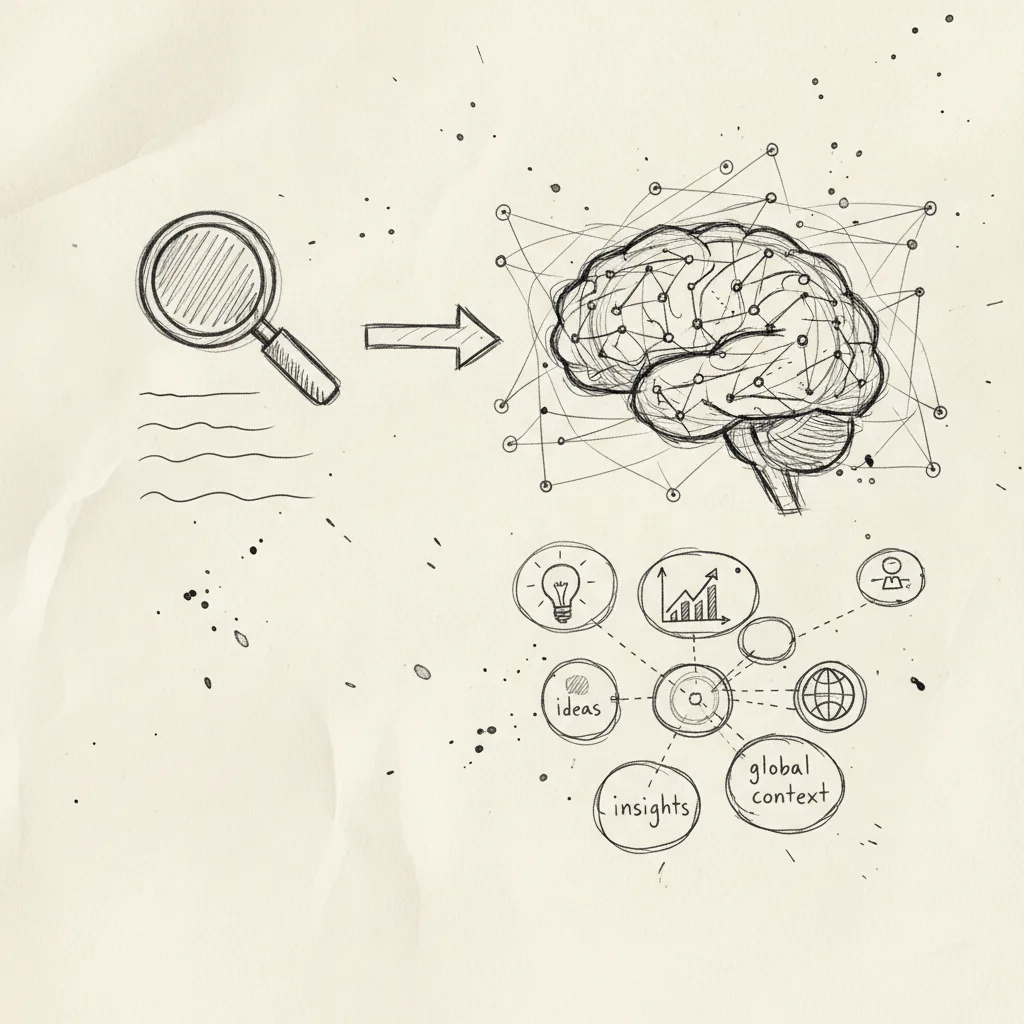
AI search engine algorithms have moved well beyond keyword matching. They now rank content based on semantic understanding, entity relationships, structured data signals, and source authority, the same signals that determine whether ChatGPT, Gemini, Claude, or Perplexity recommends your business or a competitor's.
Three things are worth acting on now: audit whether your site uses schema markup and structured data correctly; publish topical content consistently so AI engines build a clear picture of your authority; and track where your brand actually appears in AI-generated answers, not just Google rankings.
If you want all three running on autopilot, start a free 3-day trial at moonrank.ai and see exactly where your business stands in AI search today.
Sources & References
Recommended Articles
Explore more from our content library: