Why AI Search Result Attribution Matters for Your Business
Learn how AI search result attribution helps businesses track ChatGPT, Perplexity, and Gemini conversions and fix invisible analytics gaps.

AI search result attribution is the practice of identifying and measuring how AI-powered search platforms, ChatGPT, Perplexity, Claude, and Gemini, influence customer journeys and drive conversions. Unlike traditional search, AI engines rarely pass referral data, creating invisible gaps in your analytics. Businesses that solve this attribution problem can see which AI platforms generate demand, justify content investment, and stop misattributing AI-sourced revenue to 'direct' or 'organic' channels.
What Is AI Search Result Attribution and Why Does It Matter for Your Business?
AI search result attribution connects conversions and customer touchpoints back to AI-generated answers, not Google's blue links, but synthesized responses from ChatGPT, Perplexity, Claude, and Gemini.
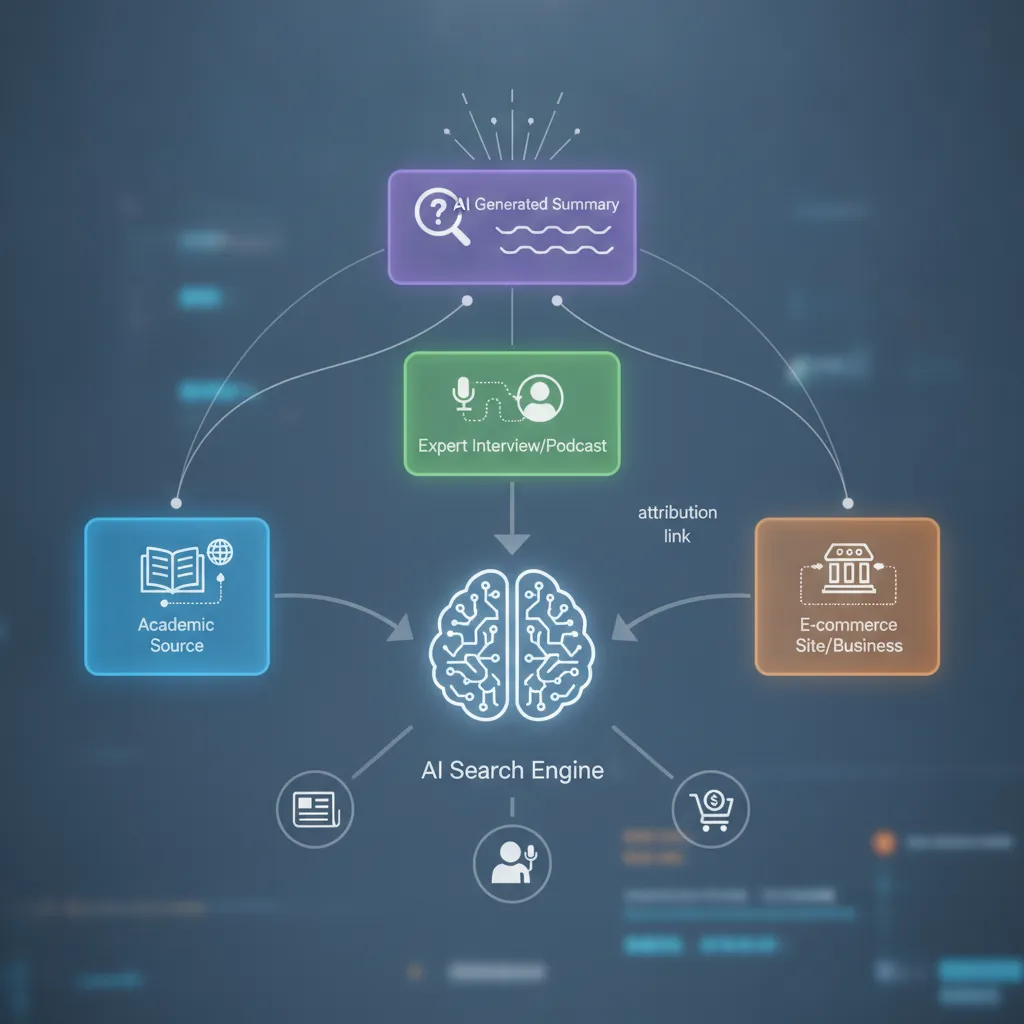
That distinction matters because the two experiences are structurally different. A traditional SERP listing is a ranked link a user clicks, generating a referral signal your analytics platform captures. An AI search result is a synthesized answer, the engine reads multiple sources, composes a response, and may cite two or three of them inline. The user often gets what they need without clicking anything, which means no referral data reaches your server and standard click-tracking records nothing.
"The shift to AI-generated answers fundamentally breaks the referral chain that marketers have relied on for two decades. When a user gets their answer inside the AI interface, the downstream click — and all the attribution data it carries — simply never happens." — Rand Fishkin, Co-founder and CEO at SparkToro
What an AI search result looks like versus a traditional search result
When someone asks Perplexity "best project management tool for a five-person team," they receive a paragraph-length answer with source citations, not a list of ten links to evaluate. The answer may name your brand, or a competitor's, without the user ever visiting your site. That influence on their decision is real, but your analytics platform will never see it.
Perplexity alone surpassed 100 million weekly queries by late 2024, and AI platforms collectively drove over 1.13 billion referral visits in June 2025 alone [1]. A growing share of those interactions end without a traceable click.
Why AI search attribution is becoming critical for marketing teams in 2026
Untracked AI-sourced visits don't vanish, they surface in your reports as direct traffic or branded search. That misclassification inflates the apparent performance of those channels and quietly starves AI-related content investment of the credit it deserves [1].
For SMB marketing teams with tight budgets, a distorted attribution picture leads to real budget mistakes: cutting content that drives AI recommendations because it shows no measurable return. Tools like Moonrank address this by tracking brand visibility across ChatGPT, Gemini, Claude, and Perplexity, giving businesses a signal where standard analytics go dark.
According to researchers at the Pew Research Center, consumer reliance on AI-assisted information discovery is growing rapidly, making accurate attribution of AI-driven touchpoints increasingly important for understanding how audiences find and evaluate brands.
For deeper context on how AI engines work and how to optimize for them, see our AI Search Engines: The Complete 2026 Guide and AI Search Optimization: A Small Business Guide.
How AI Search Breaks Traditional Attribution Tracking
Standard analytics tools fail at AI search result attribution because most AI platforms strip referrer data before sending users to your site, making visits appear as direct traffic.
Why GA4 Cannot Track Conversions from ChatGPT and Perplexity
When a user clicks a cited link inside ChatGPT, Claude, or Perplexity, the platform typically does not pass an HTTP referrer header to the destination site. GA4 receives the visit with no origin signal and logs it as direct traffic, what analysts now call the "attribution black hole" [1].
Each platform behaves differently, and those differences matter for how you interpret your data:
- Perplexity does pass some referrer data, making it the most trackable of the major AI engines.
- ChatGPT's browsing mode typically strips referrer headers entirely.
- Claude's citation behavior varies depending on which integration or interface the user is in.
- Gemini's referrer data depends on whether the user is inside Search Generative Experience or the standalone Gemini app, two distinct surfaces with different technical behaviors.
UTM parameters do not solve this. You can add UTM tags to URLs you control, but you cannot tag the links AI engines generate inside their own answers. The AI writes the citation; you don't touch it.
This misattribution problem compounds a separate but related risk: AI engines sometimes cite incorrect business information, wrong addresses, outdated hours, or fabricated details, meaning the traffic that does arrive may have been primed with inaccurate expectations before the visit even begins.
The 30% Dark Traffic Rule and Its Connection to AI Attribution Gaps
Roughly 30% of web traffic already arrives with no referral data attached [1], a phenomenon analysts call "dark traffic." AI search is accelerating this trend because every untagged AI referral adds to that unattributed pool.
In June 2025 alone, AI platforms drove over 1.13 billion referral visits [1], yet a significant share of that volume landed in analytics dashboards labeled as direct or branded search. The result is that businesses systematically undercount how much revenue AI search influences, while over-crediting channels like email or paid ads that happen to carry cleaner tracking signals.
For SMB owners without a dedicated analytics team, this gap is especially costly. Without accurate AI search result attribution data, budget decisions get made on incomplete signals, and the channels actually driving discovery go unfunded.
"Dark traffic is not a new problem, but generative AI has turbocharged it. Marketers who ignore the attribution gap today are essentially making million-dollar budget decisions with a third of their data missing." — Avinash Kaushik, Author and Digital Marketing Evangelist
How to Measure AI Influence When Direct Tracking Fails
When standard analytics can't trace AI-driven visits, proxy signals and behavioral segmentation give you a reliable picture of AI search result attribution.
Proxy signals that reveal AI-influenced customer journeys
Three signals consistently surface AI influence even when referrer data is missing. First, watch for spikes in branded search volume in Google Search Console after a piece of content gets cited in ChatGPT or Perplexity, a 15–25% week-over-week lift in branded queries is a common indicator that AI-driven awareness is converting to active search [1]. Second, rising "no-referrer" sessions in GA4 that correlate with brand query growth point to users who discovered you through an AI interface and typed your URL directly. Third, increases in direct traffic that track closely with AI mention monitoring tools confirm the same pattern.
To isolate these visits, set up custom GA4 events that fire when a user lands on a key conversion page with no referrer and then completes a goal action. Segment this "dark direct" cohort separately from your standard direct traffic, it will give you a working estimate of AI influence without waiting for platform-level attribution to catch up.
For a list of tools that monitor AI citations across ChatGPT, Gemini, Claude, and Perplexity, see our GEO tools 2026 guide.
B2B versus B2C attribution strategies for AI search
B2B and B2C teams face different data gaps, so the proxy methods differ. B2B revenue teams should search sales call transcripts in tools like Gong or Chorus for phrases such as "I saw you in ChatGPT" or "Perplexity recommended you," then add a first-touch question to prospect intake forms asking how they first heard of the brand [1]. These two inputs together build a qualitative layer that hard analytics can't provide.
B2C teams have more volume to work with. Monitor branded search trends in Google Search Console weekly, and add a single post-purchase attribution survey question, "How did you first discover us?", with AI search listed as an explicit option. Even a 5–10% response rate produces statistically useful signal at e-commerce scale.
AI Search Attribution versus Traditional Multi-Touch Attribution Models
Traditional attribution models, last-click, first-touch, and linear, all fail in AI search because they depend on a trackable referral chain that AI engines never produce.
What Data Attribution in AI Means and How It Differs from Last-Click or First-Touch Models
Last-click gives full credit to the final touchpoint before conversion. First-touch credits the first known interaction. Linear splits credit equally across every recorded step. All three models share one fatal assumption: the customer's path left a clickable trail.
AI search breaks that assumption by design. When a prospect reads a ChatGPT answer that cites your pricing page, then visits your site directly two days later and converts, last-click credits "direct," first-touch credits nothing, and the AI interaction disappears from every traditional report. The AI search result attribution that actually drove the decision registers as zero.
Data attribution in AI, meaning how AI models decide which sources to cite in their answers, is a separate but related problem. The authority signals in your content (structured data, citations, schema markup) determine whether ChatGPT or Perplexity surfaces your brand at all. Moonrank's AI-powered citation building addresses exactly this layer, helping your content earn the mentions that traditional analytics will never record but that directly influence purchase decisions.
The Interactive Advertising Bureau (IAB) has highlighted the growing need for updated measurement standards that account for AI-driven discovery, noting that legacy attribution frameworks were not designed for zero-click or synthesized-answer environments.
Concrete Examples of AI Attribution Across Industries
In B2B SaaS, the tracking gap is stark. A prospect asks ChatGPT which project management tools offer per-seat pricing under $20, reads an answer citing your pricing page, closes the tab, and returns via a direct URL two days later. Google Analytics logs a direct session. Your CRM closes the deal. The AI touchpoint, the one that named your product, gets no credit in any model you're running.
In e-commerce, the credit flows to the wrong channel entirely. A shopper asks Perplexity for "best running shoes under $150," sees your brand cited, then searches your brand name on Google and clicks a branded paid ad. Google Ads takes the conversion credit [1]. The Perplexity recommendation that triggered the brand search is invisible.
Fixing this requires an influence layer on top of traditional models, one built from brand search lift analysis, dark traffic segmentation, and AI mention monitoring rather than click-path data [2]. These proxy signals connect AI-driven discovery to downstream conversions without waiting for a referral tag that will never arrive.
Tools and Platforms You Need to Build an AI Attribution Stack
Building an AI search result attribution stack requires four layers: GA4 custom tracking, AI mention monitoring, Search Console correlation, and post-conversion surveys.
How to Set Up GA4 and API Integrations to Capture AI Search Attribution Data
Layer 1, GA4 custom channel group. In GA4, create a new channel group called "AI Search" and add regex rules to catch known referrers: perplexity.ai, chat.openai.com, claude.ai, and gemini.google.com. Also create a custom event named ai_dark_direct that fires on no-referrer sessions where the landing page URL matches your AI-optimized content paths, this captures the dark traffic that GA4 would otherwise log as direct.
Layer 2, AI mention monitoring. Use tools like Brandwatch or Mention to track how often ChatGPT, Perplexity, and Claude cite your domain in their answers. Dedicated GEO tracking platforms, including Moonrank's AI Search Visibility Tracking, which monitors citation frequency across all four major AI engines, make this systematic. Log citation frequency weekly in a shared spreadsheet so you can spot trend shifts before they show up in revenue data.
Layer 3, Google Search Console. Pull branded query volume weekly from Search Console and map it against known AI citation events in your monitoring log. A simple correlation model in a spreadsheet, citation count in column A, branded query volume in column B, is enough to quantify brand search lift over time.
Layer 4, Post-conversion surveys. Add one question at checkout or demo booking: "How did you first hear about us?" Include "AI assistant (ChatGPT, Perplexity, etc.)" as an explicit answer option. Even a 5% response rate surfaces meaningful signal that no analytics tool can replicate. For more information, see Search.
According to MarketingProfs, organizations that layer qualitative survey data on top of quantitative analytics consistently produce more accurate attribution models, particularly in environments where referral signals are incomplete or absent.
Should You Remove AI Search Results from Your Attribution Reports?
Don't exclude AI traffic from your reports, segment it separately so you can compare AI-influenced conversion rates directly against paid, organic, and direct channels. Excluding it hides one of the fastest-growing discovery paths your customers are using [1]. A dedicated AI segment also lets you measure whether AI-referred visitors convert at a higher or lower rate, which directly informs where to invest in content and technical optimization. For broader tracking context across all channels, refer to your SEO monitoring tools setup alongside this stack.
"Segmentation is the key discipline that separates mature analytics programs from immature ones. If you're not isolating AI-sourced sessions as their own cohort, you're not measuring AI's impact — you're just averaging it into noise." — Krista Seiden, Founder of KS Digital and former Google Analytics Product Manager

Frequently Asked Questions
Can small businesses realistically track AI search attribution without enterprise tools?
Yes, small businesses can build a working attribution picture using free and low-cost tools, without enterprise software. Start with Google Search Console to monitor branded query volume, Google Analytics 4 to catch direct traffic spikes, and a simple customer survey asking "How did you find us?" Run those three signals together and you get a reliable proxy for AI-driven discovery. Platforms like Moonrank add a dedicated layer on top, tracking how your brand appears across ChatGPT, Gemini, Claude, and Perplexity for $99/month, a fraction of what an agency charges to do the same manually.
Which AI search platform sends the most referral traffic, ChatGPT, Perplexity, or Gemini?
ChatGPT currently drives the largest share of measurable AI referral traffic, though the gap is narrowing fast. AI platforms collectively drove over 1.13 billion referral visits in June 2025 alone [1], and Perplexity reported more than 100 million weekly queries by late 2024. Gemini's referral footprint is harder to isolate because much of its traffic routes through Google Search. The practical implication: optimize for all three rather than betting on one platform.
How is AI search attribution different from GEO (Generative Engine Optimization)?
AI search attribution measures outcomes, which AI platforms sent traffic, influenced a decision, or drove a conversion. GEO (Generative Engine Optimization) is the practice of structuring your content and technical signals so AI engines cite your brand in the first place. Think of GEO as the input and attribution as the measurement of whether that input worked. You need both: GEO without attribution is publishing blind, and attribution without GEO gives you data but no lever to pull.
How often should you audit your AI attribution data, and what should you look for?
Run a monthly audit at minimum, with a quick weekly check on branded search volume and direct traffic trends. In each audit, look for three things: unexplained spikes in direct or branded traffic (a signal of AI-driven discovery), shifts in which pages receive the most inbound links from AI-cited sources, and changes in how your brand appears, or stops appearing, in AI-generated answers across ChatGPT, Perplexity, and Gemini [1].
What structured data formats help AI engines attribute content to your brand correctly?
Schema markup is the most reliable technical signal for improving AI search result attribution. Implementing Organization, Article, and BreadcrumbList schema helps AI engines associate content with your brand entity rather than treating it as an anonymous source. Adding author and publisher fields with consistent name and URL values reinforces brand identity across citations. Google's structured data guidelines, available through Schema.org, provide the vocabulary AI engines use to parse and attribute content accurately.

Conclusion
AI search result attribution is not a future problem, it's a gap in your analytics right now. Customers are discovering brands through ChatGPT, Gemini, Claude, and Perplexity, and most of that traffic lands in your "direct" bucket uncredited [1]. The businesses that close this gap first will make smarter content decisions, allocate budget more accurately, and compound their AI visibility faster than competitors still flying blind.
Three things to act on: set up GA4 segments to isolate AI referral sources this week, add a one-question survey to your checkout or contact form asking how customers found you, and audit whether your site's structured data and citations give AI engines enough signal to recommend you confidently.
If you want the technical side handled automatically, visit www.moonrank.ai and start a 3-day free trial, Moonrank tracks your visibility across all four major AI engines and publishes optimized content daily, without any manual input from you.
Sources & References
- AI search attribution: Tracking customer journey in the age of AI | Birdeye
- Roadway for AI Search Attribution | Roadway AI
Recommended Articles
Explore more from our content library: