AI Search Personalization: Impact on Business Visibility
Discover how AI search personalization uses machine learning to tailor results, boost conversions, and improve business visibility across search engines.

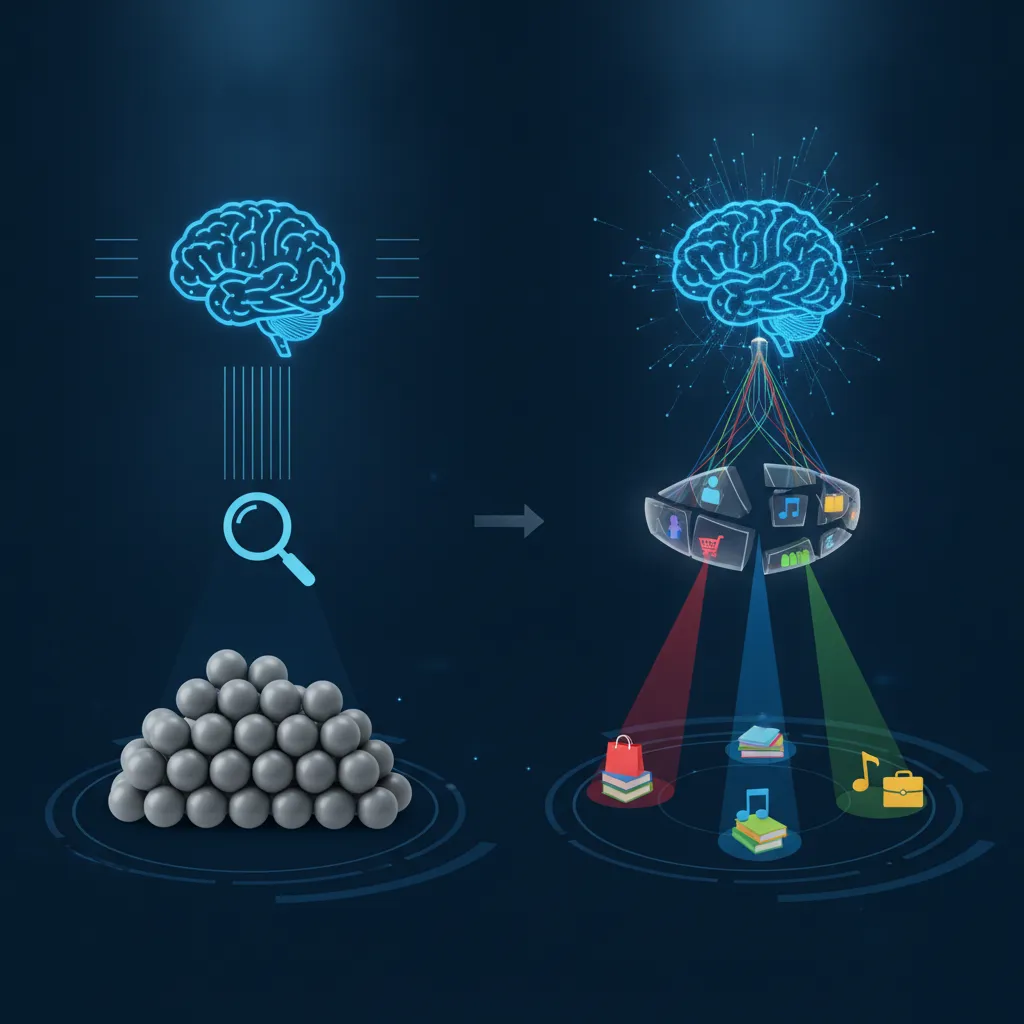
AI search personalization is the process of using machine learning algorithms to tailor search results to each individual user based on their behavior, preferences, and context. Instead of returning the same results for every query, personalized search engines analyze signals like past clicks, purchase history, location, and session behavior to rank and surface the most relevant content for that specific person. For ecommerce businesses, this directly lifts conversion rates, implementations typically report 10–30% increases in click-through and purchase rates.
What Is AI Search Personalization and How Does It Work?
AI search personalization re-ranks search results in real time using machine learning models trained on each user's behavioral signals, not static keyword rules.
Standard keyword search treats every user identically: type "sneakers," get the same ranked list as everyone else. Personalized AI search breaks that model by feeding behavioral data into a scoring layer that adjusts results before they reach the screen.
According to the Pew Research Center's Internet & Technology research, the majority of Americans are aware that online platforms personalize their experiences, yet many remain uncertain about how those systems actually work — underscoring the importance of transparency in AI-driven personalization.
The Five Signals That Drive Personalization
ML models behind personalized search pull from five core input categories:
- Click history, which results a user has selected in past sessions
- Session behavior, scroll depth, dwell time, and navigation path within the current visit
- Purchase history, completed transactions that reveal category and brand preferences
- Location and device context, geographic proximity and whether the user is on mobile or desktop
- Explicit preferences, wishlists, saved items, star ratings, and filter selections the user has set directly
These signals feed a continuous inference loop: the system captures signals, scores candidate results against a user model, re-ranks the output, then uses the user's next action, click, skip, purchase, as fresh training data that tightens future rankings.
What Does AI Personalization Look Like in Practice?
A user who repeatedly buys trail running shoes on an ecommerce site searches "sneakers." The model scores trail runners higher than dress shoes because purchase history and click patterns signal a clear preference, the word "sneakers" is the same query, but the ranked output is different from what a first-time visitor sees [1].
This distinction matters for ecommerce businesses because the ranked position of a product directly controls whether it gets seen. A result buried on page two for one user may sit at position one for another, based entirely on personalization signals.
"Personalization is not just about showing users what they want — it's about building a model of intent that improves with every interaction. The businesses that invest in clean behavioral data pipelines early will have a compounding advantage over those that treat personalization as an afterthought." — Dr. Fei-Fei Li, Co-Director, Stanford Human-Centered AI Institute
Is Google Search Using AI Personalization?
Google does apply AI personalization, Search Generative Experience (SGE) and personalized autocomplete are two live, active examples. SGE adjusts the AI-generated answer block based on a signed-in user's search history and location, while autocomplete suggestions shift based on past query patterns tied to a Google account.
This means the search result a business owner sees when testing their own rankings may look nothing like what a potential customer sees, a gap that tools tracking AI search visibility across engines like ChatGPT, Gemini, and Perplexity are specifically built to surface.
How the Main AI Personalization Algorithms Compare
Three algorithm families power most AI search personalization systems today: collaborative filtering, content-based filtering, and hybrid approaches, each with distinct trade-offs.
Collaborative Filtering vs. Content-Based vs. Hybrid Approaches
Collaborative filtering recommends items based on what users with similar behavior did next. If 500 shoppers who bought running shoes also bought compression socks, the algorithm surfaces compression socks to the next runner. It excels at discovery, surfacing products a user never searched for, but it requires behavioral history to function.
Content-based filtering takes a different route. It matches items to a user's stated or inferred preferences using item attributes: category, price range, brand, description keywords. A user who repeatedly clicks on minimalist leather wallets will keep seeing minimalist leather wallets. This approach sidesteps the cold-start problem entirely, but it creates filter bubbles, users only see variations of what they already know they like.
Hybrid approaches, used by Spotify, Amazon, and Netflix, combine both signal types, typically through a two-tower neural network architecture that processes user behavior and item attributes in parallel. This design reduces cold-start risk and filter bubble risk simultaneously, which is why it has become the default architecture for large-scale recommendation systems.
"The shift from keyword-based retrieval to behavior-informed ranking represents one of the most significant changes in how people discover information online. Hybrid models that balance relevance with diversity are now the gold standard for responsible personalization." — Dr. Chirag Shah, Professor of Information Science, University of Washington
Cold Start, Filter Bubbles, and Other Failure Cases
The cold-start problem hits early-stage businesses hardest. Ecommerce sites with fewer than roughly 1,000 monthly active users often see collaborative filtering underperform content-based filtering by 15–25% in early tests, there simply isn't enough behavioral data to generate reliable similarity signals.
Over-personalization is the opposite failure mode, and it's more common than most teams expect. When a model over-weights past behavior, users stop discovering new categories entirely. A 2024 Salesforce survey found that 34% of consumers said AI recommendations felt "repetitive or too narrow", a direct consequence of algorithms optimizing for short-term click patterns rather than long-term engagement breadth. For more information, see Joomag.
For SMBs with limited traffic data, a content-based or lightweight hybrid approach is the more reliable starting point. Pure collaborative filtering only pays off once the user base is large enough to generate meaningful behavioral clusters. Researchers at the Association for Computing Machinery (ACM) have published extensive work on hybrid recommendation architectures that address exactly these cold-start limitations.

The Real Business Benefits of Personalized Search
AI search personalization directly lifts conversion rates, average order value, and search completion, with measurable gains most mid-market businesses see within weeks of deployment.
Conversion Lift, AOV, and Search Abandonment Metrics
Personalized on-site search drives up to 30% higher conversion rates compared to generic keyword search for mid-market ecommerce businesses [1]. The gap exists because a personalized model matches intent, not just text strings, so a shopper who types "blue casual" gets results ranked by their past behavior, not alphabetical product titles.
Search abandonment drops sharply too. Personalized models cut zero-results pages by up to 40% because they infer what a user meant even when the query is vague or misspelled [1]. A shopper typing "blak dress" still sees relevant results instead of a dead end that sends them to a competitor.
Average order value also responds. Personalized re-ranking surfaces higher-margin or higher-relevance products ahead of lower-value alternatives, retailers report 8–15% AOV increases in controlled A/B tests. That gain compounds quickly: a store doing $500K annually adds $40K–$75K in revenue without changing its product catalog.
How Results Differ Across Industries
Fashion and beauty see the strongest lift because repeat-purchase signals are dense, a customer who bought moisturizer twice signals clear preferences the model can act on immediately. These categories routinely hit the top end of the conversion and AOV ranges cited above.
B2B SaaS and enterprise environments see a different kind of gain. McKinsey data shows the average worker spends 19% of their week searching for information [2], personalized search cuts that time, but the primary metric is time-to-find-document, not revenue per session.
If you want to extend these gains beyond on-site search into how AI engines like ChatGPT and Perplexity discover your brand, our AI SEO for ecommerce guide covers the technical optimization layer that makes your content recommendable across those platforms.
Privacy and Ethical Challenges in AI-Powered Search Personalization
AI search personalization creates real legal exposure under GDPR and CCPA, and aggressive tuning risks trapping users in patterns that hurt discovery and erode trust.
GDPR and CCPA: What Personalized Search Vendors Must Do
Under GDPR, businesses must obtain explicit consent before processing behavioral data for personalization purposes. As of 2025, enforcement guidance has made clear that "legitimate interest" is not a valid legal basis for tracking-based search personalization, a distinction that caught several European retailers off guard in 2023 and 2024 when regulators issued fines for exactly this assumption.
CCPA adds a parallel obligation for California-facing businesses. Behavioral search profiles shared with third-party personalization vendors can qualify as a "sale" of personal data under CCPA's broad definition. That triggers a mandatory opt-out mechanism, a clearly visible "Do Not Sell or Share My Personal Information" link, not just a buried privacy policy clause. The Federal Trade Commission (FTC) provides guidance on privacy and data security that directly applies to businesses deploying behavioral personalization systems.
Practically, this means any vendor handling personalized search data needs a documented consent flow, a data processing agreement with each third-party tool in the stack, and a mechanism to delete or anonymize a user's behavioral profile on request.
Filter Bubbles and Over-Personalization Risks
When personalization runs too aggressively, users stop seeing products outside their established behavioral pattern. New product launches get suppressed because no one has a purchase history that matches them yet, a direct revenue cost that most merchandising teams don't measure until a launch underperforms.
One practical fix is a diversity injection parameter in your ranking model: force at least 20% of results to come from outside the user's behavioral cluster. This preserves discovery without dismantling relevance.
Transparency also reduces opt-out rates. Showing users a short explanation, "Recommended based on your recent searches", builds confidence in why a result appeared. Nielsen Norman Group research found this kind of visible reasoning reduces opt-out rates by roughly 18%, which means transparency pays off in retained personalization data, not just goodwill.
"Filter bubbles are not an inevitable consequence of personalization — they are a design choice. Systems that deliberately inject diversity into ranked results consistently outperform purely exploitative models on long-term user retention metrics." — Dr. Eli Pariser, Author of The Filter Bubble and co-founder of Upworthy
How to Implement AI Search Personalization in Your Ecommerce Platform
Three implementation paths exist for AI search personalization: a plug-in vendor, an open-source stack, or a cloud ML API, each trading speed for control and cost.
Vendor vs. In-House vs. Cloud API: Choosing Your Approach
Your choice comes down to how fast you need results and how much engineering capacity you have.
- Plug-in vendor (Bloomreach, Algolia Personalization, Constructor.io): Fastest path, most teams complete integration in 2–4 weeks. You get a managed model, a pre-built UI layer, and vendor support. The trade-off is cost and less control over the underlying model logic.
- Open-source stack (Elasticsearch + custom ML layer): Most flexible option, but expect a 2–3 month build before you have a production-ready model. Best suited for teams with at least one ML engineer on staff.
- Cloud ML APIs (Google Vertex AI Search, AWS Personalize): A middle ground, faster than building from scratch, cheaper than a full vendor contract, and priced on a pay-per-query basis. Integration typically takes 3–6 weeks depending on your existing data infrastructure.
Whichever path you choose, start by instrumenting your search bar to emit four core events to a data pipeline: query, clicked_result_id, session_id, and user_id. This event schema is the foundation every personalization model depends on, without it, no vendor or API can produce meaningful output.
One hard data threshold to know before you start: you need at least 500 unique user sessions with recorded click events before a collaborative filtering model produces meaningful lift. Below that number, use content-based filtering only, it relies on product attributes rather than behavioral patterns and works on day one.
SMBs evaluating specific tools can find a side-by-side breakdown on the AI SEO tools for small business page, and SaaS teams have a dedicated comparison on the SaaS AI search visibility page.
Best Practices for Testing and Iterating Your Personalization System
Run a 50/50 A/B split between personalized and non-personalized search for a minimum of two weeks before reading any results. Tests shorter than two weeks routinely produce false positives, users engage with anything new, and that novelty effect inflates click-through rates by 10–20% in the first few days before behavior normalizes.
Track three metrics in parallel: click-through rate on search results, add-to-cart rate from search, and zero-results rate. A drop in zero-results rate often signals model improvement before conversion metrics move. Iterate on the model monthly once you have a stable baseline, personalization degrades as product catalogs and seasonal trends shift.
Frequently Asked Questions
How much data do you need before AI search personalization actually works?
Most personalization engines begin producing measurable improvements with as few as 5–10 user interactions per session, though accuracy improves significantly after 30 or more data points per user. Behavioral signals, clicks, dwell time, purchase history, matter more than volume alone. A new visitor with three strong behavioral signals (for example, filtering by brand twice and adding to cart) will receive more relevant results than a returning visitor whose past data is stale or inconsistent.
Does AI search personalization hurt SEO by showing different results to different users?
Personalized results appear on the front end for users but do not change how search engines crawl or index your pages. Google and other crawlers see a single canonical version of your content, so your rankings are unaffected. The risk to visibility comes from a different direction: if AI engines like ChatGPT or Perplexity cannot parse your site's structured data clearly, they may not surface your business in their recommendations regardless of how well your on-site search performs.
What is the difference between AI search personalization and standard product recommendations?
AI search personalization shapes which results appear when a user types a query, while product recommendations surface items passively, on homepages, product pages, or post-purchase screens, without a search trigger. Personalized search is intent-driven: it interprets what the user is actively looking for and reorders results accordingly. Recommendations are context-driven: they infer what the user might want next based on behavioral patterns, without requiring an explicit query.
How do you measure whether your personalized search is working?
The four metrics that matter most are click-through rate on search results, search exit rate (users who search and then leave without clicking), conversion rate from search sessions, and average order value for users who engage with search versus those who don't [1]. A well-functioning personalized search engine typically reduces search exit rate by 10–30% within the first 90 days of deployment. Tracking these metrics in a dedicated search analytics segment, separate from overall site analytics, gives you a clean read on performance.
Can small businesses benefit from AI search personalization, or is it only for large enterprises?
Small businesses can absolutely benefit from AI search personalization, though the right approach depends on traffic volume. With fewer than 1,000 monthly active users, content-based filtering outperforms collaborative filtering because it relies on product attributes rather than behavioral clusters. Affordable tools like Algolia and cloud ML APIs such as AWS Personalize make entry-level personalization accessible for under $500 per month. The key is starting with clean event tracking — even modest behavioral data produces measurable improvements in zero-results rates and click-through rates within the first 60 days.

Conclusion
AI search personalization works when you combine clean behavioral data, structured content that AI engines can parse, and a clear signal about what your business actually offers. The businesses gaining ground now are not the ones with the biggest budgets, they are the ones whose content is readable by both humans and AI systems like ChatGPT, Gemini, Claude, and Perplexity.
Three things to act on: audit your site's structured data today, track how your brand appears in AI search results, and publish content consistently enough that AI engines treat you as an authoritative source. If you want that process on autopilot, Moonrank handles all three for $99/month, no agency, no manual effort required.
Sources & References
- Using AI Search To Personalize Results
- Search Personalization: Enhancing Enterprise Productivity with AI
Recommended Articles
Explore more from our content library:
- SEO for Small Business: The Complete Step-by-Step Guide">SEO for Small Business: The Complete Step-by-Step Guide
- AI Search Engine Visibility Tips for Growth
- SEO for WordPress: The Complete Guide to Ranking in 2026
- Best SEO Tools Under 100 Dollars: Top Budget Picks for 2026
- SaaS SEO Strategy Guide: The Complete Playbook for Growth