AI Training Data Poisoning Threatens Small Business
AI training data poisoning is a cyberattack where adversaries inject corrupted, mislabeled, or malicious data into a model's training dataset to manipulate...

AI training data poisoning is a cyberattack where adversaries inject corrupted, mislabeled, or malicious data into a model's training dataset to manipulate its behavior. The poisoned model then makes predictable errors, produces biased outputs, or contains hidden backdoors, all by design. Because the attack happens before deployment, it's extremely difficult to detect and can persist silently across a model's entire operational life.
What Is AI Training Data Poisoning and How Does It Work?
AI training data poisoning corrupts a model's learning process by injecting bad data before training begins, making it a pre-deployment attack, not a runtime one.
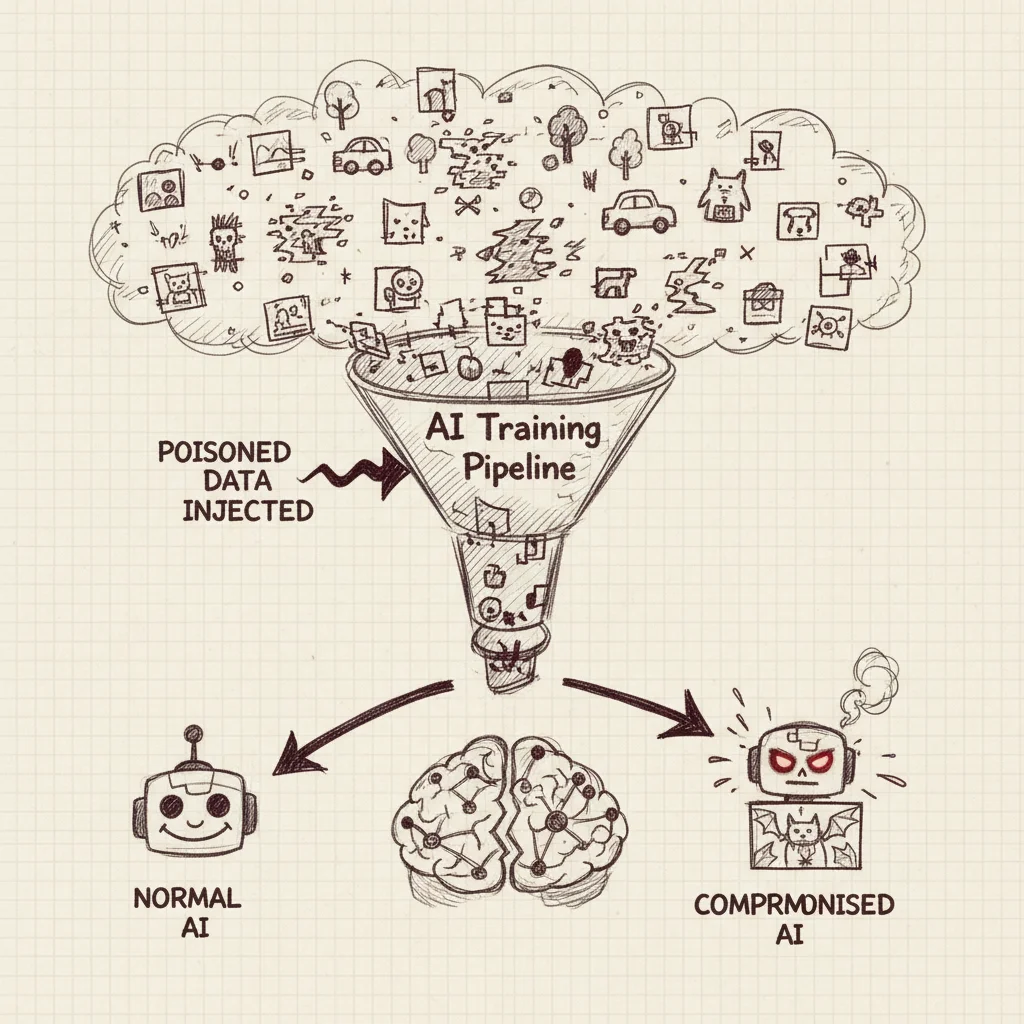
Unlike prompt injection or adversarial examples that target a deployed model, data poisoning operates upstream. Attackers introduce corrupted, mislabeled, or strategically crafted data points into the dataset a model learns from. The model then encodes those corruptions into its weights, carrying the flaw into every prediction it makes after deployment.
The Two-Stage Attack Surface
Poisoning attacks typically exploit one of two points in the pipeline. The first is data collection, models trained on web-scraped content, open datasets, or crowdsourced labels are exposed to any source a contributor or website owner can influence [1]. The second is the labeling pipeline, where human annotators or automated taggers can introduce systematic mislabels, either through error or intent.
Research shows that controlling as little as 1–3% of a training dataset is enough to reliably flip a model's predictions on targeted inputs [2]. That's a small footprint for an attacker with access to a public data source.
Targeted vs. Nontargeted Data Poisoning Attacks
Targeted attacks cause specific misclassifications on chosen inputs, for example, making a spam filter consistently pass a particular sender's emails [1]. The model performs normally everywhere else, which makes the attack hard to detect in standard accuracy evaluations.
Nontargeted attacks aim to degrade overall model performance broadly, reducing accuracy across many input types [1]. These are blunter instruments, more likely to surface during testing, but still effective against models with limited evaluation budgets.
How Emerging Regulations Like the EU AI Act Address Training Data Integrity
The EU AI Act's Article 10 requires organizations deploying high-risk AI systems to document their training data sources, governance processes, and quality controls [2]. Enforcement obligations under those provisions became active in August 2026, meaning companies that cannot demonstrate training data integrity now face direct regulatory exposure, not just reputational risk.
The Main Types of AI Training Data Poisoning Attacks
AI training data poisoning attacks fall into four main categories: label flipping, backdoor injection, gradient-based poisoning, and supply chain contamination.
Most Common Data Poisoning Techniques in 2026
Label Flipping
Label flipping is the most accessible attack for low-resourced adversaries. An attacker relabels a subset of training samples, marking spam emails as legitimate, or flagging malicious network traffic as benign, to corrupt the model's decision boundaries without needing deep access to the training pipeline [1].
Backdoor / Trojan Attacks
In a backdoor attack, the model behaves normally on clean inputs but produces a specific, attacker-controlled output whenever a hidden "trigger" pattern appears, a particular pixel cluster in an image, a specific phrase in a text prompt [1]. The model passes standard accuracy benchmarks, making the backdoor invisible until the trigger is deliberately activated.
Gradient-Based (Clean-Label) Poisoning
Clean-label attacks are the hardest to catch manually. The attacker crafts samples that look entirely legitimate to human reviewers but are mathematically optimized to shift model weights in a targeted direction [2]. Because the labels are correct and the content appears normal, standard data audits miss them entirely.
Supply Chain Poisoning
Supply chain poisoning targets publicly available datasets, Common Crawl, Hugging Face repositories, open GitHub corpora, that development teams ingest without auditing [2]. Attackers embed poisoned samples upstream, knowing those datasets will flow into dozens of downstream fine-tuning jobs.
How Attackers Inject Poisoned Data into AI Training Pipelines
Injection methods vary by attack type, but the common thread is exploiting trust in data sources. Label flipping and backdoor attacks typically require some write access to a training dataset or the ability to contribute to a crowdsourced labeling task. Clean-label attacks require only the ability to publish content that scrapers will collect.
Supply chain poisoning exploits automated data scraping directly. In 2026, the acceleration of LLM fine-tuning has made this the fastest-growing attack vector, with multiple documented incidents of open-source dataset contamination affecting models built on top of poisoned public corpora [2]. Teams that pull datasets from public repositories and begin fine-tuning without provenance checks are the primary targets.
How Data Poisoning Compares to Other AI Security Threats
AI training data poisoning operates at the supply-chain level, corrupting a model before deployment, making it structurally harder to patch than runtime attacks like prompt injection.
Key Differences Between Data Poisoning, Model Extraction, and Adversarial Examples
Prompt injection attacks the inference stage: a malicious input manipulates a live model's output during a conversation. Data poisoning attacks the training stage, meaning the corruption is baked into the model's weights before it ever serves a user. You cannot patch a poisoned model the way you patch a software vulnerability, you must retrain it.
Adversarial examples work differently again. They manipulate a specific input at inference time, slightly altering an image or text so the model misclassifies it, without ever touching the training data. The model itself remains intact; only the input is crafted to deceive it.
Model extraction attacks have a different goal entirely: the attacker probes a model repeatedly to reconstruct its capabilities, essentially stealing intellectual property. Data poisoning doesn't steal capabilities, it corrupts them. These two threat types require separate defenses: rate-limiting and query monitoring for extraction; data provenance controls and integrity checks for poisoning.
The MITRE ATLAS framework classifies data poisoning as a supply-chain-level threat, placing it one tier above prompt injection in remediation complexity, because the damage predates deployment.
Why Data Poisoning Is Harder to Detect Than Other AI Attacks
A poisoned model typically passes standard accuracy benchmarks on clean test sets [2]. The backdoor or bias only activates under specific trigger conditions, so routine evaluation produces normal-looking results. Security teams have no obvious signal that anything is wrong.
Prompt injection, by contrast, produces anomalous outputs that monitoring tools can flag in real time. Data poisoning leaves no runtime fingerprint, the corruption lives in the weights themselves, invisible until the trigger fires.
Real-World Impact of Data Poisoning on AI Models and Businesses
AI training data poisoning has caused measurable harm across healthcare, finance, and content moderation, and the attack surface widened significantly by 2026.
Industry-Specific Case Studies and Business Consequences
Healthcare: Research on medical imaging classifiers has shown that backdoor attacks, where trigger pixels are embedded in training images, can cause models to misclassify malignant tumors with over 90% attacker-controlled reliability when those triggers appear at inference time [2]. A radiologist reviewing the output would see a confident "benign" prediction with no visible sign of tampering.
Finance: Sentiment analysis models used in algorithmic trading are vulnerable to label-flipping attacks, where an attacker systematically mislabels training examples to shift a model's buy or sell signals on targeted assets [2]. Even a small, consistent bias in the training labels can move a model's threshold enough to trigger large-volume trades in the wrong direction.
Content moderation: Microsoft's Tay chatbot, released in March 2016, remains the most widely cited public example of real-time data poisoning through user input, coordinated users fed the model offensive content until it replicated those outputs within 24 hours [1]. Modern LLM fine-tuning pipelines face the same structural risk at far greater scale.
The business consequences extend beyond model accuracy. Under the EU AI Act, deploying a compromised model in a high-risk category, medical devices, credit scoring, hiring, can trigger regulatory liability. IBM estimates that enterprise model remediation costs run into the six-figure range, factoring in retraining, auditing, and downtime [1]. Reputational damage compounds those costs when a poisoned output reaches customers or regulators first.
How Data Poisoning Has Evolved and What We Are Seeing in 2026
The attack surface has expanded well beyond centralized training datasets. The rise of federated learning, where multiple participants train a shared global model without sharing raw data, introduces a new vector: a single malicious participant in a federated training round can inject poisoned gradient updates that corrupt the global model for every downstream user [2].
Third-party fine-tuning services present a parallel risk. Organizations that send base models to external vendors for domain-specific fine-tuning have no direct visibility into what data those vendors use. A compromised fine-tuning provider can embed backdoors that survive deployment and activate only under specific input conditions.
These shifts mean that AI training data poisoning is no longer just a concern for the teams that build models from scratch, it is a supply chain problem that affects any business that consumes, fine-tunes, or federates AI models built by others.
How to Detect and Defend Against Data Poisoning Attacks
Defending against AI training data poisoning requires five concrete layers: provenance auditing, anomaly detection, differential privacy, activation analysis, and continuous red-teaming.
Step-by-Step Technical Measures for Data Validation and Defensive Frameworks
Step 1, Data provenance and auditing. Maintain a full data lineage log that records every source, transformation, and contributor for each dataset. Before each training run, generate a cryptographic hash of the dataset and compare it against the previously verified checksum, any mismatch signals unauthorized modification.
Step 2, Statistical anomaly detection. Tools like CleanLab and Snorkel scan datasets for mislabeled or out-of-distribution samples automatically, before training begins. Running these checks as a mandatory pre-training gate catches a significant share of injected noise without requiring manual review of millions of records.
Step 3, Differential privacy during training. Adding calibrated noise to gradient updates, using libraries like TensorFlow Privacy or Opacus, limits how much any single poisoned sample can shift model weights. This doesn't eliminate poisoning risk, but it substantially reduces the blast radius of a successful injection.
Step 4, Activation clustering and spectral signatures. After training, inspect neuron activation patterns on a clean held-out dataset to surface hidden backdoor triggers. This technique, validated in peer-reviewed research presented at NeurIPS, groups activations by class and flags clusters that behave anomalously, a reliable signal that a backdoor was embedded during training [2].
Practical Tools and Methods for Real-Time Detection
Step 5, Red-teaming and continuous monitoring. Run adversarial data injection tests in staging environments before any model reaches production. Once deployed, monitor output distributions using tools like Evidently AI or Arize to catch distributional drift, an early indicator that poisoned data may have influenced model behavior in ways that pre-deployment checks missed [2].
No single control stops every attack. Organizations that layer all five steps, from intake auditing through live output monitoring, reduce both the likelihood of a successful poisoning and the time it takes to detect one that slips through.
Frequently Asked Questions
Can data poisoning attacks affect large language models like ChatGPT or Gemini?
Yes, large language models are directly vulnerable to data poisoning because they train on massive datasets scraped from the open web [2]. An attacker who plants corrupted content across enough public sources can influence what a model learns, how it responds to specific prompts, or which brands and facts it treats as authoritative. Poisoning can also occur during fine-tuning, where a smaller, more targeted dataset makes even a handful of corrupted examples disproportionately influential [2].
How much poisoned data does an attacker need to compromise an AI model?
Surprisingly little, research has shown that poisoning as little as 0.01% of a training dataset can introduce a functional backdoor [2]. The exact threshold depends on model size, training method, and how precisely the attack is targeted. Targeted attacks against a narrow output, such as misclassifying one specific entity, require far less corrupted data than broad, nontargeted attacks designed to degrade overall model accuracy [1].
What is the difference between data poisoning and model inversion attacks?
Data poisoning corrupts the training data before or during training to change how a model behaves; model inversion attacks exploit a trained model to extract sensitive information from it. They attack different stages of the AI lifecycle and carry different risks. Data poisoning threatens integrity, the model gives wrong or manipulated outputs. Model inversion threatens privacy, an attacker reconstructs training examples, potentially exposing personal data the model memorized [1].
Does the EU AI Act require organizations to prove their training data is clean?
Yes, for high-risk AI systems the EU AI Act mandates data governance practices that include documenting training data sources and assessing their quality and integrity. Organizations deploying high-risk models must maintain technical documentation sufficient to demonstrate compliance, which effectively requires evidence that training data was vetted for bias, errors, and tampering. General-purpose AI model providers face additional transparency obligations under the Act's GPAI provisions, which came into force in August 2024.

Conclusion
AI training data poisoning is not a theoretical edge case, it is an active attack vector that targets the foundation every AI model is built on. Three things are worth acting on now: audit where your training or fine-tuning data originates, because third-party and web-scraped sources carry the highest exposure; implement cryptographic provenance checks so tampered data is caught before it enters a pipeline; and treat your AI outputs as a monitoring surface, flagging statistical anomalies that signal a model has drifted from expected behavior.
If your business depends on AI-generated content or AI search visibility, data integrity upstream directly affects the recommendations customers see. Start by mapping every data source your models touch, that single inventory exercise surfaces more risk than most organizations expect.
Sources & References
- What Is Data Poisoning? | IBM
- Introduction to Data Poisoning: A 2026 Perspective | Lakera, Protecting AI teams that disrupt the world.
Recommended Articles
Explore more from our content library: