Neural Search Technology: Disrupting Marketing
Neural search technology uses neural networks and vector embeddings to understand the meaning behind a query — not just its exact words — so it returns...

Neural search technology uses neural networks and vector embeddings to understand the meaning behind a query, not just its exact words, so it returns results that match intent rather than keyword overlap. Unlike traditional keyword search, which scores documents by term frequency, neural search converts text into high-dimensional vectors and finds the closest semantic matches. This makes it far more effective for natural-language queries, multilingual content, and discovery tasks where users don't know the exact right words to search.
What Is Neural Search Technology and How Does It Differ from Keyword Search?
Neural search technology encodes both queries and documents as dense numerical vectors using a neural network, then ranks results by vector similarity, not word frequency.
Traditional keyword search algorithms like BM25 and TF-IDF score documents by counting how often query terms appear in them. That approach requires exact or near-exact term overlap to return a match. A query for "cheap flights" will not surface a document that only uses the phrase "affordable airfare," even though both phrases mean the same thing.
Neural search solves this by converting text into high-dimensional vectors, numerical representations that capture meaning. Two phrases with different words but the same intent end up close together in vector space, so the retrieval system finds them as matches. Distance is measured using cosine similarity or dot-product scoring rather than term counts.
Neural Search vs. Vector Search vs. Semantic Search: What's the Difference?
These three terms describe different layers of the same pipeline, and confusing them leads to poor architectural decisions.
- Semantic search is the goal: retrieval that understands meaning rather than matching characters.
- Vector search is the mechanism: an approximate nearest-neighbor (ANN) lookup inside a vector index that finds the closest embeddings at speed.
- Neural search is the full pipeline, the neural model that produces those vectors from raw text or images, plus the vector index that queries them [2].
You can run vector search without a neural model if someone else generated the embeddings. Neural search, by definition, includes the neural encoding step.
What Tasks Is Neural Search Actually Good For?
Neural search performs best where keyword overlap is an unreliable signal [2].
- Natural-language Q&A: Users phrase questions conversationally, not as keyword strings.
- Cross-lingual retrieval: A query in Spanish can match an English document when both are embedded in the same multilingual vector space.
- Image-to-text search: An image embedding and a text embedding can be compared directly in a shared vector space.
- Long-tail queries: Users searching for niche topics often don't know the precise technical terminology a document uses.
That last point surfaces a clear failure case for keyword search: a user typing "my stomach hurts after eating" gets zero relevant results if the indexed content only uses the clinical phrase "post-meal indigestion." Neural search maps both phrases to nearby vectors and returns the correct content regardless of the terminology gap.
How Neural Search Actually Works Under the Hood
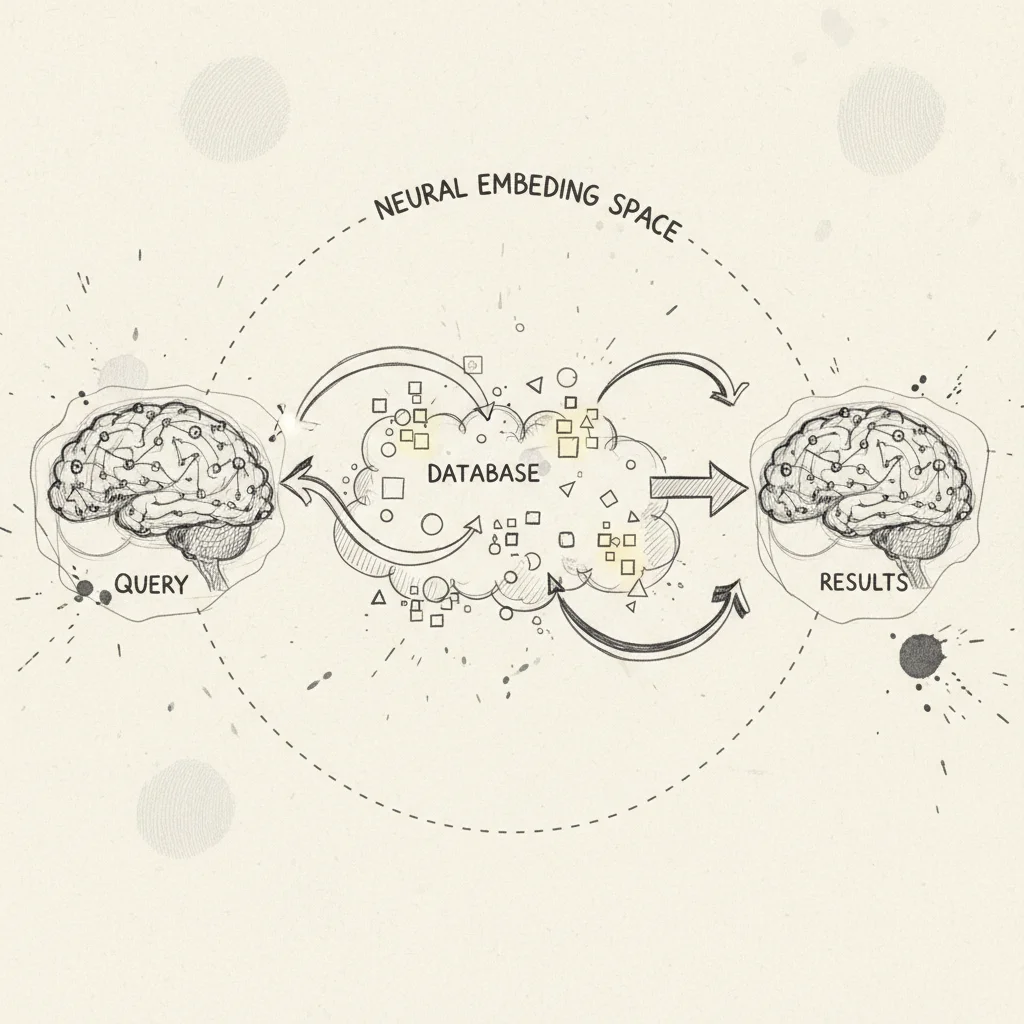
Neural search technology runs a two-phase pipeline: an offline indexing stage that converts documents into vectors, and an online retrieval stage that matches a query vector to the closest stored vectors.
What Role Do Embeddings Play in Neural Search?
An embedding is a list of numbers, typically 384 to 1,536 dimensions, that positions a piece of text as a coordinate in high-dimensional space. Texts with similar meanings cluster near each other: "dog" and "puppy" land close together, while "dog" and "invoice" land far apart.
During the offline indexing phase, a neural encoder model, such as OpenAI's text-embedding-ada-002 or a Sentence-BERT variant, converts every document in your corpus into one of these dense vectors. Those vectors are then stored in a vector index. Tools like Qdrant, Weaviate, and Pinecone use a graph structure called HNSW (Hierarchical Navigable Small World) to organize billions of vectors so they can be searched in milliseconds [2].
When a user submits a query, the same encoder model converts that query into a vector in real time. The index then returns the k nearest stored vectors by cosine similarity, documents whose meaning sits geometrically closest to the query.
How Do Neural Networks Process and Rank Search Results?
Speed at scale requires approximate nearest-neighbor (ANN) algorithms like HNSW and IVF-Flat. Rather than comparing every query vector against every document vector, an operation that becomes prohibitively slow at a billion entries, ANN algorithms navigate a pre-built graph to find close matches in sub-100ms response times [2].
Most production systems split the work across two model types. A bi-encoder encodes the query and each document independently, which is fast enough to scan millions of candidates. A cross-encoder then compares query and document jointly, reading them together for a more accurate relevance score, but only on the top candidates the bi-encoder already shortlisted.
Consider a concrete example: a user searches "how to fix a leaky tap." The bi-encoder converts that query into a vector and the ANN index returns the 100 nearest document vectors in milliseconds. A cross-encoder re-ranker then scores the top 10 candidates by reading query and document together. The final ranked list surfaces a plumbing guide that never uses the word "fix", because its embedding sits close to the query's meaning, not its exact words.
Which Neural Models and Embeddings Should You Use?
The right embedding model depends on your data type, accuracy requirements, and budget, no single model fits every neural search technology deployment.
Beyond BERT: Newer Models Like LLaMA and GPT Embeddings
BERT established the foundation, but the current model landscape has moved well past it. For general-purpose text retrieval, the sentence-transformers library offers two reliable starting points: all-MiniLM-L6-v2 (384 dimensions, fast and cheap) and all-mpnet-base-v2 (768 dimensions, higher accuracy). Both run locally at low cost [2].
For commercial deployments where accuracy is the priority, OpenAI's text-embedding-3-large (1536 dimensions) and Cohere Embed v3 consistently rank among the top performers on retrieval benchmarks. Open-source teams increasingly turn to LLaMA-based models, such as E5-Mistral, built on a Llama 3 base, which match commercial accuracy without API costs.
To compare models objectively, check the MTEB (Massive Text Embedding Benchmark) leaderboard. It scores models across retrieval, clustering, and classification tasks in multiple languages, so you can filter by your domain and pick the current leader rather than relying on vendor claims.
For multilingual applications, multilingual-e5-large (mE5-large) encodes 100+ languages into a single embedding space, removing the need to maintain separate per-language indexes.
How to Choose Between General-Purpose and Domain-Specific Models
A general model trained on web text will underperform on legal contracts, medical records, or source code, the vocabulary and phrasing simply don't match. Fine-tuning on your own domain data typically lifts recall by 15–30% in specialized verticals, which is a meaningful gain when retrieval accuracy directly affects product quality.
The other key trade-off is dimension size versus speed. OpenAI's 1536-dimension embeddings are more accurate but cost more to store and query at scale. A 384-dimension MiniLM model is 4–6× faster and cheaper, with only modest accuracy loss for general e-commerce or SaaS search use cases. Start with a smaller model, measure recall against your test queries, and scale up only if the gap is noticeable.
The Real Performance Costs and Infrastructure Requirements of Neural Search
Neural search technology delivers strong accuracy gains, but it demands meaningfully more compute, memory, and infrastructure budget than traditional keyword search.
Latency and Computational Overhead vs. Keyword Search
A well-tuned Approximate Nearest Neighbor index using the HNSW algorithm returns results in 5–50 ms at the p99 level for corpora in the millions of documents [2]. That is competitive with keyword search in raw retrieval speed.
The cost appears when you add re-ranking. Running a cross-encoder re-ranker over the top 100 candidates adds 50–200 ms depending on model size and whether you are running on CPU or GPU. For latency-sensitive applications like e-commerce search, that overhead matters.
Elasticsearch running BM25 operates comfortably on a single CPU node for millions of documents. A neural stack requires a vector database, Qdrant, Weaviate, Pinecone, or pgvector are common choices, plus a dedicated embedding inference service, and roughly 2–5× the memory footprint because dense vectors must be stored alongside raw text [2].
How Much Infrastructure Investment Does Neural Search Require at Scale?
Embedding generation is a one-time cost that is easy to quantify. Generating embeddings for 10 million documents using OpenAI's text-embedding-3-small model costs roughly $10–$20 at current API pricing. Self-hosting a sentence-transformer on a single A10G GPU drops the marginal cost to near zero but adds approximately $1–$2 per hour in compute.
Hybrid search, combining BM25 keyword retrieval with neural re-ranking rather than pure vector retrieval, is the most practical cost-control lever. It cuts vector index size, reduces GPU dependency, and retains most of the accuracy improvement over pure keyword search.
For teams that want the lowest-friction starting point, managed vector databases, Pinecone, Weaviate Cloud, Qdrant Cloud, and MongoDB Atlas Vector Search, remove GPU cluster management entirely. All four offer sub-100 ms SLAs and predictable monthly pricing, making them the sensible default before any team considers building their own infrastructure.
When to Use Neural Search, and When It's the Wrong Choice
Neural search technology wins on intent-driven queries but fails on exact-match lookups, knowing which category your users fall into determines whether the investment pays off.
Where Neural Search Performs Best
Neural search delivers clear advantages in five scenarios: natural-language customer support queries ("why won't my order ship?"), e-commerce product discovery where shoppers describe what they want rather than naming it, internal knowledge-base search over unstructured documents like PDFs and meeting notes, multilingual search where the same concept appears in different languages, and recommendation systems that surface "similar items" based on semantic proximity rather than tag matching.
In each case, the underlying strength is the same, the model understands meaning, not just characters. A shopper typing "comfortable running shoes for flat feet" will find relevant results even if no product description contains that exact phrase.
Limitations and Failure Cases of Neural Search
Exact-match lookups are where neural models break down. Order numbers, SKUs, error codes, and legal citations require character-perfect retrieval. A neural model may return a semantically "close" result that is factually wrong, returning SKU AB-1024 when the user searched AB-1042. Keyword search is strictly better here.
The freshness problem adds engineering cost. Neural indexes require re-embedding new documents before they become searchable, unlike keyword indexes, which update in near real-time. For catalogs that change daily, that re-embedding pipeline is non-trivial infrastructure.
How to Know If Neural Search Is Worth the Complexity for Your Use Case
A practical decision heuristic: if more than 30% of your queries are natural-language or conversational, neural search is worth the investment. If your users mostly search with exact product codes, filters, or structured IDs, keyword search should remain the primary retrieval layer.
For most production systems, the pragmatic default is hybrid retrieval, BM25 for precision on exact terms, neural for recall on intent, combined with a re-ranker to merge results. Companies like Shopify, Spotify, and LinkedIn run hybrid architectures in production precisely because neither approach alone covers the full range of real user behavior. That combination avoids the all-or-nothing infrastructure bet that a pure neural migration would require.

Frequently Asked Questions
Is neural search the same as vector search?
Neural search and vector search overlap significantly but are not identical. Vector search is the retrieval mechanism, it finds nearest neighbors in a high-dimensional vector space. Neural search is the broader system: it uses neural networks to generate those vectors from raw text, images, or audio, then applies vector search to retrieve results. Think of vector search as the engine and neural search as the full pipeline that feeds it.
Can neural search work without a GPU?
Yes, neural search can run on CPU hardware, though query latency increases noticeably. Lightweight embedding models such as MiniLM run on CPU in production for low-traffic applications. For high-volume workloads, GPU acceleration reduces embedding generation time from seconds to milliseconds. Many cloud-hosted vector databases handle the compute layer for you, so you don't need to provision GPU infrastructure directly.
How does neural search handle queries in multiple languages?
Multilingual embedding models, such as multilingual-E5 or LaBSE, map text from different languages into a shared vector space, so a query in French can match a document written in English. The quality depends on how well the chosen model was trained on each language pair. For niche or low-resource languages, retrieval accuracy drops and a specialized model is usually worth the added complexity.
What is hybrid search and when should you use it instead of pure neural search?
Hybrid search combines neural (vector) retrieval with traditional keyword (BM25) retrieval, merging results through a ranking step. Use it when your queries include precise identifiers, product SKUs, legal citations, medical codes, where exact-match keyword logic outperforms semantic approximation. E-commerce catalogs and B2B software documentation are two cases where hybrid search consistently outperforms either method alone. Pure neural search is sufficient when queries are conversational and documents contain no critical exact-match terms.

Conclusion
Neural search technology has moved from research curiosity to production infrastructure, and the businesses that understand it earliest will build better search, better recommendations, and better AI visibility than those that don't. Three things are worth acting on now: choose an embedding model matched to your data type, test hybrid search before committing to a pure vector approach, and audit whether your content is structured in a way that AI retrieval systems can actually parse.
That last point matters beyond your own search product. AI engines like ChatGPT, Gemini, and Perplexity use the same retrieval logic to decide which businesses to recommend. If your site lacks structured data and clean semantic signals, you won't appear in those answers. Moonrank handles exactly that gap, run a free 3-day trial to see where your business currently stands in AI search results.
Sources & References
Recommended Articles
Explore more from our content library: