Real-Time Content Syndication SEO Matters
Real-time content syndication SEO is the practice of distributing your content to third-party publishers the moment it's published, while using technical...

Real-time content syndication SEO is the practice of distributing your content to third-party publishers the moment it's published, while using technical signals like canonical tags and rel=syndication markup to protect your original page's search rankings. Done correctly, it multiplies your content's reach across multiple channels without triggering duplicate content penalties. The key is pairing instant distribution with the right SEO markup so search engines credit your site as the authoritative source.
What Real-Time Content Syndication SEO Is and How It Works
Content syndication means republishing your original content on third-party sites to reach new audiences, real-time syndication pushes that content within seconds via API feeds, not 24–48 hours later.
Batch syndication, the older approach, exports content on a fixed schedule, often overnight or every 24–48 hours. Real-time syndication uses API-driven pipelines, live RSS/Atom feeds, and webhook triggers to distribute content the moment it publishes. That timing difference has measurable SEO consequences.
What are the actual SEO benefits of content syndication compared to organic reach alone?
Syndication expands your content's distribution without requiring new writing. A single well-researched article, pushed to five relevant third-party publishers, can generate backlink equity, brand mentions, and referral traffic that a standalone organic post rarely achieves on its own.
The lead-generation numbers are significant. Studies on B2B content programs show syndicated content can produce 2–5x more leads than organic reach alone [1], because it places your material in front of audiences who are already engaged on the host platform rather than waiting for them to find you through search.
Faster indexing is a concrete secondary benefit. When a high-authority publisher syndicates your content and links back to the original, Google's crawlers follow that link, often indexing your source page sooner than if it sat on your own domain waiting for a scheduled crawl.
How does real-time content freshness in syndication affect search engine rankings differently than static content?
Google's crawl prioritization responds to freshness signals: updated XML sitemaps, live RSS/Atom feeds, and crawl timestamps all tell Googlebot that a URL is worth revisiting now. Static content, pages that rarely change, gets crawled on a slower cycle, sometimes days apart.
Real-time content syndication SEO exploits this by triggering crawl activity across multiple domains simultaneously. When your content appears on a partner site with a fresh timestamp and an updated sitemap entry, both the syndicated copy and your canonical source page receive crawl attention within minutes rather than days [2].
The practical result is that time-sensitive content, product launches, industry news, data reports, ranks faster when distributed through real-time feeds than when published once and left static on a single domain.
How to Avoid Duplicate Content Penalties When Syndicating Content
Three technical safeguards, canonical tags, rel=syndication markup, and a 24–48 hour publication delay, protect your SEO when republishing content across partners.
Can you use canonical tags and rel=syndication markup to prevent search engine flags?
The canonical tag is the primary defense. Every syndication partner must insert <link rel='canonical' href='[your-original-URL]' /> inside the <head> of their republished page. This tells Google which URL to credit for rankings and consolidates link equity back to your domain [2].
Google's John Mueller has confirmed, however, that canonical tags are treated as "strong hints, not directives", meaning Google can override them. The safest approach pairs a canonical tag with a noindex directive on the partner page, creating a dual layer that removes any ambiguity about which version should rank.
The rel=syndication microformat is a separate, emerging signal. Where a canonical tag says "this page's canonical source is X," rel=syndication explicitly labels the relationship between the two URLs as a syndication pair. Use canonical tags to consolidate ranking signals; use rel=syndication to give crawlers cleaner relationship context, they serve different purposes and work best together.
What's the difference between safe syndication strategies and practices that trigger SEO pitfalls?
In real-time content syndication SEO, timing is as important as markup. Publish on your own domain first and wait at least 24–48 hours before syndicating. This window gives Googlebot time to index your original URL, establishing clear priority before the republished copy appears [1].
Safe practices also include clear attribution links pointing to your original, consistent canonical tags across all partner pages, and noindex on syndicated copies. Risky practices run in the opposite direction: syndicating before your own page is indexed, allowing partners to strip canonical tags during CMS import, and copying meta descriptions verbatim, which creates duplicate signals at the metadata level even when body content is properly attributed [2].
A practical check: after any syndication goes live, use Google Search Console's URL Inspection tool to confirm which version Google has selected as canonical. If it's the partner's URL rather than yours, the canonical tag was likely overridden or missing.
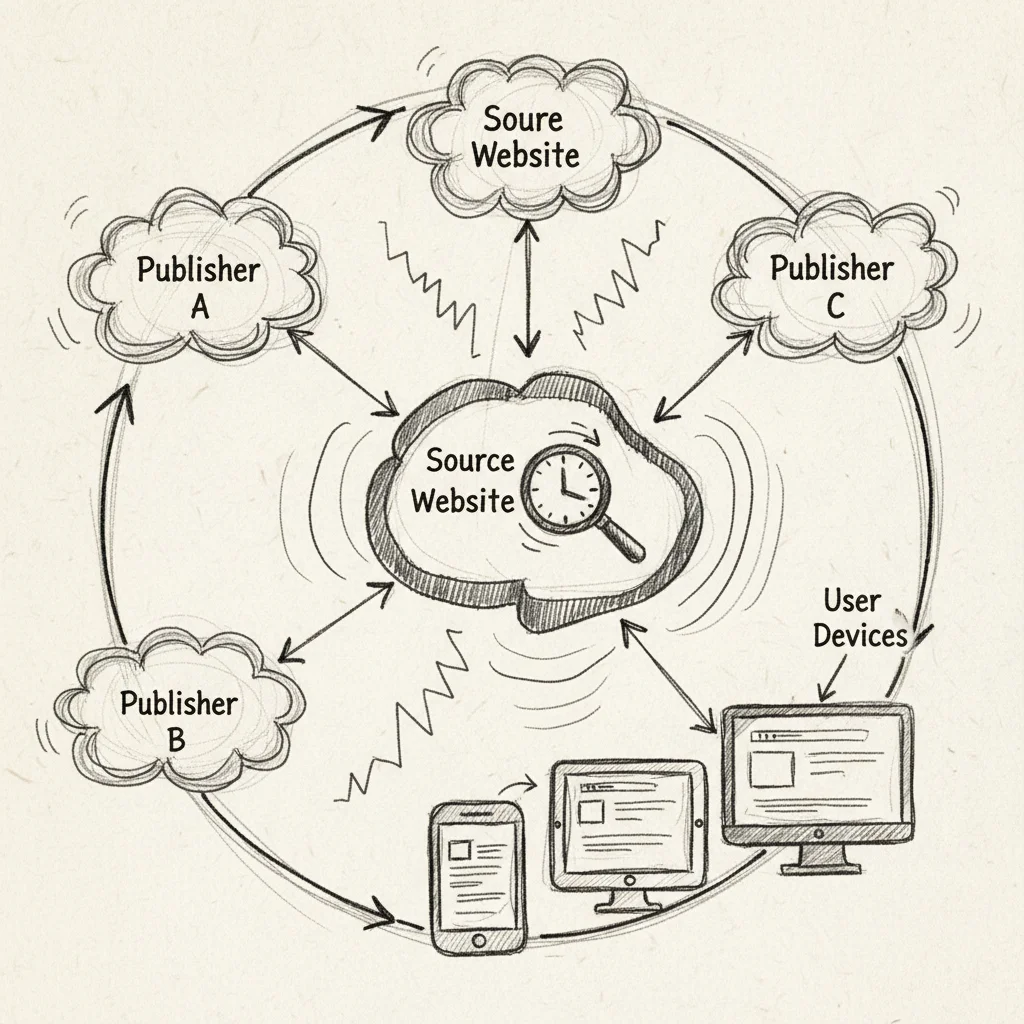
Which Real-Time Syndication Platforms Actually Deliver Content Instantly vs. in Batches
Outbrain, Taboola, PR Newswire, and Business Wire push content within minutes; most B2B RSS aggregators and content marketing platforms run on 12–24 hour batch cycles.
What multi-channel syndication capabilities do leading platforms offer for real-time distribution?
Outbrain and Taboola distribute content to their publisher networks within minutes of submission via API, making them practical choices when freshness signals matter for real-time content syndication SEO. PR Newswire and Business Wire go further, both simultaneously push press releases to thousands of outlets, newsrooms, and financial terminals the moment you hit publish.
Top-tier platforms distribute across news aggregators, social channels, email newsletters, and partner sites in a single submission. That single-push model eliminates the manual work of posting channel by channel, which is where most SMB teams lose hours they don't have.
Batch-processing platforms, older RSS aggregators and some B2B content marketing networks, operate on 12–24 hour refresh cycles. That delay costs you two things: Googlebot sees stale content, and your freshness signals weaken relative to competitors who syndicated the same story faster.
How do you compare syndication platforms based on their actual real-time performance and API integration options?
Evaluate four criteria when assessing any platform's real-time capability: webhook support, feed format compatibility (JSON-LD, Atom, or RSS 2.0), rate limits per hour, and whether the platform preserves your canonical URL in every syndicated output.
Canonical URL preservation is non-negotiable. Without it, search engines attribute your content to the syndication host, not your domain, erasing the authority signal the distribution was meant to build.
Webhook support separates genuine real-time platforms from batch tools. A platform that pulls your feed on a schedule, even every 30 minutes, is not real-time; a platform that accepts a push the moment your content publishes is.
What Technical Setup You Need for Real-Time Syndication with Proper SEO Markup
Real-time content syndication SEO requires three technical layers: a live feed from your CMS, canonical tags embedded in that feed, and Article schema to signal freshness to Google.
How do you implement canonical tags, rel=syndication markup, and API feeds for real-time content distribution?
Start with your feed infrastructure. Configure your CMS, WordPress, Contentful, or a headless setup, to expose a dedicated syndication endpoint (not your standard RSS feed) that fires on every publish event. That endpoint should return full article content, not excerpts, and include canonical and og:url values pointing back to your original URL in the feed metadata itself. Partner sites that ingest the feed then inherit the correct canonical automatically, without any manual intervention on their end.
The second layer is structured data. Wrap each syndicated article in Article or NewsArticle schema and populate both datePublished and dateModified fields on every update. Google uses these timestamps to evaluate content freshness, a missing or stale dateModified value undercuts the speed advantage that real-time syndication is supposed to deliver.
The third layer covers situations where you don't control the partner's HTML. In those cases, implement rel=syndication in the HTTP response header of your original page. This tells crawlers that syndicated copies exist and which URL is authoritative, no in-page markup required on the partner's side.
What are the technical requirements for integrating real-time syndication into your content workflow?
Before any feed goes live, run a staging check that confirms canonical tags are present and resolving correctly. A missing canonical on even one partner page can create a duplicate content signal that dilutes your original URL's authority [2].
Build a partner onboarding checklist that covers three items: canonical tag implementation confirmation, a robots.txt audit to ensure syndicated partner pages aren't accidentally blocking crawlers, and agreement on update frequency so partner caches don't serve stale versions after you push edits.
Finally, audit your own robots.txt to confirm your syndication endpoint is crawlable. Blocking it, a common misconfiguration, prevents Google from discovering the canonical relationship entirely and negates the SEO benefit of the whole setup.
How to Monitor and Measure the Real-Time Performance Impact of Syndicated Content
Track syndicated content performance using Google Search Console, GA4 real-time reports, and a rank tracker, checked within 48 hours of each syndication event.
What tools and metrics should you track to measure traffic and lead lift from syndication campaigns in real-time?
Your core tracking stack has three layers. Google Search Console confirms canonical consolidation, check that impressions and clicks are accruing to your original URL, not the syndicated copies. GA4 captures referral sessions when every syndication link carries a UTM parameter (utm_source=partner_name&utm_medium=syndication). A rank-tracking tool like Semrush or Ahrefs then shows position changes on your target keywords within 48 hours of a new syndication going live.
To surface traffic spikes the same day content publishes, build a GA4 real-time report filtered by Source / Medium. Set the dimension to your syndication partners' UTM sources and watch referral sessions as they arrive, no waiting for the next morning's report.
Review four metrics every week to run a tight real-time content syndication SEO operation:
- Canonical consolidation rate, the percentage of syndicated copies correctly pointing back to your original URL via a
rel="canonical"tag - Referral sessions from each syndication partner, segmented by UTM source in GA4
- New backlinks generated, tracked in Ahrefs or Semrush's backlink index
- Change in organic impressions on the original URL in GSC, compared week-over-week post-syndication
What do case studies show about quantified results from real-time content syndication strategies?
The numbers from documented campaigns are concrete. DemandScience reports that properly canonicalized syndicated content drives a 30–50% lift in qualified leads compared to non-syndicated campaigns [1]. PR Newswire data shows real-time press release syndication generates an average of 200+ media pickups within the first hour of distribution, a signal that speed of syndication directly multiplies reach.
These benchmarks set a realistic baseline. If your weekly referral sessions from syndication partners are flat and your canonical consolidation rate sits below 90%, the technical setup, not the content, is the bottleneck to fix first.

Frequently Asked Questions
Does syndicating content hurt your original page's Google ranking?
Syndication does not hurt your original page's ranking if you implement canonical tags correctly. When a third-party publisher adds a rel="canonical" tag pointing back to your original URL, Google attributes the ranking signals, links, engagement, authority, to your page, not the syndicated copy [2]. Without that canonical tag, Google may index the syndicated version instead, which can suppress your original. Always confirm the publisher will add the canonical before you agree to syndicate.
How long should you wait before syndicating a piece of content after publishing it on your own site?
Wait at least 48 to 72 hours after publishing before syndicating to give Google time to crawl and index your original URL first. If Google indexes the syndicated copy before yours, it may treat the third-party site as the source. Some SEO teams wait a full week for high-priority content. The goal is a clear timestamp advantage, your domain on record as the origin before any republication goes live.
Can small businesses benefit from real-time content syndication, or is it only for large publishers?
Small businesses can benefit directly from content syndication, the barrier is strategy, not company size. A local e-commerce store or B2B SaaS founder who publishes a well-researched article and syndicates it to a niche trade publication or industry newsletter reaches a targeted audience they couldn't build alone. Tools like Moonrank that automate daily content publishing make it practical for SMBs to maintain the publishing volume that syndication partners expect before they'll accept your submissions.
What's the difference between content syndication and guest posting for SEO purposes?
Syndication republishes existing content on a third-party site; guest posting creates an original piece written exclusively for that site [2]. For SEO, guest posts typically generate stronger link equity because the content is unique and the host site has full editorial investment in it. Syndicated content, by contrast, scales reach faster with less effort but depends on canonical tags to protect ranking credit. Most content strategies use both: guest posts to build authority, syndication to extend reach.

Conclusion
Real-time content syndication works when three things are in place: canonical tags that protect your original URL, a publishing cadence fast enough to give Google a clear indexing head start, and distribution partners whose audiences match your buyers. Without all three, syndication adds duplicate content risk without the traffic upside.
The practical next step is to audit your current content for pieces that already rank on page two or three, those are your best syndication candidates, because wider distribution can accelerate the authority signals that push them onto page one.
If producing content at the volume syndication requires feels out of reach, Moonrank publishes fresh SEO content to your site every day automatically, so you always have material worth syndicating. Start a free 3-day trial at moonrank.ai.
Sources & References
- Effective SEO and Content Syndication Strategy - DemandScience
- What Is Content Syndication? The Basics + How to Do It
Recommended Articles
Explore more from our content library: