Retrieval Augmented Generation SEO: Content Ranking
Retrieval augmented generation SEO is the practice of optimizing your content so AI-powered search engines — ChatGPT, Perplexity, Google's AI Overviews, and...

Retrieval augmented generation SEO is the practice of optimizing your content so AI-powered search engines, ChatGPT, Perplexity, Google's AI Overviews, and Gemini, retrieve and cite it when generating answers. Unlike traditional SEO, which targets blue-link rankings, RAG-based optimization focuses on making your content the trusted source an AI pulls from its retrieval index. Businesses that structure content for RAG retrieval get cited in AI answers, not just ranked on a results page.
What Is Retrieval Augmented Generation SEO and How Does It Work?
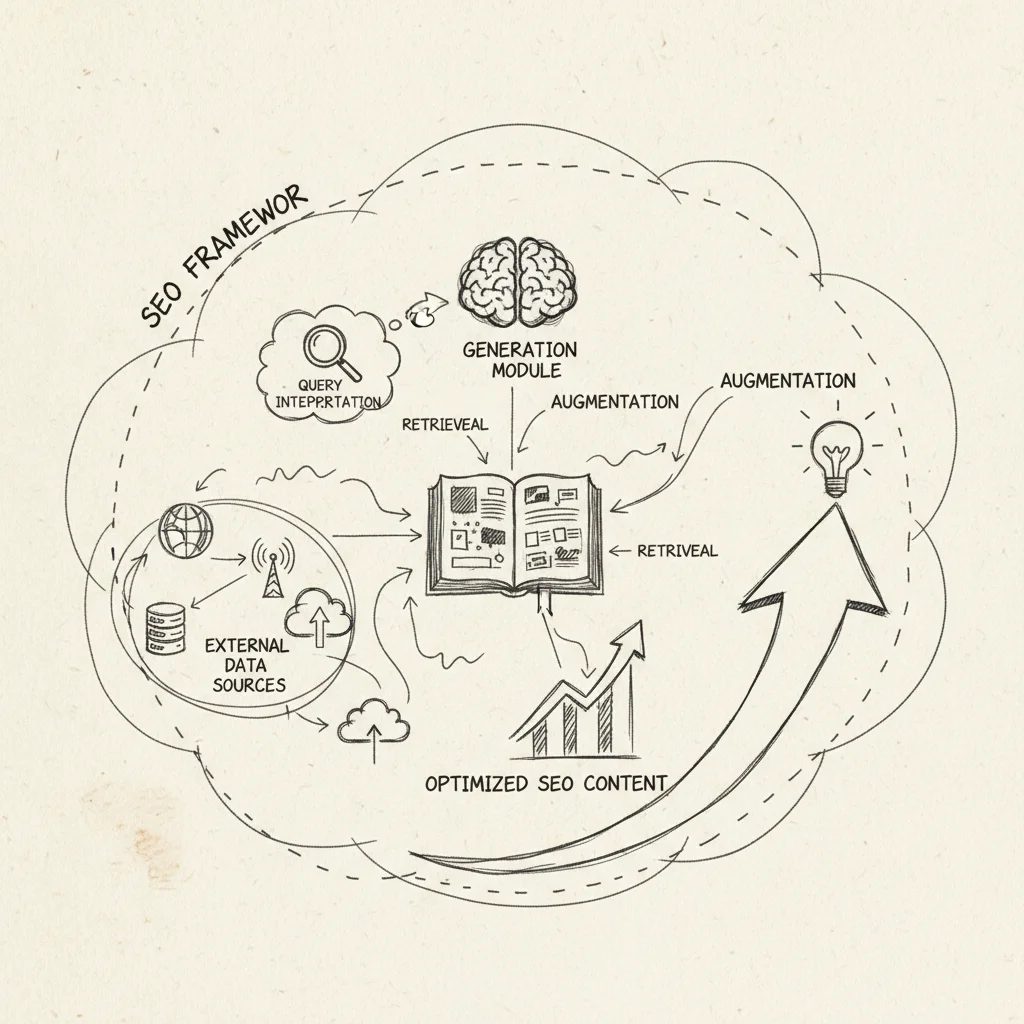
RAG is a two-step pipeline: an AI retrieves relevant documents from an index, then generates an answer grounded in those documents rather than memory alone.
The retrieval step works like a search engine inside the AI, it queries a vector index to find documents whose meaning matches the user's question, not just their keywords. The generation step then passes those documents to a large language model, which synthesizes a cited answer from the retrieved text. If your content never enters that retrieval pool, the model has nothing to cite, regardless of where you rank on a traditional results page.
This is the core implication for retrieval augmented generation SEO: traditional ranking signals get you onto a results page, but retrieval signals get you into an AI-generated answer. The two goals require different optimization strategies.
How REALM, RETRO, and RARR differ in their retrieval approaches
Three architectures define how major AI search systems retrieve content [1]. Google's REALM (Retrieval-Enhanced Language Model) integrates retrieval directly into model pre-training, so the system learns which documents are worth fetching during the training process itself. DeepMind's RETRO (Retrieval Transformer) keeps a separate, chunked document database and retrieves passages at inference time, prioritizing scale and recency over tight model integration. RARR (Retrieve and Rerank), the approach behind Google's AI Overviews [1], adds a reranking layer that scores retrieved documents for factual consistency before passing them to the generator, prioritizing citation accuracy above all.
Each architecture weights different signals: REALM favors documents the model already associates with authority, RETRO favors freshness and breadth, and RARR favors verifiable factual alignment.
Why RAG improves content retrieval accuracy in AI-powered search
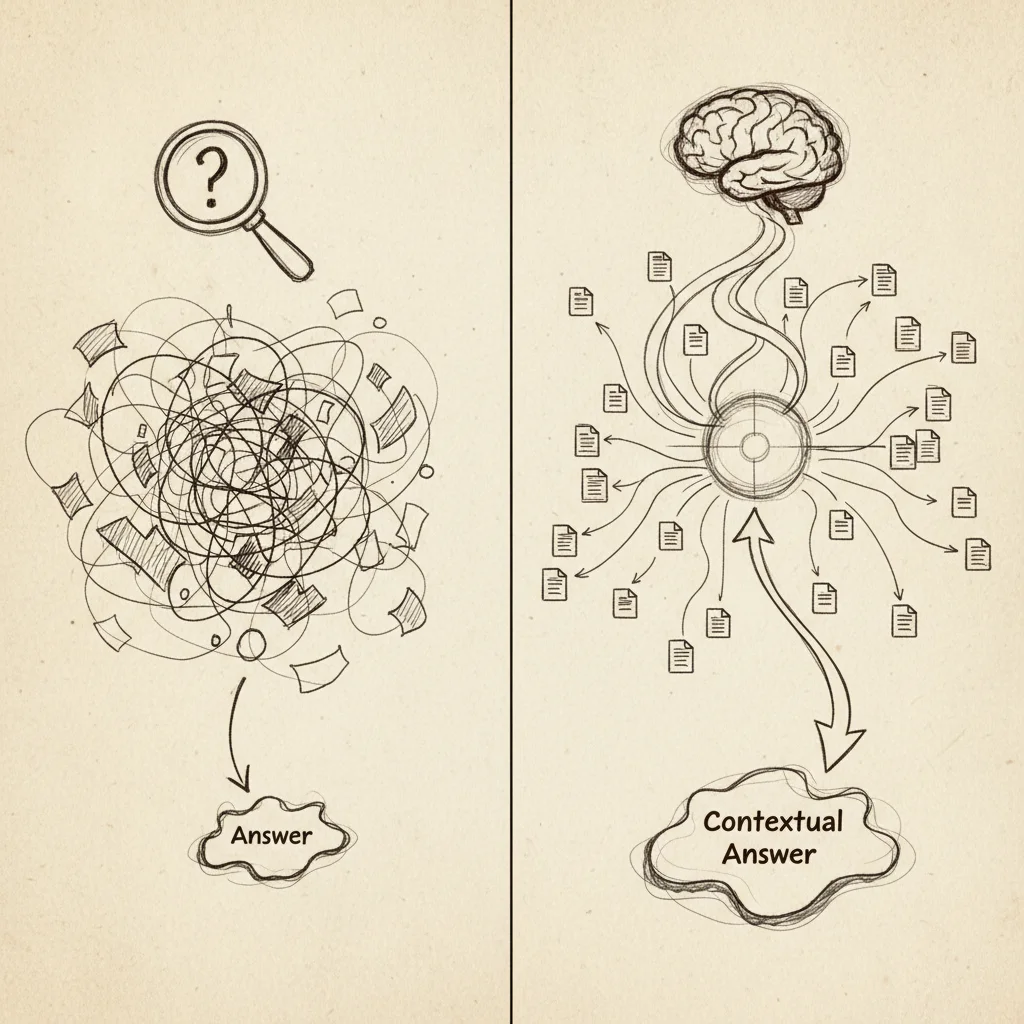
RAG reduces hallucinations because the model is anchored to retrieved source text rather than reconstructing facts from training data alone. When a source document is present in the context window, the model can quote, paraphrase, and cite it, which is why the presence of your content in the retrieval index directly affects whether your brand gets credited in an answer.
The retrieval index itself differs fundamentally from a traditional search index. A keyword index ranks documents by term frequency and backlink authority. A RAG retrieval index encodes semantic meaning and entity relationships as dense vectors, so a document about "best espresso machines under $200" can surface for "affordable home coffee gear" without sharing a single keyword. Structured data, clear entity definitions, and topical depth all improve how accurately your content is encoded in that vector space.
How RAG Is Changing the Way Search Engines Rank and Display Content
RAG-powered search engines retrieve and cite content before a user ever clicks, making visibility in AI-generated answers the new front line of search.
Google's AI Overviews, Perplexity, and ChatGPT Search all run RAG pipelines: they pull candidate content from an index, rank it for relevance, and weave the best sources into a generated answer with citations [1]. The click is secondary. If your content isn't retrieved, it doesn't appear, regardless of where you rank on the traditional results page.
What ranking factors matter most for RAG-optimized content
Retrieval augmented generation SEO shifts the weight away from raw backlink counts toward three signals that AI systems can evaluate directly.
Topical authority matters most. A site that covers a subject with both depth and breadth, multiple detailed pages on related subtopics, signals to the retrieval layer that it is a reliable source on that domain [2]. A single well-ranked post rarely beats a site with 20 interconnected pages on the same topic.
Structured data and entity clarity come second. Schema markup makes entities machine-readable, so AI systems can confirm what your business does, where it operates, and who wrote the content. A well-structured FAQ page with FAQ schema is more likely to be retrieved by Perplexity than a long-form post burying the same answers inside dense paragraphs [1].
E-E-A-T signals, named authors, verifiable credentials, and clear citations, determine factual trustworthiness. Content with traceable claims scores higher in retrieval relevance because RAG systems are designed to surface factually grounded sources [2].
How search engines index and evaluate content differently under RAG
Traditional backlinks and click-through rates still influence which sources enter the retrieval pool, they act as a trust filter at the indexing stage [1]. But once inside the pool, semantic relevance and entity coverage determine which sources actually get cited in the generated answer.
Google and Perplexity evaluate content differently at the retrieval step. Google's AI Overviews draw from its existing index and apply E-E-A-T weighting built up over years [1]. Perplexity re-crawls sources in near real-time and weights recency and citation density more heavily [2]. Both reward content that is structured for machine parsing, not just human reading.
Tools like Moonrank address this directly by implementing schema markup, structured data, and citation signals automatically, so your content clears the retrieval filter on both platforms without requiring manual technical work.
RAG-Based SEO vs. Traditional Optimization: Key Differences and When to Use Each
Traditional SEO targets link rankings; retrieval augmented generation SEO targets AI citation, and the tactics required to win each surface are meaningfully different.
Traditional optimization focuses on keyword density, backlink volume, and page authority to secure a position in a list of ranked links. RAG-focused optimization works differently: it prioritizes semantic completeness, entity clarity, and structured data so that an AI system retrieves your page as a trusted source and cites it in a generated answer.
Concrete metrics and case studies comparing RAG vs. traditional SEO performance
Content structured for RAG retrieval, clear H2/H3 headings, schema markup, and concise factual statements, appears in Google AI Overviews at measurably higher rates than equivalent content optimized only for keyword ranking [1]. The structural signals that help a language model parse and extract a passage are the same ones that make a page easier for a human to scan: short declarative sentences, labeled sections, and explicit entity relationships.
RAG optimization delivers its strongest returns on informational queries, comparison searches, and "best of" questions. When a user asks ChatGPT or Perplexity to recommend the best project management tool for a small team, the AI synthesizes multiple sources, and pages structured for retrieval are far more likely to be cited than pages built around keyword density alone. These citation opportunities carry real commercial value, particularly for e-commerce and B2B SaaS brands competing on high-intent informational terms.
When conventional search optimization tactics still outperform RAG
RAG is the wrong priority when your goal is local map-pack placement, image search visibility, or shopping ad impressions. Those surfaces run on traditional ranking signals, Google Business Profile completeness, image alt text, product feed data, not generative retrieval logic.
Most businesses need both approaches running in parallel. Traditional SEO protects existing organic traffic; RAG optimization captures the growing share of queries answered by ChatGPT, Gemini, Claude, and Perplexity. The two strategies share a practical foundation, structured data and topical depth benefit both, which means the incremental investment in RAG readiness is lower than it first appears. Tools like Moonrank handle the technical layer automatically, implementing schema markup and structured data that serves both ranking signals simultaneously.
How to Implement RAG Optimization in Your SEO Strategy by Industry
RAG optimization starts with structured data and content architecture, the exact signals AI retrieval pipelines use to select and surface your pages as source material.
RAG Implementation for E-Commerce and Local Search
E-commerce sites should structure every product page with JSON-LD schema covering three entities: Product, Review, and Offer. These are the signals RAG pipelines use to retrieve product answers inside ChatGPT Shopping and Google AI Overviews [2]. Without them, a product page is plain text to a retrieval model, it has no machine-readable price, rating, or availability to pull into an answer.
Local businesses need LocalBusiness schema with complete NAP data, name, address, and phone number, plus service area and opening hours. Perplexity and Google AI Overviews pull local answers directly from structured entity data, not just from Google Business Profile [1]. A restaurant or boutique hotel that skips this schema is invisible to the retrieval layer even if its website ranks on page one.
Content publishers and B2B teams should build topical clusters: one pillar page covers a subject in full, and supporting pages each answer a specific follow-up question. This structure mirrors how RAG retrieval scores document relevance against a query, the model rewards depth and specificity, not broad coverage alone [2].
Technical Setup and Content Structure for RAG-Ready Pages
A retrieval augmented generation SEO checklist covers four areas: implement schema markup, write an llms.txt file (the robots.txt equivalent that tells AI crawlers what to index), use H2/H3 headings that match natural language questions, and place factual claims in the first 100 words of each section.
On the schema side, a basic FAQPage JSON-LD block takes under 10 lines and directly increases the chance your Q&A content enters a RAG retrieval pool. A minimal structure looks like this:
{
 "@context": "https://schema.org",
 "@type": "FAQPage",
 "mainEntity": [{
 "@type": "Question",
 "name": "Your question here?",
 "acceptedAnswer": {
 "@type": "Answer",
 "text": "Your concise answer here."
 }
 }]
}
Tools like Moonrank handle schema markup, llms.txt configuration, and structured data implementation automatically, so an SMB owner gets the full technical setup without editing a single line of code.
Common Pitfalls and Limitations of RAG for SEO
RAG-based optimization fails most often because of crawl blocks, poor content structure, and mismatched expectations, not because the strategy is wrong.
Failure modes and edge cases to watch when deploying RAG for search
The most common retrieval augmented generation SEO mistake is never making it into the retrieval pool at all. If your content sits behind a login, or if your robots.txt file blocks GPTBot, PerplexityBot, or ClaudeBot, AI engines cannot index your pages regardless of how well-written they are. Audit your crawl settings before doing anything else.
Context window limits compound this problem. RAG systems retrieve only the most relevant chunks of a page, not the full document. A 400-word introduction that buries your core claim means that claim may never surface in a retrieval result. Front-load every section with your key fact or answer, then add context.
Hallucination risk drops with RAG but does not disappear. A retrieval system can misattribute a statistic to your page or quote a sentence out of context, which can damage your brand's credibility in ways that are hard to trace. Monitor AI citations of your content in tools like Perplexity and ChatGPT on a regular schedule, Moonrank's AI search visibility tracking does this automatically across ChatGPT, Gemini, Claude, and Perplexity.
Over-optimizing for retrieval is also a real failure mode. Pages stuffed with schema markup but lacking genuine analytical depth get retrieved once and then deprioritized, AI engines track source quality over repeated queries, so thin content catches up with you quickly.
How RAG limitations differ across content types and search contexts
RAG performs differently depending on what you publish. Time-sensitive news content degrades fast in retrieval relevance because RAG indexes are not updated in real time. For news publishers, traditional Google News indexing still outperforms RAG optimization for breaking stories, RAG is better suited to evergreen, authoritative content that holds its value over weeks or months.
E-commerce product pages face a different constraint: highly structured but low-narrative content gives RAG systems little text to chunk meaningfully. Adding a concise, factual product description with specifications and use-context improves retrieval without sacrificing the page's commercial function.
Frequently Asked Questions
Does RAG optimization replace traditional keyword research?
RAG optimization extends keyword research rather than replacing it, you still need to know what terms your audience uses, but the goal shifts from ranking a page to becoming the source an AI retrieves. Instead of targeting a single keyword, you map clusters of related questions and entities that a retrieval system would associate with your topic. Keyword intent still matters; what changes is how you structure the content around that intent so an AI can extract and cite it cleanly.
Which AI search engines use RAG, and do they retrieve content differently?
ChatGPT (via web browsing), Perplexity, Google's AI Overviews, and Gemini all use RAG-based retrieval, but their indexing signals differ. Perplexity crawls the live web and surfaces citations visibly, making structured, quotable content especially effective there. Google's AI Overviews draw heavily on pages already ranking in organic results [1]. Claude retrieves external content when given tools to do so. Each engine weights authority signals, freshness, and schema markup differently, so optimizing across all four requires a consistent technical foundation rather than platform-specific tricks.
How long does it take for RAG-optimized content to start appearing in AI answers?
Most businesses see initial AI citation activity within four to eight weeks of publishing well-structured, retrieval-ready content, though this varies by niche competitiveness and crawl frequency. Perplexity tends to surface new content faster than Google's AI Overviews because it crawls continuously rather than relying on a traditional index update cycle. Consistent daily publishing accelerates the process by giving retrieval systems more opportunities to index and associate your content with relevant queries.
Can small businesses compete with large brands in RAG-based AI search results?
Yes, RAG retrieval favors specificity and source clarity over domain authority alone, which gives small businesses a real opening. A local restaurant with a well-structured menu page, FAQ schema, and consistent citations can outperform a generic food directory in a hyper-local AI query. Tools like Moonrank automate the technical groundwork, schema markup, llms.txt configuration, structured data, that makes a small business's content readable and citable by AI engines like ChatGPT and Perplexity, at $99/month versus agency rates.

Conclusion
RAG has changed the rules for how content gets found and cited, AI engines now retrieve specific, structured, trustworthy sources rather than ranking pages by link count alone. Three things move the needle most: publishing content organized around questions and entities, implementing schema markup and structured data so AI systems can parse your pages cleanly, and building the citation signals that make your brand a credible retrieval source across ChatGPT, Gemini, Claude, and Perplexity.
The businesses that act on this now will occupy the retrieval index before their competitors do. Start by auditing one core page on your site for schema completeness and question-based structure, then visit www.moonrank.ai to see how automated daily publishing and technical AI optimization can do the rest on autopilot.
Sources & References
- How Retrieval-Augmented Generation is Redefining SEO - iPullRank
- Retrieval-Augmented Generation (RAG) And SEO | BrainZ
Recommended Articles
Explore more from our content library: