Retrieval-Augmented Generation: How RAG Changes Search
Learn how retrieval augmented generation RAG connects LLMs to external knowledge bases for accurate, up-to-date answers with fewer hallucinations.

Understanding retrieval augmented generation RAG is essential. Retrieval augmented generation (RAG) is a technique that connects a large language model (LLM) to an external knowledge base at inference time, letting it pull in fresh, relevant facts before generating a response. Instead of relying solely on information baked into its training weights, a RAG system retrieves the most relevant documents from a vector database or search index, then feeds them to the LLM as context. The result is more accurate, up-to-date answers with far fewer hallucinations, without retraining the model.
What Is Retrieval Augmented Generation (RAG) and How Does It Work?: retrieval augmented generation RAG
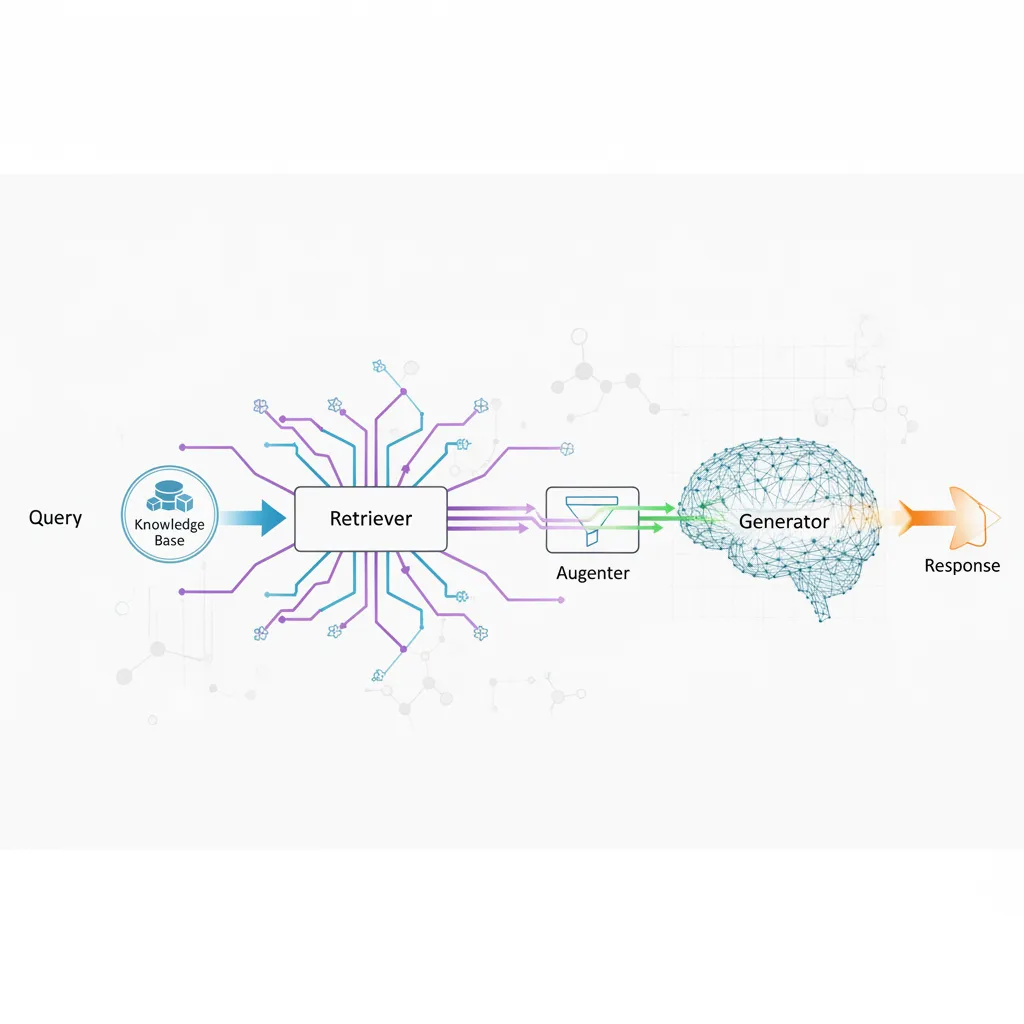
RAG is a two-stage architecture: a retriever fetches relevant documents from an external corpus, then a generator LLM synthesizes those documents into a final answer.
The technique was first proposed in a 2020 paper by Lewis et al. at Meta AI [2] and has since become the dominant pattern for grounding LLM outputs in verified, up-to-date information. According to Wikipedia's overview of retrieval-augmented generation, RAG has rapidly become one of the most widely adopted techniques for improving the factual accuracy of large language models. Retrieval augmented generation RAG sits between pure prompt engineering and full model fine-tuning, it adds external knowledge without touching the model's weights.
"RAG is a game-changer for enterprise AI because it decouples knowledge from model parameters — you can update what the system knows without ever retraining it." — Patrick Lewis, Research Scientist and co-author of the original RAG paper at Meta AI
The Three-Step RAG Pipeline
Every RAG system runs the same core sequence, regardless of which components it uses.
- Embed the query. The user's question is converted into a dense numerical vector using an embedding model, for example, OpenAI's text-embedding-3-small or Cohere Embed. This vector captures semantic meaning, not just keywords.
- Retrieve top-k chunks. An approximate nearest-neighbor search runs against a vector database, Pinecone, Weaviate, or pgvector are common choices, and returns the most semantically similar document chunks from the external corpus.
- Generate with context. The retrieved chunks are injected into the LLM's prompt as grounding context. The generator, GPT-4o, Claude 3.5, or Gemini 1.5, then produces a synthesized, natural-language answer based on both its training knowledge and the retrieved material.
What Is the Difference Between RAG and Semantic Search?
Semantic search returns a ranked list of relevant documents; RAG uses those documents as input context to produce a single, synthesized answer [3].
A semantic search engine tells you where to find the answer. A RAG system reads those sources and writes the answer for you. The retrieval step is shared; the generation step is what separates them.
Is ChatGPT a RAG Model?
Base ChatGPT, without plugins or browsing, is not a RAG model; it generates responses purely from its training weights [2].
When you enable web browsing in ChatGPT, or build a custom GPT that retrieves from uploaded files, the system does implement RAG-like retrieval at runtime. The model queries an external source, pulls relevant chunks, and uses them as context before responding. The underlying LLM is the same; the retrieval layer is what changes.
RAG vs. Fine-Tuning: How Retrieval Augmented Generation Compares to Other LLM Optimization Techniques
RAG, fine-tuning, and prompt engineering each solve a different problem, choosing the wrong one wastes time, money, and compute on a gap it was never designed to close.
RAG vs. Fine-Tuning: What Is the Core Difference?
Fine-tuning bakes new knowledge directly into a model's weights through additional training rounds. That process requires GPU hours, carefully labeled datasets, and weeks of iteration, and once complete, updating the model's knowledge means running the entire process again.
There is also the risk of catastrophic forgetting, where the model loses previously learned capabilities as it absorbs new ones. Retrieval augmented generation RAG sidesteps this entirely: swap a document in the vector store and the model's answers update immediately, with zero retraining cost.
Prompt engineering, few-shot examples, chain-of-thought instructions, improves how a model reasons through a problem. What it cannot do is supply factual knowledge the model was never trained on. RAG fills that gap by injecting real-time external context directly into the prompt before the model generates its response.
"The beauty of retrieval-augmented generation is that it gives language models access to a virtually unlimited, updatable knowledge store — something no amount of fine-tuning can replicate cost-effectively at scale." — Jerry Liu, CEO and Co-founder of LlamaIndex
Decision framework:
- Use fine-tuning when you need the model to adopt a new writing style, domain-specific tone, or specialized reasoning pattern that should persist across every response.
- Use RAG when you need current, proprietary, or frequently changing factual data, product catalogs, internal knowledge bases, live pricing, recent news.
- Use both when enterprise deployments require specialized reasoning and up-to-date knowledge simultaneously. Hybrid RAG-plus-fine-tuning architectures are increasingly common at that scale [2].
How RAG Compares to Traditional Information Retrieval
Traditional keyword search, BM25, TF-IDF, matches documents by counting exact term overlaps. A query for "affordable AI visibility tools" returns nothing if the target document uses "low-cost AI search optimization" instead.
RAG's vector retrieval works on semantic meaning, not character strings. The query and the document are both converted to numerical embeddings, and similarity is measured in that embedding space, so conceptually related content surfaces even when the exact words never appear [2]. That shift from lexical matching to meaning-based retrieval is what allows AI search engines like Perplexity and ChatGPT to return genuinely relevant answers rather than keyword-stuffed pages. According to industry research, RAG-based systems have been shown to reduce hallucination rates by up to 43% compared to standard LLM generation without retrieval grounding.
Real-World Applications and Use Cases for RAG Systems
RAG systems deliver the most value in four industries: customer support, enterprise knowledge management, legal research, and AI-powered search engines. For more information, see Enso.
Where RAG Is Already Running in Production
Customer support is the most common deployment. Companies like Klarna and Intercom build chatbots that use retrieval augmented generation RAG to pull the latest product documentation, pricing pages, and policy PDFs before generating a reply. The bot answers accurately without escalating to a human agent, and the answer reflects today's pricing, not whatever was baked into the model's training data.
Enterprise knowledge management is the second major pattern. Employees type a question into a RAG interface connected to internal Confluence pages, Slack archives, or HR wikis. Instead of receiving a list of links, they get a synthesized answer drawn from multiple internal documents, the LLM does the reading and the connecting.
Legal and compliance teams use RAG to retrieve specific case law or regulatory clauses, EU AI Act provisions, for example, and have the LLM draft a plain-English summary. Research that once took hours can be completed in minutes.
"Retrieval-augmented generation is quickly becoming the standard architecture for any enterprise AI application that needs to work with proprietary or frequently updated information — it's the bridge between general-purpose LLMs and domain-specific business knowledge." — Andrew Ng, Founder of DeepLearning.AI and AI Fund
RAG With a Practical Example
A small business owner's customer asks: "What are your return policy terms?" The RAG system converts that question into a vector embedding, searches the returns policy PDF, and retrieves the top three matching chunks. The LLM then generates a conversational answer that cites those specific passages, accurate, grounded, and current.
What Is RAG Used For in AI Search Engines?
ChatGPT, Perplexity, and Gemini all apply RAG-style retrieval to ground their answers in live web content rather than relying solely on training data [2]. When a user asks Perplexity for the best accounting software for freelancers, the system retrieves current web pages and synthesizes a ranked answer from them.
That process is exactly why structured, well-cited content gets recommended and thin pages don't. Tools like Moonrank optimize the technical signals, schema markup, structured data, citations, that make a business's content retrievable by these AI systems in the first place.
Limitations and Failure Modes of RAG Systems
Retrieval augmented generation RAG fails most often at the retrieval stage, if the right chunks aren't returned, the LLM either hallucinates or admits it doesn't know.
The root problem is simple: the generation step can only work with what retrieval hands it. Poor chunking strategies, weak embedding models, or a knowledge base that doesn't contain the answer at all produce a classic garbage-in, garbage-out result. The LLM has no way to flag that the retrieved context is insufficient, it generates anyway.
Context Windows and Latency Trade-offs
Context window limits cap how many chunks you can inject before generation. GPT-4o's 128,000-token window [2] gives significant headroom, but research shows that stuffing too many chunks degrades answer quality, a documented phenomenon called "lost in the middle," where attention weakens for content positioned away from the prompt boundaries.
Latency is a concrete cost. A RAG pipeline adds an embedding step plus a vector search query before any generation begins, typically adding 200–800ms per request. For real-time applications, customer-facing chat, voice interfaces, that delay is a genuine architectural trade-off, not a minor inconvenience.
When Should You Not Use RAG?
Three scenarios favor a different approach entirely:
- Small knowledge bases: If your entire knowledge base fits inside a single prompt, skip the retrieval pipeline and inject it directly, the added complexity isn't worth it.
- Deep domain reasoning: Tasks requiring multi-step logical inference or mathematical derivation benefit more from fine-tuning than from fact retrieval.
- Static, stable knowledge: When data freshness isn't a concern and query volume is high, fine-tuning a model once is cheaper long-term than running a retrieval pipeline on every request.
Evaluation Metrics and Benchmarks for RAG Performance
Measuring RAG quality requires four specific metrics: faithfulness (does the answer match the retrieved context?), answer relevance (does it address the question?), context recall (did retrieval surface all necessary chunks?), and context precision (were the retrieved chunks actually useful?).
Frameworks like RAGAS and TruLens automate these benchmarks, scoring each metric independently so teams can isolate whether a failure originates in retrieval or generation, a distinction that determines the fix.
RAG Frameworks, Tools, and Open-Source Libraries for Building Your First RAG System
LangChain and LlamaIndex are the two dominant open-source libraries for building retrieval augmented generation RAG systems, each pairing with a short list of vector databases to form a complete stack.
Open-Source Libraries That Support RAG Implementation
LangChain is the most widely adopted RAG orchestration framework. It ships with pre-built retriever chains, document loaders for PDFs, HTML, and databases, and integrations with every major vector store and LLM provider, making it the fastest route from idea to working prototype.
LlamaIndex (formerly GPT Index) is optimized specifically for RAG over structured and unstructured data. Its built-in chunking strategies, query engines, and evaluation modules make it the stronger choice when your source documents vary widely in format or size.
For vector storage, four options cover most scenarios:
- Pinecone, managed, production-ready, minimal infrastructure overhead
- Weaviate, open-source, supports hybrid BM25 + vector search
- Chroma, lightweight, ideal for local development and prototyping
- pgvector, a PostgreSQL extension for teams already running Postgres
How to Build a RAG System: Practical Starting Point
A working prototype requires four steps and under 50 lines of Python. First, chunk your documents into segments of roughly 512 tokens. Second, embed each chunk using OpenAI or Cohere embeddings. Third, store the resulting vectors in Chroma (local) or Pinecone (production). Fourth, wire a LangChain retriever to GPT-4o or Claude, the retriever pulls the top-k chunks and passes them as context to the model before it generates a response.
For businesses focused on AI search visibility, this architecture matters beyond internal tooling. Engines like Perplexity and ChatGPT use retrieval augmented generation to pull and cite external content, which means structuring your content for accurate retrieval is the same discipline as optimizing for AI recommendations. Moonrank's AI Search Optimization guide and AI search engines guide cover exactly how to make your business content retrievable by these systems, without writing a line of code yourself.
Frequently Asked Questions
What is the difference between RAG and an LLM?
An LLM generates responses from patterns learned during training; RAG adds a live retrieval step that pulls external documents before the LLM writes its answer [2]. Think of the LLM as the writer and RAG as the researcher who hands it current, relevant source material first. Without RAG, an LLM can only draw on what it knew at its training cutoff, which may be months or years out of date.
How does RAG reduce hallucinations in AI-generated answers?
RAG reduces hallucinations by grounding each response in retrieved documents rather than letting the model rely on memorized patterns alone [1]. When the model cites a specific source passage, it has less room to fabricate plausible-sounding but incorrect details. The retrieved context acts as a factual anchor, the model fills gaps with retrieved text instead of invented text.
Can a small business use RAG without a data science team?
Yes, managed RAG pipelines and AI search optimization tools handle the technical infrastructure so business owners never touch the underlying system. Platforms that automate content publishing, structured data, and citation building, like Moonrank, operate on a similar principle: the technical optimization runs on autopilot at $99/month, requiring no engineering resources from the business owner. The barrier is lower than most SMB owners expect.
How does RAG affect what AI search engines like Perplexity and ChatGPT recommend?
AI search engines use RAG-style retrieval to pull authoritative web sources before generating their recommendations [2]. If your business's content is well-structured, clearly cited, and technically readable by AI crawlers, it is more likely to be retrieved and surfaced in those answers. Businesses that invest in schema markup, llms.txt configuration, and consistent content publishing give AI engines the signals they need to treat their pages as trustworthy sources worth recommending.
What are the main components needed to implement a RAG system?
A functional retrieval augmented generation RAG system requires four core components: an embedding model to convert text into vectors, a vector database to store and search those embeddings, a document corpus containing your knowledge base, and a generator LLM to synthesize retrieved content into answers. Open-source tools like LangChain and LlamaIndex connect these components, while managed services like Pinecone handle vector storage, making implementation accessible even to teams without deep machine learning expertise.

Conclusion
RAG is the mechanism that lets AI search engines move beyond static training data and pull current, authoritative sources into every answer they generate [1]. For your business, that has a direct consequence: the content you publish, how it is structured, and whether AI crawlers can parse it cleanly all determine whether you get cited or ignored.
Three things worth acting on now: make sure your site publishes fresh, structured content consistently; implement schema markup and llms.txt so AI systems can read your pages accurately; and track where your brand actually appears across ChatGPT, Gemini, Claude, and Perplexity.
If you want all three running on autopilot, start a free 3-day trial at moonrank.ai and see where your business currently stands in AI search recommendations.
Sources & References
- What is RAG? - Retrieval-Augmented Generation AI Explained - AWS
- Retrieval-augmented generation - Wikipedia
- What is Retrieval-Augmented Generation (RAG)? | Google Cloud
Recommended Articles
Explore more from our content library: