How to Write SEO Optimized Content That Ranks High in Search
Learn how to write SEO optimized content with keyword research, proper structure, and technical tips that boost rankings and drive organic traffic to your site.

Understanding how to write SEO optimized content is essential for any website that wants to rank. Start with keyword research to match search intent, then structure your content with a clear H1, descriptive subheadings, and a logical flow that answers the reader's question fast. Place your target keyword in the title, first paragraph, and at least two subheadings. Add internal links, a compelling meta description, and original insights that demonstrate real expertise. Done right, this signals relevance to Google and credibility to AI engines like ChatGPT and Perplexity.
How to Write SEO Optimized Content: Keyword Research and Search Intent
Keyword research sets the foundation: pick the wrong keyword or misread its intent, and even well-written content won't rank.
Start with free tools. Google Search Console shows which queries already send traffic to your site. Google's "People Also Ask" boxes surface related questions real users type. For volume and difficulty data, paid tools like Ahrefs or Semrush let you filter by keyword difficulty, target low-to-medium difficulty scores (roughly KD 0–40 in Ahrefs) where a newer or smaller site can realistically compete. A keyword with 800 monthly searches and a KD of 22 beats a 10,000-search term with a KD of 78 every time.
According to Moz's guide to on-page SEO factors, aligning keyword selection with genuine user intent is one of the highest-impact actions a content creator can take to improve organic visibility.
Match Search Intent Before You Outline
Every keyword carries one of three primary intent types, and each demands a different content format and CTA placement.
- Informational ("how to write SEO optimized content"): The reader wants to learn. Use a how-to guide or listicle. Place any CTA at the end, after the reader has received value.
- Commercial ("best SEO tools"): The reader is comparing options. Use a comparison table or ranked list. A CTA mid-article works because the reader is already in evaluation mode.
- Transactional ("buy SEO software"): The reader is ready to act. Lead with the offer. Place the CTA above the fold.
Before you write a single word, read the SERP for your target keyword. If the top 5 results are all listicles, a long-form essay won't outrank them, Google has already signaled what format it rewards for that query. Reverse-engineer the winner's structure, then improve on the substance.
A concrete before/after shows how this works in practice:
| Vague brief | Intent-matched brief |
|---|---|
| "Write about SEO" | "Informational listicle targeting 'how to write SEO optimized content', 1,500 words, no product pitch, CTA at end" |
Implement E-E-A-T From the Planning Stage
Google's E-E-A-T framework, Experience, Expertise, Authoritativeness, Trustworthiness, works best as a planning filter, not a post-draft checklist.
Before outlining, decide which signals you'll build in: original data from your own tests, an author bio that names credentials, and cited third-party sources. These aren't decorative, they're structural decisions. A piece planned around first-hand experience signals reads differently from one that aggregates existing articles, and Google's quality raters are trained to spot the difference [1].
"Content that demonstrates genuine first-hand experience and expertise will consistently outperform content that simply aggregates what others have already published." — Danny Sullivan, Public Liaison for Search at Google
For SMB owners using an automated content platform like Moonrank, E-E-A-T signals can be built into content templates at the system level, so every published piece includes structured author attribution and cited sources by default, without requiring manual input on each article.
According to the Google Search Central guidelines on creating helpful content, pages that demonstrate direct experience with the subject matter receive preferential treatment in quality evaluations conducted by human raters.
Structure and Write Content That Ranks
Place your primary keyword in the H1, within the first 100 words, and in at least two H2s, then let structure and readability do the rest.
Keyword placement only works when it reads naturally. Compare these two H2 examples:
- Stuffed: "How to Write SEO Optimized Content for SEO Optimized Content Results"
- Natural: "How to Write SEO Optimized Content That Converts Readers"
The first signals manipulation to Google's quality systems. The second earns the placement because the keyword fits the meaning of the heading.
Optimize for Blog Posts, Product Pages, and Landing Pages Differently
Each format serves a different reader intent, so each demands a different structure.
Blog posts need a direct hero answer in the opening paragraph, one sentence that answers the article's core question before any context. Follow it with a scannable H2/H3 hierarchy so a mobile reader can jump to the section they need.
Product pages need keyword-rich bullet specs above the fold, plus schema markup, the structured data that tells AI engines like ChatGPT and Gemini exactly what you sell, at what price, and with what reviews. Moonrank's technical audit layer handles this automatically, adding schema and structured data without requiring you to edit a single line of code.
Landing pages need one CTA and benefit-led copy above the fold. Every sentence should answer "what do I get?" before it answers "how does it work?"
For all three formats, aim for 2–3 sentence paragraphs and one idea per sentence. Use numbered lists for any sequential step, readers on mobile skip walls of text.
Write With AI Tools Without Losing Quality Signals
Using ChatGPT or a similar tool to draft an outline or a first pass is a legitimate time-saver, the problem is publishing that output unchanged.
Thin AI content with no original data, examples, or author perspective is exactly what Google's Helpful Content system targets. The fix is straightforward: add your own numbers, name real tools, and rewrite generic claims with specific evidence.
Before (generic AI output):
"Creating high-quality content is essential for businesses looking to improve their online presence and engage their target audience effectively."
After (specific, active rewrite):
"A Semrush study found that articles over 3,000 words earn 3.5× more backlinks than shorter posts, so if you run a Shopify store and publish one detailed buying guide per month, you build authority faster than competitors posting thin daily updates."
The rewritten version names a source, gives a number, and speaks directly to a real business owner. That specificity is what separates content that ranks from content that sits.
"The best SEO content isn't written for search engines — it's written for people, with enough technical precision that search engines can understand and reward it." — Rand Fishkin, Founder of SparkToro and co-founder of Moz
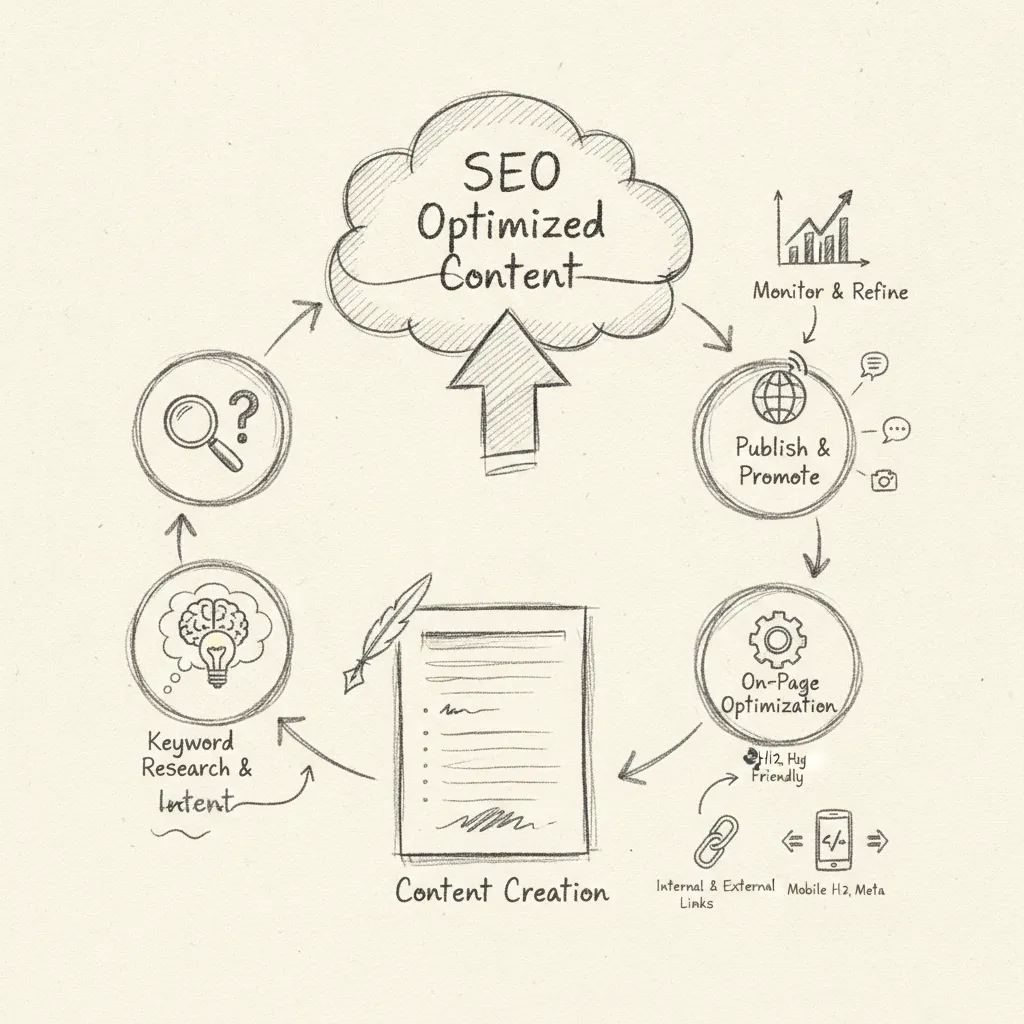
Apply On-Page Technical Optimizations
On-page technical elements, meta tags, URL structure, alt text, internal links, and schema markup, determine whether search engines and AI engines can read and rank your content. According to Siteimprove's SEO content optimization best practices, addressing these technical fundamentals is just as important as the quality of the writing itself.
Write Meta Titles and Descriptions That Get Clicked
Your meta title must stay under 60 characters; your meta description under 155. Both should contain your primary keyword and a specific value proposition.
Bad title: "SEO Content Tips and Tricks for Your Website Blog Posts"
Good title: "How to Write SEO Optimized Content (Step-by-Step)"
The good version is 50 characters, leads with the keyword, and signals a clear format. The bad version is 56 characters but buries the keyword and adds no hook.
Keep URLs short, lowercase, and hyphen-separated, /how-to-write-seo-optimized-content outperforms /post?id=4892 because Google reads the words in the slug as relevance signals.
Add descriptive alt text to every image: describe what's shown, then include the keyword where it fits naturally. Compress each image to under 100KB to protect your Core Web Vitals scores, which Google uses as a ranking factor.
Build internal links to at least 2–3 related pages using descriptive anchor text, "keyword research guide" rather than "click here", to pass link equity and signal topical depth to Google's crawlers.
Add FAQ or HowTo schema markup, the structured data that tells AI engines like ChatGPT and Perplexity exactly what your content answers. Schema markup improves eligibility for rich results and increases the chance that AI search engines cite your page directly. Tools like Moonrank handle schema implementation automatically, including llms.txt configuration and structured data, without requiring you to touch a line of code.
The Schema.org HowTo specification provides the technical vocabulary that search engines and AI engines use to parse step-by-step instructional content, making it a valuable resource when implementing structured data for tutorial-style articles.
Avoid These Common SEO Content Mistakes
Five mistakes account for most ranking failures: keyword stuffing, intent mismatch, thin content, missing internal links, and publishing without ever updating.
Keyword Stuffing
Using your target keyword more than once every 100–150 words triggers over-optimization signals and makes the text harder to read. Use semantic variants and related terms instead, Google's algorithms have understood synonyms since the BERT update in October 2019.
Ignoring Search Intent
Writing a 2,000-word guide when the top 5 SERP results are all quick definition snippets means you're solving the wrong problem. Always audit those top 5 results before you write a single word, format and length should follow what Google already rewards for that query.
Thin Content With No Original Value
Republishing what competitors already say, with no new data, examples, or perspective, gives Google no reason to prefer your page. Original insight, a proprietary test, a real customer example, a contrarian angle, is what separates your page from the dozens that look identical.
Skipping Internal Links
Orphan pages, content with no internal links pointing to or from them, are harder for Google to crawl and rank. Every new page you publish should link to at least two related pages on your site, and at least one existing page should link back to it.
Publishing and Forgetting
SEO content decays. A page that ranked well in 2023 may have dropped because a competitor refreshed theirs with newer stats and examples. Set a 6-month review cadence: update statistics, swap out stale examples, and re-check keyword targeting against the current SERP.
Measure Whether Your SEO Content Is Working
Track organic clicks, average position, on-page engagement, and AI citation visibility, these four signals tell you whether to update, promote, or retire each page.
Key KPIs That Actually Predict SEO Content Success
Open Google Search Console and pull impressions and clicks for each target URL weekly. Impressions rising while CTR stays flat means your meta title isn't compelling enough to earn the click, rewrite it with a clearer benefit or number. Clicks rising while rankings stay stagnant points to a content quality problem: the page isn't authoritative enough to move up, even though users want it.
Watch average position for your target keyword on a 30-day rolling window. A drop of 3 or more positions is a direct signal to audit the page against the current top-ranking competitors, check their structure, depth, and E-E-A-T signals, then close the gaps.
In GA4, scroll depth above 50% and time-on-page above 90 seconds indicate the content holds attention. High bounce rate paired with low scroll depth means the opening paragraph isn't delivering on the title's promise, one of the most common mistakes writers make when producing SEO content.
Check AI citation visibility monthly. Search your target question directly in ChatGPT, Perplexity, and Gemini. If competitors appear in the answers and your brand doesn't, your schema markup, content depth, or E-E-A-T signals need work. Moonrank tracks this automatically, monitoring your brand's visibility across ChatGPT, Claude, Perplexity, and Gemini daily so you don't have to run manual checks each month.
Set a clear performance threshold: any page with fewer than 100 organic clicks after 6 months needs a decision. Update it with new keywords and fresh examples, consolidate it into a stronger related page, or redirect and retire it. Letting underperforming pages accumulate dilutes your site's overall authority.
Frequently Asked Questions
How long should SEO-optimized content be?
Content length should match search intent, informational guides typically perform well at 1,500–2,500 words, while product pages can rank with 300–600 words of well-structured copy. Google's John Mueller has stated repeatedly that word count alone is not a ranking factor. A 600-word article that fully answers a specific question outperforms a 2,000-word piece that pads the same answer with filler. Match depth to the complexity of the query, not an arbitrary word target.
How often should you update SEO content to keep it ranking?
Review and refresh high-traffic pages at least every six months, or sooner if rankings drop or the topic changes. Google's Quality Rater Guidelines treat content freshness as a relevance signal for time-sensitive queries, product comparisons, pricing pages, and how-to guides go stale faster than evergreen definitions. A practical rule: if a page's organic traffic drops 20% or more over 90 days, audit it for outdated facts, broken links, and missing entities before creating new content.
Does using AI to write content hurt your SEO rankings?
AI-generated content does not automatically hurt rankings, Google's March 2024 core update targeted unhelpful content regardless of how it was produced. The risk is publishing low-quality, generic output without human editing. AI drafts that lack original insight, accurate facts, or genuine expertise can trigger quality signals that suppress rankings. Treat AI as a drafting tool, then add proprietary data, real examples, and subject-matter review before publishing. The quality bar is the same whether a human or a machine wrote the first draft.
What is the difference between SEO writing for a blog post versus a product page?
Blog posts target informational keywords and build topical authority through depth, internal linking, and structured answers; product pages target transactional keywords and must convert as well as rank. A blog post earns clicks by answering a question, a product page earns clicks and then a purchase, so every element (headline, bullet features, schema markup) serves both the search engine and the buyer's decision. Product pages also benefit from review schema and structured data that AI search engines like ChatGPT and Perplexity use to surface specific product recommendations directly in answers.
How do you measure whether your SEO content strategy is working?
Track four core metrics in Google Search Console and GA4: organic clicks, average position, scroll depth, and time on page. Organic clicks confirm real traffic; average position shows ranking momentum; scroll depth above 50% and time on page above 90 seconds indicate the content holds attention. Set a 6-month performance threshold — any page earning fewer than 100 organic clicks in that window should be updated, consolidated, or retired to protect your site's overall authority.

Conclusion
Producing well-optimized content comes down to three decisions made before you type a word: choosing a keyword with the right intent, structuring your content so both readers and search engines parse it instantly, and building the technical signals, schema markup, internal links, structured data, that tell AI search engines your page is the authoritative answer.
Start with one existing page that already ranks on page two. Refresh the title tag, add an FAQ block targeting related questions, and implement schema markup. That single update, applied consistently, compounds faster than publishing new content from scratch.
If you want that process to run daily without doing it yourself, Moonrank automates content publishing and technical optimization for $99/month, so your business shows up when customers ask ChatGPT or Perplexity for a recommendation in your category.
Sources & References
- SEO Content Optimization Best Practices Overview
- Moz: On-Page SEO Factors
- Google Search Central: Creating Helpful Content
- Schema.org: HowTo Structured Data Specification
Recommended Articles
Explore more from our content library: